
Rome's Sant'Andrea University Hospital Rebuilds Its Heart Attack Pathway Around AI, Reaching Cardiology in Seconds
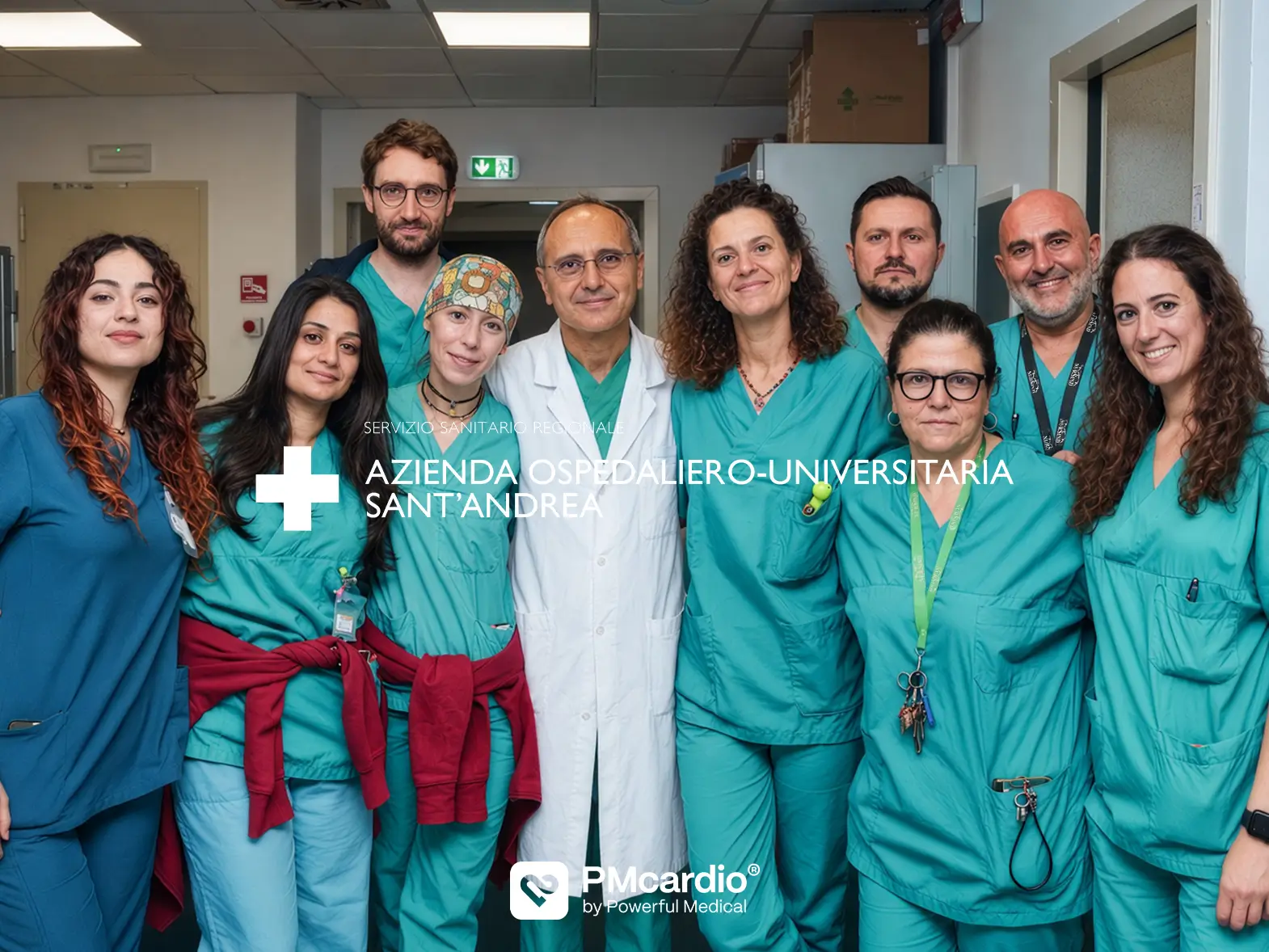
Automated ECG analysis and cardiology alerting screened 5,629 patients in six months at Sant'Andrea University Hospital in Rome, with high-risk results escalated without a manual step.
ROME, ITALY — October 2026 — Sant'Andrea University Hospital, Sapienza University of Rome, has redesigned its acute heart attack pathway around artificial intelligence following the deployment of Powerful Medical's PMcardio platform earlier this year. Between February 13 and August 13, 2026, the hospital screened 5,629 patients through PMcardio, generating 138 STEMI alerts with 96% accuracy. The median time from alert to a clinician opening the AI report was under 17 seconds, and the median door-to-balloon time was 56 minutes.
Every minute of delay to reperfusion increases damage to the heart muscle and the risk of death. In routine emergency care, an electrocardiogram (ECG) can be obtained well within the recommended window, yet the patient may still have to wait for a physician to become available to read it. Sant'Andrea set out to remove that waiting period entirely.
What began in February 2026 as an implementation to evaluate AI-supported ECG analysis in the emergency department has evolved into an integrated pathway connecting emergency medicine, cardiology, and the catheterization laboratory. Every eligible 12-lead ECG is analyzed for signs of acute myocardial infarction immediately after acquisition, with 69% of alerts generated automatically, without a clinician needing to initiate the analysis. The full data, workflow and a patient case are covered in the Sant'Andrea case study.
From ECG Acquisition to Cardiology, Without a Manual Step
Once an ECG is acquired in the emergency department, it is transmitted automatically from the hospital's Cardioline ECG infrastructure to PMcardio. Powerful Medical's Queen of Hearts™ AI ECG model analyzes the recording for STEMI and STEMI-equivalent patterns associated with acute coronary occlusion. When a high-risk ECG is identified, the cardiology team is notified through the hospital's Ascom DECT communication system, allowing the cardiologist to review the case immediately and determine whether the patient should proceed to the catheterization laboratory.
No manual step is required between ECG acquisition, AI analysis, and cardiology notification.
“Previously, an ECG could be acquired within the recommended timeframe, but still had to wait until an emergency physician or cardiologist was able to review it,” said Prof. Emanuele Barbato, Director of Cardiology at Sant'Andrea University Hospital, Sapienza University of Rome. “Today, the ECG is analyzed immediately, and when a high-risk case is identified, the cardiology team is automatically alerted. Everything is now more focused, and I would say nearly no fish is escaping from the net.”
Prof. Barbato has also contributed to the scientific validation of Powerful Medical's Queen of Hearts technology as a co-author of published clinical studies evaluating the AI model, including the international evaluation of the AI model for detecting occlusion myocardial infarction and a study of its performance in suspected STEMI, and serves as a member of Powerful Medical's Scientific Advisory Board.
Beyond Conventional STEMI Criteria
The redesigned pathway also addresses an important limitation of conventional STEMI criteria. Acute coronary occlusion does not always present with ST-segment elevation on the ECG, which is traditionally used to identify patients requiring immediate coronary reperfusion. As a result, some patients with an actively occluded coronary artery are initially classified as non-STEMI despite needing similarly urgent treatment.
At Sant'Andrea hospital, patients identified by Queen of Hearts as presenting with STEMI-equivalent or occlusive myocardial infarction (OMI) patterns can now be escalated through the same urgent pathway, even when their ECG does not meet conventional STEMI criteria. The final decision to activate the catheterization laboratory remains with the treating clinical team.
“The classic STEMI criteria, which are based on the presence of ST-segment elevation, are not enough to identify all patients who have an occlusive myocardial infarction,” said Dr. Marta Belmonte, Interventional Cardiologist at Sant'Andrea University Hospital, Sapienza University of Rome. “Integrating the AI directly into our pathway gives us an additional layer of support for recognizing these patients as early as possible, regardless of the level of experience of the person first reading the ECG. Of course, the final decision to take the patient to the cath lab remains clinical.”
AI as Infrastructure, Not Another Tool
Rather than introducing another standalone diagnostic application for clinicians to operate, Sant'Andrea embedded PMcardio into the infrastructure its teams already use. ECGs acquired via Cardioline are automatically transmitted for analysis, and high-risk results are delivered via the hospital's existing communication system. AI-supported ECG interpretation and escalation, therefore, run in the background of the established clinical workflow.
“Clinical AI delivers the greatest value when it becomes part of the care pathway rather than another tool physicians need to remember to use,” said Viktor Jurasek, Chief Product Officer and Co-founder of Powerful Medical. “At Sant'Andrea hospital, an ECG can move from acquisition to AI analysis and cardiology notification without a single manual step. After thousands of ECGs analyzed through this pathway, we are seeing what this model looks like in practice: AI working in the background of existing hospital infrastructure to help the right information reach the right specialist when every second matters.”
The pathway reflects a broader shift in the management of acute myocardial infarction: from relying exclusively on conventional STEMI criteria toward identifying the underlying pathology that requires urgent treatment, acute coronary occlusion. It also shows how clinical AI can move beyond delivering a diagnostic result to becoming part of the operational infrastructure of time-critical cardiovascular care.
Read the Full Case Study
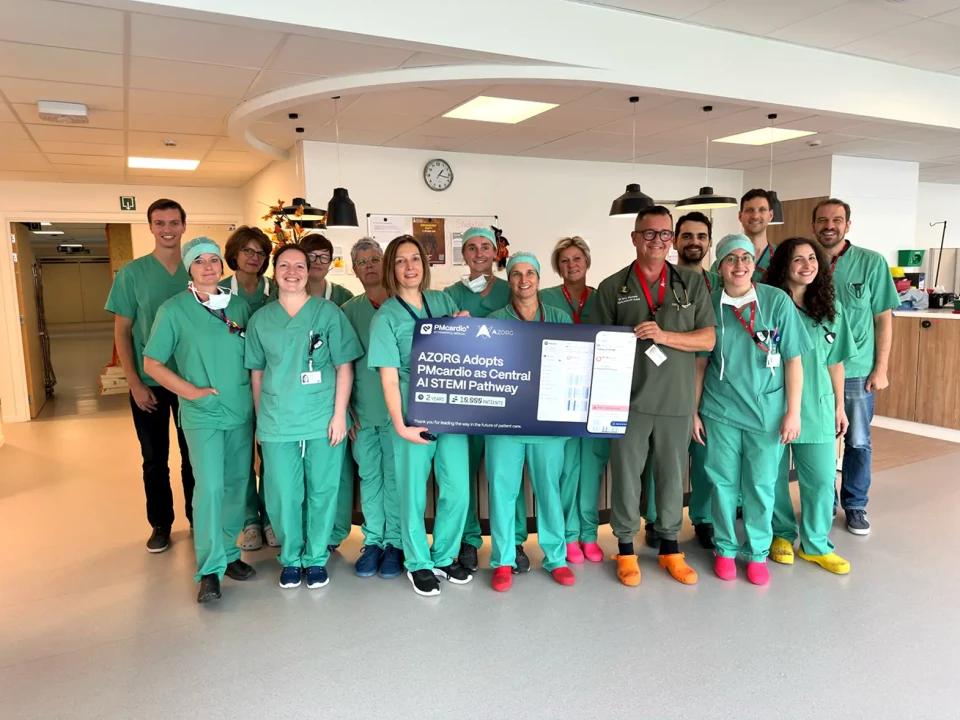
The Sant'Andrea case study details how the hospital connected Cardioline and DECT to PMcardio, how STEMI equivalents made up 64% of all STEMI alerts, and what six months of real-world data show across 84 clinicians on the pathway. Sant'Andrea joins health systems such as Belgium's AZORG, where the same platform cut heart attack treatment delays by 48 minutes on average.
PMcardio is available to hospitals and health systems through PMcardio for Organizations. Learn how the Queen of Hearts™ AI ECG model detects OMI.
About Sant'Andrea University Hospital, Sapienza University of Rome
Sant'Andrea University Hospital is one of the two university hospitals of Sapienza University of Rome and the seat of its Faculty of Medicine and Psychology. Active since 2001 and located in the Grottarossa district of northern Rome, it serves as a reference centre for emergency and cardiovascular care, oncology, surgery and psychiatry across northern Rome and the surrounding Lazio region. As a teaching hospital, Sant'Andrea combines clinical care with research and the training of physicians, psychologists and allied health professionals across more than 30 specialty schools.
For more information about Sant'Andrea University Hospital visit: www.ospedalesantandrea.it.
Share this article



About PMcardio
PMcardio features FDA-authorized and CE-marked AI ECG models that interpret any 12-lead ECG — from a photo or a digital file — in seconds. It detects 50+ ECG findings, including occlusion myocardial infarction (OMI) — the acute coronary occlusions that conventional STEMI criteria miss in over half of cases. Its Queen of Hearts™ OMI model holds FDA Breakthrough Device Designation, and PMcardio is already used by 100,000+ clinicians who have analyzed more than 2.5 million ECGs.

About Powerful Medical
Powerful Medical is a medical-technology company using artificial intelligence to transform how cardiovascular disease — the world’s leading cause of death — is diagnosed. Founded in 2017, it built PMcardio, the world’s first AI medical device to detect acute coronary occlusion (OMI) from an ECG. Its research is published in the European Heart Journal – Digital Health and validated across 25+ clinical studies, and its Queen of Hearts™ model earned FDA Breakthrough Device Designation. To date, PMcardio has supported the detection of 120,000+ heart attacks across 150+ hospital deployments worldwide.