
Frequently Asked Questions
General Questions
What is PMcardio?
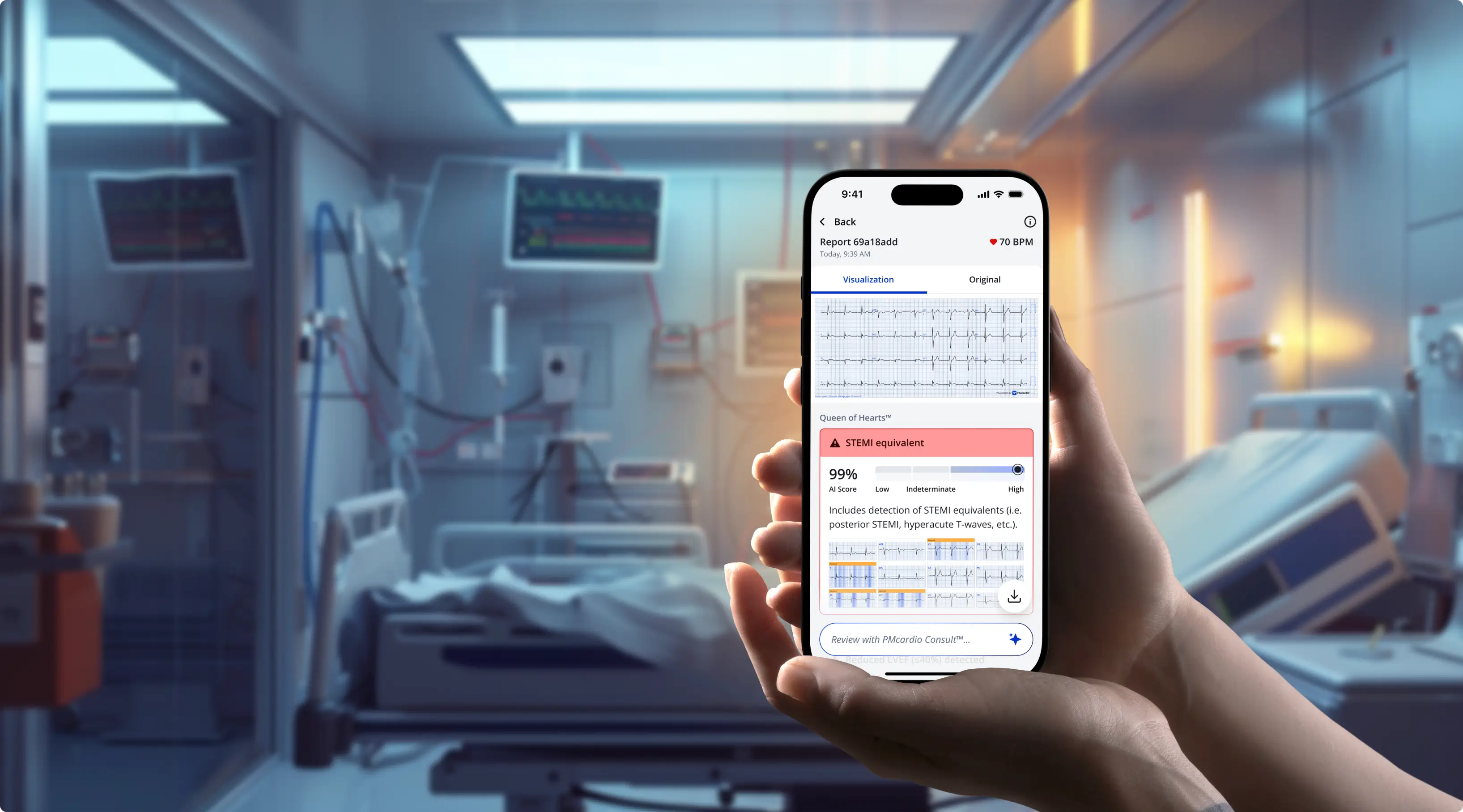
PMcardio features FDA-authorized and CE-marked AI ECG Models that read ECGs and return a comprehensive assessment of 50+ cardiac findings. Clinically validated in 25+ peer-reviewed studies and trusted by over 120,000 clinicians worldwide, it delivers rapid, expert-level interpretations, empowering emergency physicians, GPs, nurses, paramedics, and cardiologists to act with confidence at the point of care.
Certain AI ECG Modules are CE-marked medical devices under the EU MDR and are certified for marketing in the European Union and the United Kingdom. The Queen of Hearts™ (ACS AI ECG Module) has received De Novo authorization from the U.S. Food and Drug Administration (FDA) for marketing in the United States. Not all modules of the PMcardio platform, and not all features and functionality within a given AI ECG Module, may be available in your region.
Is it safe to upload ECG images to PMcardio?
Yes, your encrypted data never leaves your region. PMcardio is fully GDPR and HIPAA compliant and adheres to the strictest regulatory and security frameworks, including SOC 2 Type II and ISO 27001 certifications. For a detailed overview of compliance, data protection practices, and security protocols, visit the Trust Center.
Is PMcardio clinically validated?
Yes, PMcardio's AI ECG Modules have been rigorously validated in more than 25 independent, peer-reviewed clinical studies. Across these studies, PMcardio AI ECG interpretation outperformed standard-of-care methods, delivering:
- 2x sensitivity for early STEMI detection (often on the very first ECG)
- Up to 92% fewer false-positive cath-lab activations (JACC: Cardiovascular Interventions, presented at TCT)
- Identifies atrial fibrillation (and other arrhythmias) with 98.3% accuracy — on par with board-certified cardiologists
For more information, the latest published evidence, and ongoing RCTs, please visit the Research page.
Which ECG formats does PMcardio accept?
PMcardio accepts any commercially available 12-lead ECG — whether a single-page image or a multi-page report. For a reliable read, three things matter: the ECG must be on standard ECG graph paper (the grid where every five 1 mm squares form a heavier 5 mm square); the whole tracing must appear on one continuous grid, not split across intersecting grids; and the image should contain only that ECG's leads, with no leads from other ECGs in the frame. Fewer-lead recordings (1-, 3-, or 6-lead) are not supported.
What ECG abnormalities can PMcardio detect?
PMcardio's AI-powered ECG algorithms recognize 50+ distinct findings across four major categories:
- Rhythms & arrhythmias: Atrial fibrillation/flutter, supraventricular or ventricular tachycardia, sinus bradycardia/tachycardia
- Conduction disorders: Left/right bundle-branch block, second- and third-degree AV block
- Ischaemia & infarction: Acute ST-elevation myocardial infarction (STEMI) and STEMI equivalents
- ECG measurements: QTc, PR, QRS and nine additional measurements
Looking for the full, continuously updated list? Navigate to the Full List of ECG Findings Detected by PMcardio AI.
Is PMcardio just another AI chatbot like ChatGPT or Perplexity?
No. PMcardio's AI ECG Models are deterministic, CE-certified medical devices purpose-built for ECG interpretation, not a conversational large language model (LLM).
- Zero hallucinations: The same ECG file always returns the same diagnosis.
- Evidence-based training: Fixed model weights are derived from 4 million+ clinically labelled ECGs with matched patient outcomes.
- Independent proof: Performance has been independently validated in 25+ peer-reviewed validation studies across Europe and the U.S.
- Regulatory oversight: Post-market surveillance and quality-management systems ensure ongoing compliance with Medical Device Regulation.
Learn more about how PMcardio compares to AI chatbots like ChatGPT.
Is PMcardio more accurate than automated ECG machine reads?
Yes. In six peer-reviewed studies, PMcardio AI ECG Models have demonstrated up to 2x higher accuracy than conventional ECG algorithms used in standard ECG machines (e.g., GE Marquette 12SL, Philips, Glasgow Algorithm).
Learn more about how PMcardio compares to Conventional ECG Algorithms.
Is PMcardio free?
Yes. Start with a Free Plan that lets you analyze up to 5 ECGs per month at no cost. When you need more reports and advanced Pro features, you can upgrade to a paid subscription with:
- Larger monthly ECG quota: run as many studies as your workflow demands.
- AI explainability for STEMI: colour-coded highlights show the waveform segments driving each positive diagnosis.
- 12 validated interval measurements: instant PR, QRS, QTc intervals and more.
- 30-day report history: revisit, download, or share any ECG analysed in the past month.
Try PMcardio for free — available now on the Apple App Store and Google Play Store.
How do I get started?
PMcardio is available on iOS, Android, and web. Start free with 5 ECGs/month — no credit card required. Download it on the Apple App Store or Google Play.
Certain AI ECG Modules are CE-marked medical devices under the EU MDR and are certified for marketing in the European Union and the United Kingdom. The Queen of Hearts™ (ACS AI ECG Module) has received De Novo authorization from the U.S. Food and Drug Administration (FDA) for marketing in the United States. Not all modules of the PMcardio platform, and not all features and functionality within a given AI ECG Module, may be available in your region.
PMcardio for Organizations
What is PMcardio for Organizations?
PMcardio for Organizations is a unified cardiac AI platform supporting the full cardiac care journey — from acute emergency detection through screening, procedural analytics, and longitudinal monitoring. It combines multiple AI models, clinical decision support, real-time escalation, and outcomes intelligence into one deployment, integration, and governance model.
Certain AI ECG Modules are CE-marked medical devices under the EU MDR and are certified for marketing in the European Union and the United Kingdom. The Queen of Hearts™ (ACS AI ECG Module) has received De Novo authorization from the U.S. Food and Drug Administration (FDA) for marketing in the United States. Not all modules of the PMcardio platform, and not all features and functionality within a given AI ECG Module, may be available in your region.
How is PMcardio different from point-solution AI tools?
Most cardiac AI tools serve one condition or one modality. PMcardio is a platform spanning the full cardiac pathway — acute care, screening, remote monitoring, procedural analytics, and patient-facing use cases. One integration, one security review, one vendor relationship, one governance model.
Which clinical suites are available?
PMcardio is organized into six clinical suites spanning the cardiac pathway: Acute Care, Echo Screening, Core Diagnostics, Remote Monitoring, Patient, and Angio. Available today are the STEMI (Queen of Hearts™) and LVEF (LVsense™) models, alongside Core Diagnostics and ECGxplain™. Additional diagnostic capabilities — including PE/RV strain, hyperkalaemia (HyperK), aortic stenosis, HCM, wearable integrations, Holter and coronary angiogram analysis — are in active development and rolling out progressively. Health systems can start with the modules available today and add new ones as they launch.
How does PMcardio integrate with existing hospital systems?
PMcardio connects to ECG devices, EHR/CVIS, EMS systems, angiographic systems, and existing alerting and on-call tools — with live deployments across leading device manufacturers including GE HealthCare, Philips, LIFEPAK (Stryker), corpuls, and ZOLL. It can be launched from the EHR with secure links and SSO, and sends results back to clinical systems where care is documented.
How long does it take to deploy PMcardio?
Immediately — clinicians can start on day one, with no IT integration required: download the mobile or web app, log in, and begin scanning ECGs. Most health systems run a proof-of-concept on real patients within their first weeks. Scaling up — a phased rollout across departments, campuses, and suites with enterprise integrations and EHR connectivity — depends on integration scope and the number of sites and suites, but the platform is built to deliver value before that integration work even begins.
Can we start with one suite and expand later?
Yes. Most health systems start with one suite — often the Acute Care Suite for STEMI pathway standardization — and expand to additional suites as their priorities evolve. Because everything runs on the same platform, each new suite adds capability without adding vendor complexity.
Does PMcardio replace clinician judgment?
No. PMcardio's AI ECG Modules provides interpretable, clinically validated decision support designed to augment clinical judgment — not replace it. Clinicians always make the final call. The AI surfaces high-risk presentations and provides explainable reasoning that can be reviewed, taught, and audited.
What results can health systems expect?
Results vary by suite and deployment scope. Health systems using the Acute Care Suite have seen 48-minute reductions in door-to-balloon times, 92% reductions in false-positive cath-lab activations, and 6 hours faster treatment for STEMI equivalents. Echo Screening and Remote Monitoring Suites deliver value through earlier detection of previously missed conditions like reduced LVEF and subclinical SHD.
Is PMcardio secure and suitable for enterprise use?
Yes. PMcardio is built for regulated healthcare environments, with SOC 2 Type II, ISO 27001, GDPR, and HIPAA compliance. Certain AI ECG Modules within the platform are CE-marked medical devices certified under the EU MDR, and the Queen of Hearts™ (ACS AI ECG Module) has received De Novo authorization from the U.S. Food and Drug Administration (FDA) for marketing in the United States. The platform supports regional data residency, role-based access control, SSO, and full audit trails. Visit the Trust Center for full details.
Can we try PMcardio before committing to a full deployment?
Yes. PMcardio's mobile and web app lets your team start using AI-powered ECG interpretation immediately — no IT integration, no setup project, no waiting. Clinicians download the app, log in, and start scanning real ECGs from day one. Most health systems run a proof-of-concept on their own patients and see measurable results before moving to a system-wide rollout.
Queen of Hearts (STEMI)
What is Queen of Hearts™ (QoH) AI?
Queen of Hearts (QoH) is a clinically validated AI ECG model designed to accurately distinguish true STEMI (requiring emergent cathlab activation) from common mimics such as benign early repolarization (BER) and left ventricular hypertrophy (LVH). It was trained on a global dataset comprising millions of ECGs from chest pain patients, with robust outcome labels based on biomarker rule-out or angiographically confirmed STEMI, including STEMI-equivalent patterns indicative of Occlusion Myocardial Infarction (OMI).
The Queen of Hearts™ (ACS AI ECG Module) is a CE-marked medical device under the EU MDR, certified for marketing in the European Union and the United Kingdom, and has received De Novo authorization from the U.S. Food and Drug Administration (FDA) for marketing in the United States. Not all features and functionality within the module may be available in your region.
Can I try out the Queen of Hearts™?
Yes, the Queen of Hearts is built into the PMcardio platform, available for individuals or institutions. Download the PMcardio app and get the Queen of Hearts AI interpretation on any image of a 12-lead ECG within seconds.
The Queen of Hearts™ (ACS AI ECG Module) is a CE-marked medical device under the EU MDR, certified for marketing in the European Union and the United Kingdom, and has received De Novo authorization from the U.S. Food and Drug Administration (FDA) for marketing in the United States. Not all features and functionality within the module may be available in your region.
Is the Queen of Hearts™ certified for clinical use?
Yes — in certain regions. Queen of Hearts is Class IIb medical device, CE-marked under the EU Medical Device Regulation (MDR) and certified for clinical use through the PMcardio platform.
In the United States, the Queen of Hearts™ (ACS AI ECG Module) has received De Novo authorization from the U.S. Food and Drug Administration (FDA) for marketing in the United States, following its earlier FDA Breakthrough Device Designation. Other modules of the PMcardio platform do not carry that authorization and remain investigational in the US. Not all features and functionality may be available in your region.
For more information on regulatory status and compliance, please visit our Trust center.
Has the Queen of Hearts™ been clinically tested and validated?
Yes. The Queen of Hearts AI model is one of the most clinically validated cardiovascular AI tools to date, having undergone rigorous testing across diverse patient populations. It has been evaluated in thousands of real-world cases across North and South America, Europe, Asia, Australia, and Africa.
Key highlights from validation studies involving over 10,000 patients:
- 2× higher sensitivity than traditional criteria and standard-of-care interpretation
- 92% reduction in false-positive cath-lab activations due to common STEMI mimics (JACC: Cardiovascular Interventions, presented at TCT)
- 100% sensitivity for STEMIs that meet standard STEMI criteria
- Average of 48 minutes saved in door-to-balloon times following implementation
Beyond observational data: Queen of Hearts is currently the focus of multiple prospective clinical trials and randomized controlled studies (RCTs). These are being conducted across a range of clinical settings — including emergency departments, ambulance systems, and primary care — to further confirm its real-world impact, safety, and effectiveness.
Can I see how Queen of Hearts™ came to its conclusion? Is it explainable AI?
Yes. Powered by the exclusive ECGxplain™ feature, Queen of Hearts offers built-in AI explainability (blue heat maps).
The model highlights specific ECG leads and segments that had the greatest diagnostic influence and provides a confidence score for each prediction. This helps you understand the reasoning behind the output, making it easier to interpret.
Learn more about AI explainability here.
Who is liable if the AI makes a wrong call?
Queen of Hearts is a clinical decision support tool, not a standalone diagnostic system. Just like a lab value, guideline recommendation, or scoring system, it provides clinicians with evidence-based insights to support, not replace, their medical judgment.
The responsibility for final clinical decisions remains with the healthcare provider. Physicians are expected to consider the AI output in the broader context of each patient's clinical presentation, history, and other diagnostics.
Can the Queen of Hearts™ be used with serial ECGs or to monitor ischemia over time?
Re-running Queen of Hearts on serial ECGs helps detect evolving ischemia or dynamic changes. Currently, the AI model analyzes each ECG individually and does not yet compare serial ECGs over time.
However, in a recent study, Queen of Hearts identified 100% of STEMIs on the first ECG, compared to just 40% with traditional STEMI criteria — highlighting its ability to detect early signs of coronary occlusion even without serial input.
What is OMI and how is Queen of Hearts™ different from standard STEMI criteria?
The Queen of Hearts is built to detect Occlusion MI (OMI) — acute coronary occlusion that often does not meet the classic STEMI ST-elevation threshold and is therefore missed by traditional criteria. By recognising these STEMI-equivalent patterns, QoH flags patients who need emergent cath-lab activation sooner. In one study it identified 100% of STEMIs on the first ECG versus 40% with traditional criteria.
LVsense (LVEF)
What does LVsense™ measure and what does "reduced LVEF" mean?
LVsense™ estimates left ventricular systolic function — how effectively the heart's main pumping chamber contracts — directly from a 12-lead ECG. It flags reduced LVEF, defined as a left ventricular ejection fraction ≤ 40%. Ejection fraction is the share of blood the left ventricle pumps out with each beat; a normal value is roughly ≥ 50%, so ≤ 40% indicates impaired pumping (left ventricular systolic dysfunction), the hallmark of heart failure with reduced ejection fraction. Detecting it earlier helps route patients to timely confirmation and treatment.
What is a normal ejection fraction and what counts as reduced?
A normal left ventricular ejection fraction (LVEF) is generally 50–70%. An LVEF of 41–49% is considered mildly reduced, and 40% or below is classified as reduced. LVsense™ is built to flag the patients most at risk — those with an LVEF of 40% or lower.
What are the symptoms of reduced ejection fraction?
Common symptoms include fatigue, breathlessness on exertion, and swelling in the legs or ankles. The difficulty is that these signs are nonspecific and often absent in early disease — a meaningful share of people with reduced LVEF have no symptoms at the stage where treatment could most change their outcome. That silent window is exactly why a point-of-care screen matters.
Does LVsense™ replace echocardiography?
No. Echocardiography remains the reference standard for measuring LVEF. LVsense™ is a screening signal, not a diagnosis — it helps identify which patients should be prioritized for confirmatory echo. Because a negative result carries a high negative predictive value (99.5% at the prevalence studied), it supports rule-out and helps focus limited echo capacity on higher-probability patients. A positive flag should always be confirmed by echocardiography.
What ECG input does LVsense™ need?
A standard resting 12-lead ECG. No proprietary hardware is required — LVsense™ works from a smartphone photo of a printed or on-screen ECG, which the PMcardio app digitizes before analysis. It is designed to work with ECGs from the wide range of standard devices used in primary care, emergency, and hospital settings. For health systems, PMcardio also integrates with existing clinical infrastructure, so ECGs and results can flow directly to and from the electronic health record (EHR) without disrupting current workflows.
How accurate is LVsense™?
Validated against echocardiography (LVEF ≤ 40% model), LVsense™ achieved an AUC of 0.963, sensitivity of 92.4%, specificity of 88.7%, and a negative predictive value of 99.5%, evaluated on 25,510 echo-paired ECGs. Full methods, the secondary LVEF < 50% model, and peer-reviewed results are available on our publications page.
Is LVsense™ available in my region / authorized by the FDA?
Availability depends on your region. In the EU and UK, LVsense™ is provided as part of PMcardio's CE-marked AI-ECG modules under the EU Medical Device Regulation (MDR). In the United States, the LVEF AI ECG Model (LVsense™) is considered an investigational device and is not for clinical use. US authorization to date covers the Queen of Hearts™ (ACS AI ECG Module), which has received De Novo authorization from the U.S. Food and Drug Administration (FDA); it does not extend to LVsense™. Not all modules of the PMcardio platform are available in every region.
How do I get access and what does it cost?
LVsense™ is available in the PMcardio app — download it from the App Store or Google Play and try it free, with 5 free ECGs per month and no credit card required. Plans for individuals and organisations are listed on the Pricing page; to roll it out across a hospital or network, use Get access to start.
Pricing
Can I try PMcardio before purchasing?
Absolutely. PMcardio for Individuals offers a Free Plan that lets you try out the application with 5 free ECG reports monthly. For PMcardio for Teams or PMcardio for Organizations, we are open to discussing a trial option on a case-by-case basis.
How can I purchase PMcardio for Individuals?
If you wish to upgrade from the free trial (Free Plan) and get the full paid PMcardio for Individuals Pro license, you can do so directly through the PMcardio for Individuals application.
What happens if I exceed the monthly ECG limit included in my PMcardio for Individuals or PMcardio for Teams plan?
In PMcardio for Individuals, the application won't allow you to surpass the 5 ECGs/month limit in the Free Plan or 100 ECGs/month limit in the paid Pro Plan. You will be notified that you have reached the limit and will need to wait for the quota to reset in your next billing month so that you can continue creating ECG reports.
In PMcardio for Teams, there is a soft cap on the monthly ECG quota. If you considerably surpass the purchased quota, the functionality of your account will be limited, and upon such limitation, you will not be able to create additional reports.
Can I purchase PMcardio for Individuals with a higher ECG quota?
Yes, depending on your use-case. We are happy to discuss it further with you. Please reach out to us at support@powerfulmedical.com.
Can I purchase PMcardio for Teams for more than 50 users or with a higher ECG quota?
Yes, we can set up a custom team plan for you. To discuss your specific requirements, please reach out to sales@powerfulmedical.com.
What support is included with my subscription?
All plans include email support and access to our help center.
In addition, PMcardio for Teams and PMcardio for Organizations get priority email support.
Plus, PMcardio for Organizations includes dedicated Service Level Agreements (SLAs), support, onboarding, and training.
Can I change my subscription at any time?
Yes, you can decide to upgrade or downgrade your plan at any time.
For PMcardio for Individuals, you can make changes directly through the application's settings.
For PMcardio for Teams and PMcardio for Organizations, please let us know at sales@powerfulmedical.com.
Do you offer discounts for non-profit and educational institutions?
Currently, we do not provide special discounts for these types of institutions, but we offer a Free Plan under PMcardio for Individuals, and we are also glad to discuss your case on an individual basis via support@powerfulmedical.com.
Which payment methods do you accept?
For the PMcardio for Individuals application, the payment is processed directly through the app store, so it can be any payment method that you have associated with your app store account.
For PMcardio for Teams and PMcardio for Organizations, we will issue an invoice for you, which you can pay by card or via bank transfer.
To discuss any alternative payment methods, please let us know at support@powerfulmedical.com.
Can I use my CME funding to purchase PMcardio?
Yes. You should be able to get reimbursed by providing PMcardio's invoice (receipt) to your employer. (Note: If you have the PMcardio for Individuals subscription, you should be able to locate and download your receipt directly from your app store account.)
What is your refund policy?
Subscription fees are generally non-refundable; however, refunds may be granted in cases such as an accidental purchase with no use yet, or documented issues preventing proper use of the software. Each request will be reviewed individually to determine eligibility.
Try PMcardio
for Free
Join 100,000+ clinicians already using PMcardio to detect heart conditions with AI-powered accuracy. Get instant access to PMcardio, designed for speed, simplicity, and clinical confidence.


- No credit card required
- 5 FREE ECGs/month
- Works with any 12-lead ECG image