
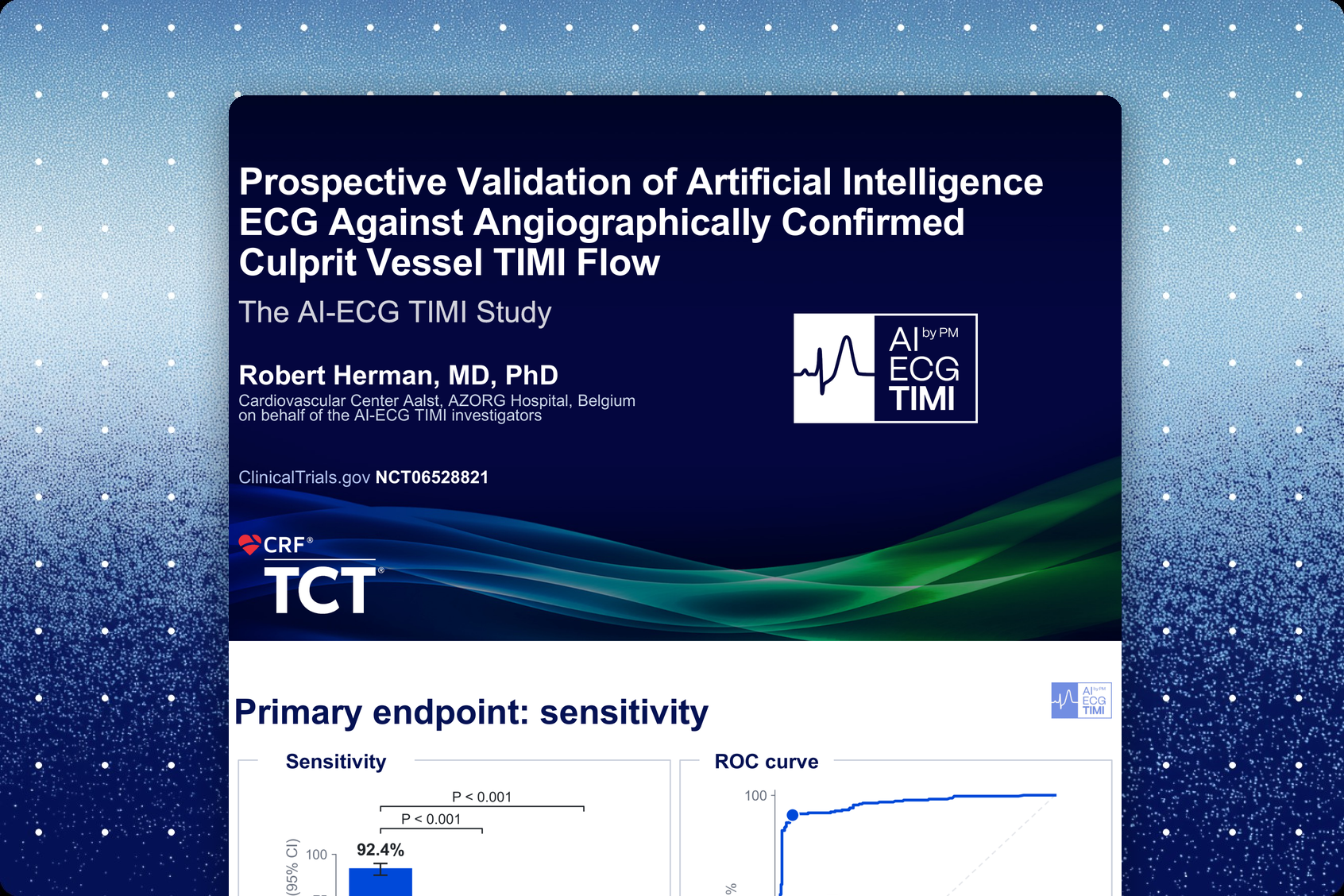
Prospective Validation of Artificial Intelligence ECG Against Angiographically Confirmed Culprit Vessel TIMI Flow: The AI-ECG TIMI Study
Overview
This prospective 9-center registry in Belgium, Italy, and Austria validated the AI-ECG recorded at the moment of coronary angiography against the culprit artery in all-comer ACS patients undergoing coronary angiography as indicated. Of 662 patients in the study population, 262 (39.6%) had an acute culprit occlusion (TIMI 0–1 flow, absent or insufficient collaterals), and 46% of them did not meet STEMI criteria at the ECG at angiography. The Queen of Hearts AI-ECG model (aOMI v1) detected 92.4% of acute active occlusions (AUC 0.970) vs 53.6% by STEMI criteria and 58.5% by timely standard of care (first medical contact to wire < 120 min). In occluded patients with treatment delays, AI flagged the occlusion a median 2 h 38 min before reperfusion.
Key findings
- Primary endpoint, sensitivity: 92.4% for Queen of Hearts vs 53.6% for STEMI criteria and 58.5% for standard of care (P < 0.001)
- AUC 0.970; significant improvement in every subgroup vs STEMI criteria and standard of care (P < 0.001)
- 46% of acute culprit occlusions did not meet STEMI criteria at the ECG at angiography
- In occluded patients with treatment delays, AI flagged the occlusion a median 2 h 38 min before reperfusion
Published in: TCT 2026, San Diego – presented as a late-breaking study in the TCT AI Lab session "From Detection to Intervention: AI-Powered Pathways of Care"
Published on: 2 November 2026
Background
Acute coronary syndromes (ACS) are characterized by dynamic culprit-lesion occlusion and reperfusion. Nearly half of acute coronary occlusions lack diagnostic ST-segment elevation, while spontaneous recanalization before invasive coronary angiography (ICA) may obscure the relationship between ECG findings and true culprit-vessel flow. AI-enabled ECG analysis may identify acute coronary occlusion beyond conventional ECG criteria, but has not been prospectively validated against angiographic flow using ECGs time-synchronized to ICA.
Methods
AI-ECG TIMI (NCT06528821) is a prospective registry at 9 centers in Belgium, Italy and Austria that enrolled all-comer patients with suspected acute coronary syndrome undergoing coronary angiography as clinically indicated. The study design and rationale were published previously. 12-lead ECGs were recorded at admission (T0), at angiography before wire crossing (T1), after PCI (T2) and at follow-up (T3). The Queen of Hearts AI-ECG model (aOMI v1) distinguishes active occlusion myocardial infarction (OMI; artery currently occluded), reperfused OMI (occlusion that has reopened) and subendocardial ischemia without occlusion; its active OMI output on the T1 ECG was the index test. The reference standard, adjudicated by a core laboratory and clinical events committee, was an acute culprit lesion with TIMI 0–1 flow without sufficient collateral circulation. The primary endpoint was the sensitivity of Queen of Hearts compared with millimeter, age- and sex-specific STEMI criteria on the same ECG and with timely standard of care, defined as first medical contact to wire crossing in under 120 minutes. Sensitivities were reported with 95% Wilson confidence intervals and compared with the exact McNemar test.
Results
Of 718 patients enrolled, 56 were excluded (46 without a valid ECG at angiography, 4 withdrawn, 3 screening failures and 3 with an angiogram that could not be evaluated), leaving a study population of 662. Of these, 262 (39.6%) were reference-positive, with an acute culprit occlusion, and 400 (60.4%) were reference-negative: 293 had culprit TIMI 2–3 flow, 58 had no acute culprit lesion and 49 had TIMI 0–1 flow with sufficient collaterals. In the occlusion cohort, the median age was 63 years and 20% were women; the culprit artery was the LAD in 42%, the RCA in 37% and the LCx in 19%, multivessel disease was present in 40% and PCI was performed in 97%. Forty-six percent did not meet STEMI criteria on the ECG at angiography, 41% reached the wire 120 minutes or more after first medical contact, 18% were discharged with a diagnosis of NSTEMI and 2% died in hospital. Queen of Hearts detected 92.4% of acute culprit occlusions, compared with 53.6% for STEMI criteria and 58.5% for standard of care (P < 0.001 for both comparisons), with an area under the ROC curve of 0.970. Sensitivity across subgroups (sex, age, symptom duration, culprit artery, number of diseased vessels, collateral status and discharge diagnosis) showed a significant improvement in every subgroup vs STEMI criteria and standard of care, P < 0.001. In occluded patients with treatment delays, the AI flagged the occlusion a median 2 h 38 min before reperfusion.
Conclusion
Validated against the culprit artery at the moment of coronary angiography, the Queen of Hearts AI-ECG model (aOMI v1) detected 92.4% of acute active occlusions (AUC 0.97) vs 53.6% by STEMI criteria and 58.5% by timely standard of care (FMC → wire < 120 min). In occluded patients with treatment delays, AI flagged the occlusion a median 2 h 38 min before reperfusion. AI ECG reliably identifies angiography-confirmed occlusions missed by STEMI criteria and standard of care.
Share this article



About PMcardio
PMcardio is the market leader in AI-powered diagnostics, addressing the world’s leading cause of death – cardiovascular diseases. The innovative clinical assistant empowers healthcare professionals to detect up to 40 cardiovascular diseases. In the form of a smartphone application, the certified Class IIb medical device interprets any 12-lead ECG image in under 5 seconds to provide accurate diagnoses and individualized treatment recommendations tailored to each patient.

About Powerful Medical
Powerful Medical leads one of the most important shifts in modern medicine by augmenting human-made clinical decisions with artificial intelligence. Our primary focus is on cardiovascular diseases, the world’s leading cause of death.
Established in 2017, Powerful Medical has embarked on a mission to revolutionize the diagnosis and treatment of cardiovascular diseases. We are a medical company backed by 28 world-class cardiologists and led by our expert Scientific Board with decades of experience in daily patient care, clinical research, and medical devices. The results of our research are implemented, developed, certified, and brought to market by our 50+ strong interdisciplinary team of physicians, data scientists, AI experts, software engineers, regulatory specialists, and commercial teams.