
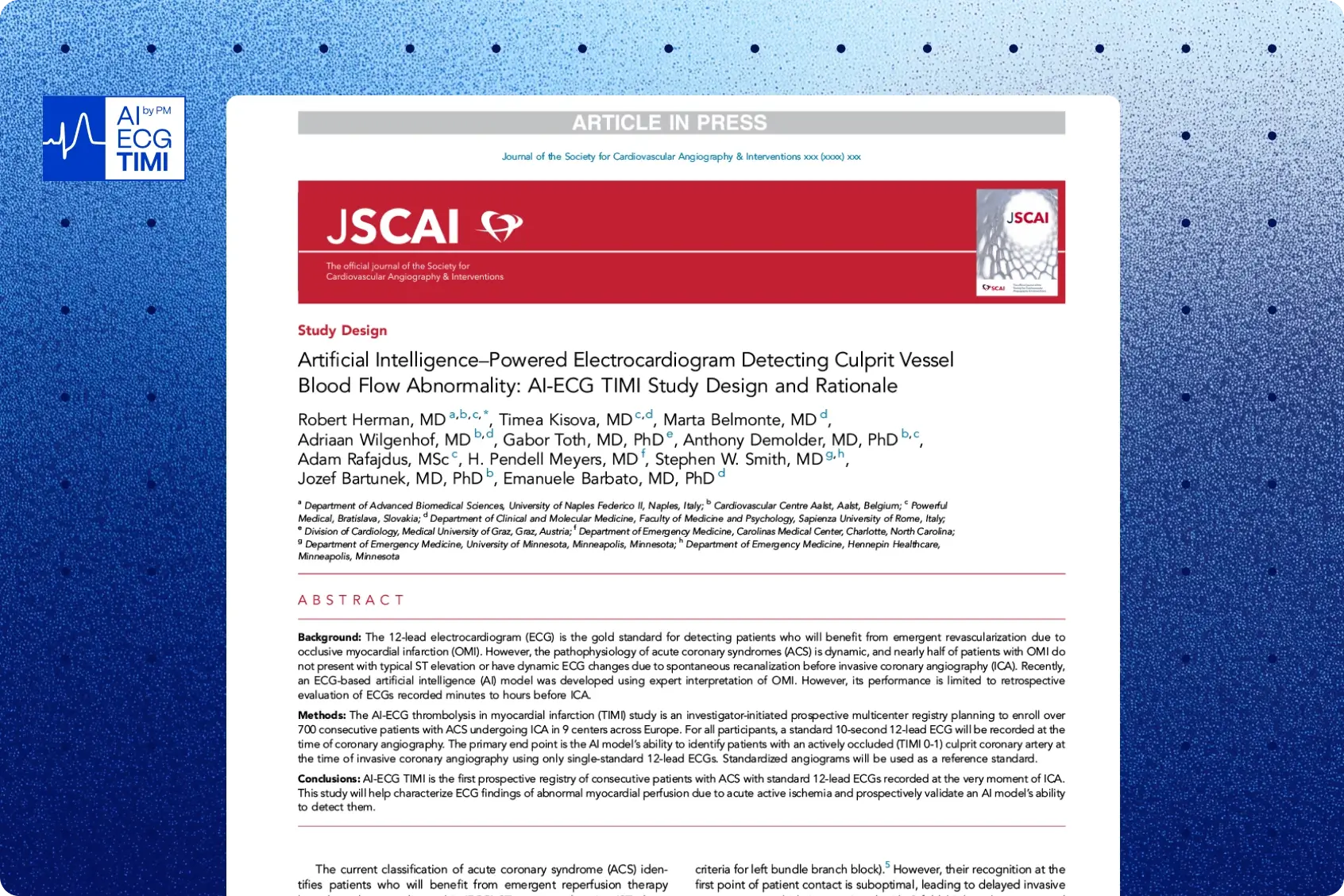
Artificial Intelligence–Powered Electrocardiogram Detecting Culprit Vessel Blood Flow Abnormality: AI-ECG TIMI Study Design and Rationale
Overview
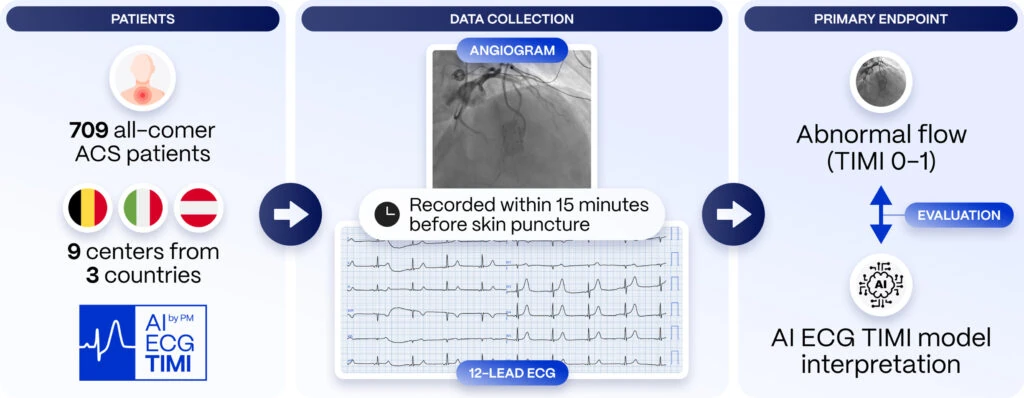
The AI-ECG TIMI study is a unique, multicenter registry currently enrolling patients to evaluate an AI-powered ECG model for detecting actively obstructed arteries in acute coronary syndrome (ACS). It is the first study to collect standard 12-lead ECGs precisely at the time of coronary angiography, providing novel insights into coronary occlusion and reperfusion. By identifying high-risk ECG patterns and assessing AI’s role in predicting intervention success, it paves the way for AI-driven precision cardiology in acute care.
Key findings
- First registry to record 12-lead ECGs at the moment of angiography.
- Validates AI detection of actively occluded (TIMI 0–1) culprit arteries.
- Multicenter registry enrolling ACS patients across Europe.
| Study Design | Prospective Observational Study |
| Status | Enrolling patients |
| Countries / Sites | 3 (BE, IT, AT) / 9 |
| Study Start | December 24, 2024 |
| Primary Completion (estimated) | July 1, 2025 |
| Enrollment (target) | 709 |
| clinicaltrials.gov ID | NCT06528821 |
Published in: Journal of the Society for Cardiovascular Angiography & Interventions (JSCAI) in their special issue on Role of AI in Cardiovascular Interventions Date of Publication: January 13, 2025
Background
The 12-lead electrocardiogram (ECG) is the gold standard for detecting patients who will benefit from emergent revascularization due to occlusive myocardial infarction (OMI). However, the pathophysiology of acute coronary syndromes (ACS) is dynamic, and nearly half of patients with OMI do not present with typical ST elevation or have dynamic ECG changes due to spontaneous recanalization before invasive coronary angiography (ICA). Recently, an ECG-based artificial intelligence (AI) model was developed using expert interpretation of OMI. However, its performance is limited to retrospective evaluation of ECGs recorded minutes to hours before ICA.
Methods
The AI-ECG thrombolysis in myocardial infarction (TIMI) study is an investigator-initiated prospective multicenter registry planning to enroll over 700 consecutive patients with ACS undergoing ICA in 9 centers across Europe. For all participants, a standard 10-second 12-lead ECG will be recorded at the time of coronary angiography. The primary end point is the AI model’s ability to identify patients with an actively occluded (TIMI 0-1) culprit coronary artery at the time of invasive coronary angiography using only single-standard 12-lead ECGs. Standardized angiograms will be used as a reference standard.
Conclusion
AI-ECG TIMI is the first prospective registry of consecutive patients with ACS with standard 12-lead ECGs recorded at the very moment of ICA. This study will help characterize ECG findings of abnormal myocardial perfusion due to acute active ischemia and prospectively validate an AI model’s ability to detect them.
Share this article



About PMcardio
PMcardio is the market leader in AI-powered diagnostics, addressing the world’s leading cause of death – cardiovascular diseases. The innovative clinical assistant empowers healthcare professionals to detect up to 40 cardiovascular diseases. In the form of a smartphone application, the certified Class IIb medical device interprets any 12-lead ECG image in under 5 seconds to provide accurate diagnoses and individualized treatment recommendations tailored to each patient.

About Powerful Medical
Powerful Medical leads one of the most important shifts in modern medicine by augmenting human-made clinical decisions with artificial intelligence. Our primary focus is on cardiovascular diseases, the world’s leading cause of death.
Established in 2017, Powerful Medical has embarked on a mission to revolutionize the diagnosis and treatment of cardiovascular diseases. We are a medical company backed by 28 world-class cardiologists and led by our expert Scientific Board with decades of experience in daily patient care, clinical research, and medical devices. The results of our research are implemented, developed, certified, and brought to market by our 50+ strong interdisciplinary team of physicians, data scientists, AI experts, software engineers, regulatory specialists, and commercial teams.