
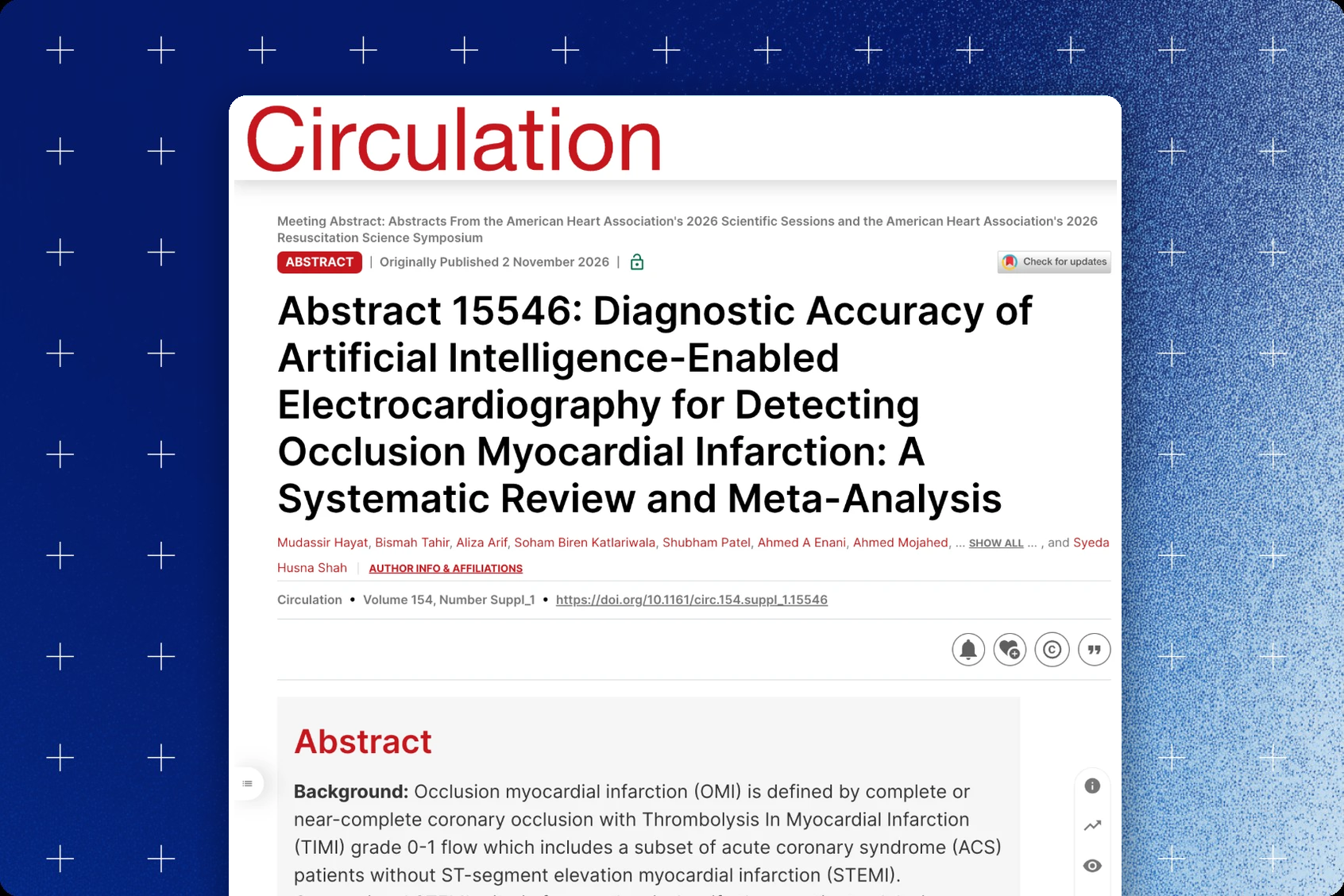
Diagnostic Accuracy of Artificial Intelligence-Enabled Electrocardiography for Detecting Occlusion Myocardial Infarction: A Systematic Review and Meta-Analysis
Overview
Eight studies with 7,358 patients were included in this systematic review and meta-analysis of artificial intelligence-enabled electrocardiography (AI-ECG) for occlusion myocardial infarction (OMI), with coronary angiography TIMI 0-1 flow as reference standard. Included models comprised Queen of Hearts (QoH) family algorithms including QoH_aOMI, QoH_eOMI, QoH_mACS, and PMcardio architectures, plus a non-QoH model. The primary pooled analysis demonstrated a sensitivity of 0.865 (95% confidence interval 0.745-0.934), specificity 0.815 (0.741-0.869), and area under the curve 0.890.
Key findings
- Eight studies with 7,358 patients were included from 796 records after deduplication.
- The primary pooled analysis demonstrated a sensitivity of 0.865 (95% confidence interval 0.745-0.934), specificity 0.815 (0.741-0.869), and area under the curve 0.890.
- Sensitivity analysis excluding ECG-SMART-NET reduced heterogeneity to I² = 0%, with sensitivity 0.875 (0.723-0.950), specificity 0.781 (0.750-0.809), and AUC 0.818.
- Risk of bias for index tests was low across studies, while overall bias was low in two, high in four, and unclear in two.
Published in: American Heart Association (AHA) Scientific Sessions 2026 – abstract published in Circulation (AHA Journals)
Published on: 6 November 2026
Background
Occlusion myocardial infarction (OMI) is defined by complete or near-complete coronary occlusion with Thrombolysis In Myocardial Infarction (TIMI) grade 0-1 flow which includes a subset of acute coronary syndrome (ACS) patients without ST-segment elevation myocardial infarction (STEMI). Conventional STEMI criteria frequently misclassify these patients, delaying timely reperfusion. Artificial intelligence-enabled electrocardiography (AI-ECG) may improve recognition of OMI beyond standard interpretation, but existing evidence remains limited and a systematic diagnostic synthesis is required.
Hypothesis
AI-ECG based deep learning algorithms provide improved diagnostic accuracy for OMI compared to conventional STEMI-based interpretation, enabling earlier identification of patients eligible for reperfusion therapy.
Methods
PubMed/MEDLINE, Embase, Scopus, and Cochrane Library were searched from inception through June 3, 2026. Eligible studies included adults with suspected ACS, applied machine learning or deep learning electrocardiography algorithms, and used coronary angiography TIMI 0-1 flow as reference standard. Risk of bias was assessed using QUADAS-2. A bivariate random-effects model and hierarchical summary receiver operating characteristic analysis were performed. Included models comprised Queen of Hearts (QoH) family algorithms including QoH_aOMI, QoH_eOMI, QoH_mACS, and PMcardio architectures, plus a non-QoH model.
Results
Eight studies with 7,358 patients were included from 796 records after deduplication. Risk of bias for index tests was low across studies, while overall bias was low in two, high in four, and unclear in two. The primary pooled analysis demonstrated a sensitivity of 0.865 (95% confidence interval 0.745-0.934), specificity 0.815 (0.741-0.869), and area under the curve 0.890. Hierarchical summary receiver operating characteristic analysis showed stable performance across thresholds. Sensitivity analysis excluding ECG-SMART-NET reduced heterogeneity to I² = 0%, with sensitivity 0.875 (0.723-0.950), specificity 0.781 (0.750-0.809), and AUC 0.818. These suggest that heterogeneity was largely driven by model-specific effects, while overall diagnostic performance remained robust.
Conclusions
Deep learning-based AI-ECG shows strong diagnostic accuracy for OMI, outperforming conventional STEMI-based classification and improving identification of reperfusion-eligible patients. Sensitivity analysis confirmed robustness of pooled estimates, while residual variability reflects algorithm-dependent performance. Findings support potential clinical integration of validated AI-ECG tools for early triage of suspected OMI; however, limited study numbers and heterogeneity warrant prospective validation and real-world studies.
Share this article



About PMcardio
PMcardio is the market leader in AI-powered diagnostics, addressing the world’s leading cause of death – cardiovascular diseases. The innovative clinical assistant empowers healthcare professionals to detect up to 40 cardiovascular diseases. In the form of a smartphone application, the certified Class IIb medical device interprets any 12-lead ECG image in under 5 seconds to provide accurate diagnoses and individualized treatment recommendations tailored to each patient.

About Powerful Medical
Powerful Medical leads one of the most important shifts in modern medicine by augmenting human-made clinical decisions with artificial intelligence. Our primary focus is on cardiovascular diseases, the world’s leading cause of death.
Established in 2017, Powerful Medical has embarked on a mission to revolutionize the diagnosis and treatment of cardiovascular diseases. We are a medical company backed by 28 world-class cardiologists and led by our expert Scientific Board with decades of experience in daily patient care, clinical research, and medical devices. The results of our research are implemented, developed, certified, and brought to market by our 50+ strong interdisciplinary team of physicians, data scientists, AI experts, software engineers, regulatory specialists, and commercial teams.