
Artificial intelligence-assisted ECG interpretation for identification of occlusive myocardial infarction following cardiac arrest: a multi-reader, multi-case study
Overview
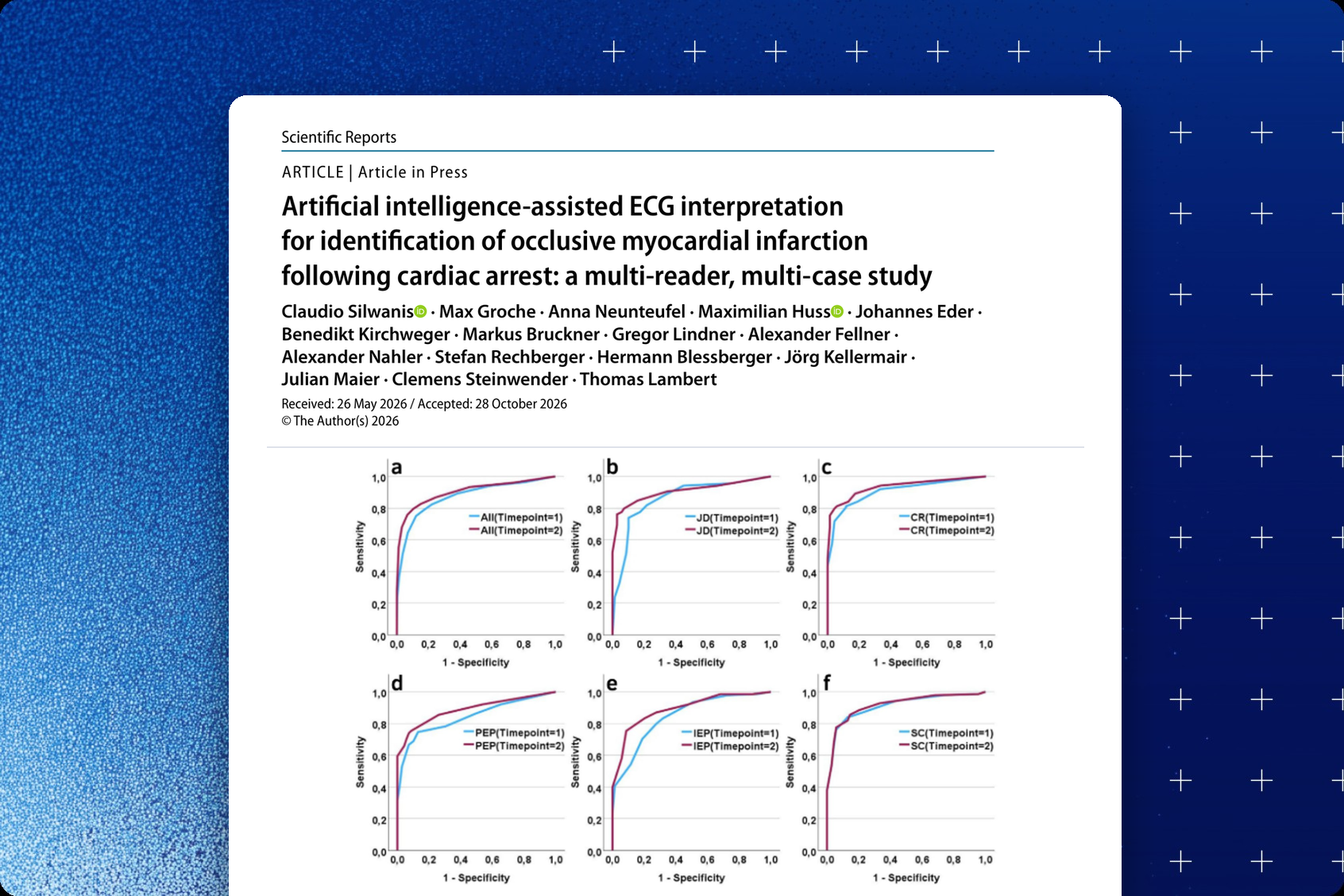
In this single-center multi-reader, multi-case study, 69 real-world post-ROSC ECGs were evaluated by 15 physicians from five groups at two timepoints, without AI and with PMcardio Queen of Hearts (aOMI v1) support, yielding 2,070 interpretations. For the primary endpoint, MRMC AUC increased from 0.882 to 0.912 (Δ 0.030, 95% CI 0.008–0.058; p = 0.018). Sensitivity/specificity were 77.97%/84.64% without AI and 78.55%/90.43% with QoH. Of 66 changed decisions, 64 (97%) followed QoH: the error rate fell by 5.03% where QoH was correct and rose by 10.56% where it was not.
Key findings
- Reader-averaged AUC increased from 0.882 at T1 to 0.912 at T2 (Δ 0.030; 95% CI 0.008–0.058; p = 0.018); the direction of change was positive in all five groups, although no individual group reached significance.
- At T1, sensitivity/specificity were 77.97%/84.64%; at T2, 78.55%/90.43%.
- Of 66 changed decisions, 64 (97%) followed QoH: the error rate fell by 5.03% where QoH was correct and rose by 10.56% where it was not.
- Sensitivity for non-STEMI high-risk OMI did not improve. Confidence increased, and within-group agreement rose through convergence on the algorithm output.
Published in: Scientific Reports
Published on: 4 November 2026
Background
Interpretation of post–return of spontaneous circulation (ROSC) electrocardiograms (ECGs) is challenging, yet critical for identifying occlusive myocardial infarction (OMI) requiring urgent reperfusion. While artificial intelligence (AI)–based decision-support tools show promising results, their impact on physician decision-making remains unclear.
Methods
In this multi-reader, multi-case study (MRMC), 69 real-world post-ROSC ECGs were evaluated by 15 physicians from five groups at two timepoints (T1 [without AI] and T2 [with Queen of Hearts (QoH) neural network support]), yielding 2,070 interpretations.
Results
At T1, sensitivity/specificity were 77.97%/84.64% (LR + 5.08, LR − 0.26); at T2, 78.55%/90.43% (LR + 8.21, LR − 0.24). For the primary endpoint, MRMC AUC increased from 0.882 to 0.912 (Δ 0.030, 95% CI 0.008–0.058; p = 0.018). The error rate fell by 2.32% (95% CI − 0.9 to + 5.6; p = 0.156); odds of correct identification were numerically higher at T2 (aOR 1.29, 95% CI 0.98–1.69). Of 66 changed decisions, 64 (97%) followed QoH: the error rate fell by 5.03% where QoH was correct and rose by 10.56% where it was not. Sensitivity for non-STEMI high-risk OMI did not improve. Confidence increased, and within-group agreement rose through convergence on the algorithm output.
Conclusion
The benefit of AI support is tied to algorithm accuracy.
Share this article



About PMcardio
PMcardio is the market leader in AI-powered diagnostics, addressing the world’s leading cause of death – cardiovascular diseases. The innovative clinical assistant empowers healthcare professionals to detect up to 40 cardiovascular diseases. In the form of a smartphone application, the certified Class IIb medical device interprets any 12-lead ECG image in under 5 seconds to provide accurate diagnoses and individualized treatment recommendations tailored to each patient.

About Powerful Medical
Powerful Medical leads one of the most important shifts in modern medicine by augmenting human-made clinical decisions with artificial intelligence. Our primary focus is on cardiovascular diseases, the world’s leading cause of death.
Established in 2017, Powerful Medical has embarked on a mission to revolutionize the diagnosis and treatment of cardiovascular diseases. We are a medical company backed by 28 world-class cardiologists and led by our expert Scientific Board with decades of experience in daily patient care, clinical research, and medical devices. The results of our research are implemented, developed, certified, and brought to market by our 50+ strong interdisciplinary team of physicians, data scientists, AI experts, software engineers, regulatory specialists, and commercial teams.