
Predictors of long-term atrial fibrillation recurrence after catheter ablation: non-linear analytical approach for individualized prognostic stratification
Overview
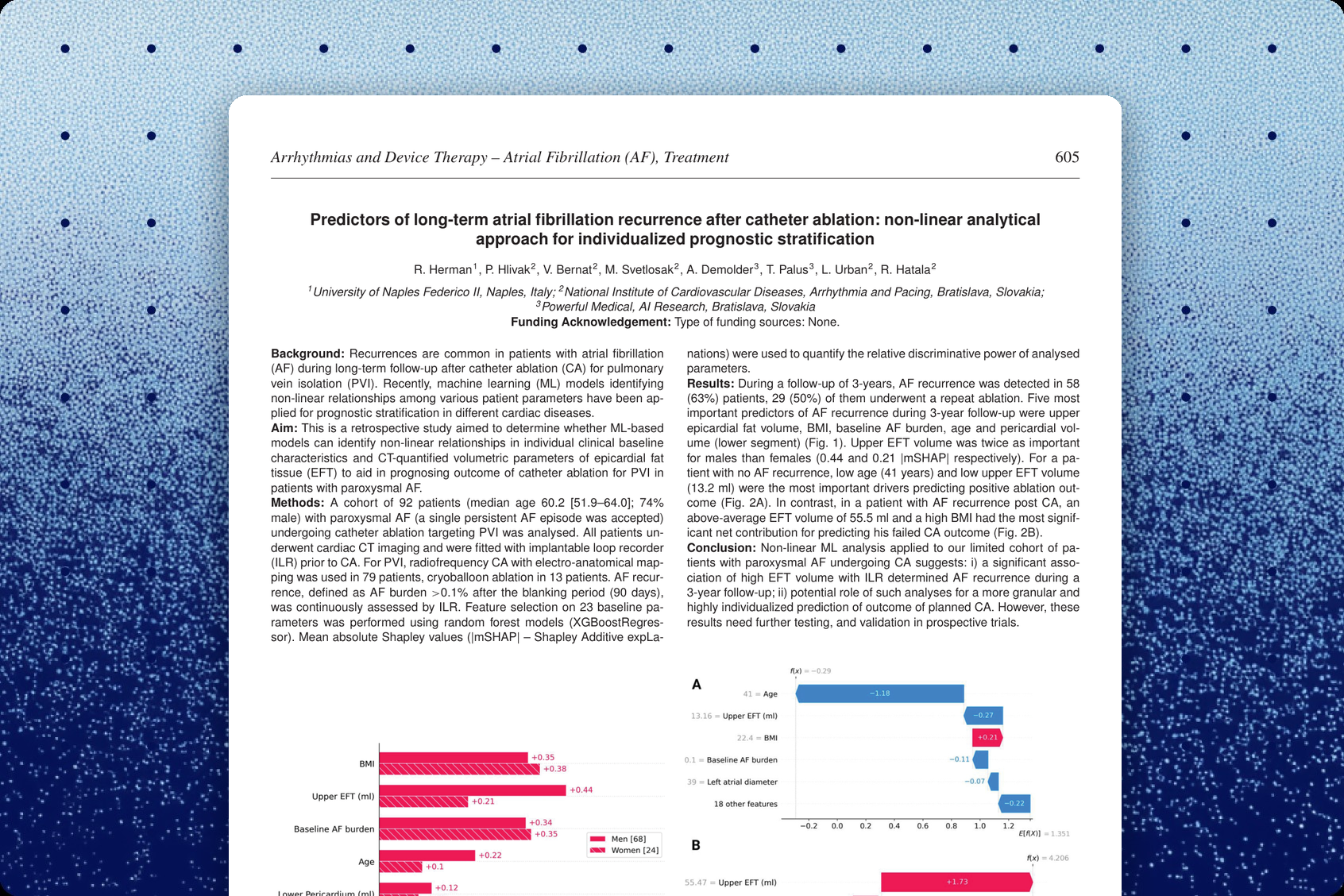
In this retrospective study, investigators from the National Institute of Cardiovascular Diseases in Bratislava, Slovakia, and Powerful Medical used non-linear machine learning to identify predictors of long-term atrial fibrillation (AF) recurrence in 92 patients with paroxysmal AF undergoing catheter ablation for pulmonary vein isolation. All patients had cardiac CT and an implantable loop recorder before ablation, and 23 baseline clinical and CT-derived epicardial fat parameters were analyzed with random forest models and Shapley values. Over 3 years, AF recurred in 58 patients (63%). Upper epicardial fat volume, BMI, baseline AF burden, age and lower-segment pericardial volume were the five most important predictors, and upper epicardial fat volume was twice as important in men as in women.
Key findings
- AF recurrence (AF burden >0.1% after a 90-day blanking period, continuously monitored by implantable loop recorder) occurred in 58 of 92 patients (63%) during 3-year follow-up; 29 of them (50%) underwent a repeat ablation.
- Among 23 baseline parameters, the five most important predictors of recurrence were upper epicardial fat volume, BMI, baseline AF burden, age and lower-segment pericardial volume.
- Upper epicardial fat volume was twice as important for men as for women (mean absolute SHAP value 0.44 vs 0.21).
- At the individual level, low age (41 years) and low upper epicardial fat volume (13.2 ml) drove a predicted successful ablation, while an above-average epicardial fat volume of 55.5 ml and high BMI drove a predicted failed ablation.
Published in: ESC Congress 2022, Barcelona; abstract published in European Heart Journal, Volume 43, Supplement 2
Published on: 26 August 2022
Background
Recurrences are common in patients with atrial fibrillation (AF) during long-term follow-up after catheter ablation for pulmonary vein isolation (PVI). Machine learning models that identify non-linear relationships among patient parameters have recently been applied for prognostic stratification in different cardiac diseases. This retrospective study aimed to determine whether machine learning models can identify non-linear relationships in individual baseline clinical characteristics and CT-quantified volumetric parameters of epicardial fat tissue to help predict the outcome of catheter ablation for PVI in patients with paroxysmal AF.
Methods
The study analyzed 92 patients (median age 60.2 years [51.9–64.0]; 74% male) with paroxysmal AF (a single persistent AF episode was accepted) undergoing catheter ablation targeting PVI. All patients underwent cardiac CT imaging and were fitted with an implantable loop recorder before ablation. PVI was performed with radiofrequency ablation and electroanatomical mapping in 79 patients and with cryoballoon ablation in 13 patients. AF recurrence, defined as an AF burden >0.1% after a 90-day blanking period, was continuously assessed by the loop recorder. Feature selection on 23 baseline parameters was performed with random forest models (XGBoostRegressor), and mean absolute Shapley values (|mSHAP|, SHapley Additive exPlanations) were used to quantify the relative discriminative power of the analyzed parameters.
Results
During 3 years of follow-up, AF recurrence was detected in 58 patients (63%), and 29 of them (50%) underwent a repeat ablation. The five most important predictors of AF recurrence were upper epicardial fat volume, BMI, baseline AF burden, age and pericardial volume (lower segment). Upper epicardial fat volume was twice as important for men as for women (|mSHAP| 0.44 and 0.21, respectively). For a patient without AF recurrence, low age (41 years) and low upper epicardial fat volume (13.2 ml) were the most important drivers of a predicted positive ablation outcome. In contrast, for a patient with AF recurrence after ablation, an above-average epicardial fat volume of 55.5 ml and a high BMI made the largest net contribution to predicting the failed outcome.
Conclusion
In this limited cohort of patients with paroxysmal AF undergoing catheter ablation, non-linear machine learning analysis suggests a significant association between high epicardial fat volume and loop-recorder-detected AF recurrence during 3-year follow-up, and a potential role for such analyses in more granular, highly individualized prediction of the outcome of planned ablation. These results need further testing and validation in prospective trials.
Share this article



About PMcardio
PMcardio is the market leader in AI-powered diagnostics, addressing the world’s leading cause of death – cardiovascular diseases. The innovative clinical assistant empowers healthcare professionals to detect up to 40 cardiovascular diseases. In the form of a smartphone application, the certified Class IIb medical device interprets any 12-lead ECG image in under 5 seconds to provide accurate diagnoses and individualized treatment recommendations tailored to each patient.

About Powerful Medical
Powerful Medical leads one of the most important shifts in modern medicine by augmenting human-made clinical decisions with artificial intelligence. Our primary focus is on cardiovascular diseases, the world’s leading cause of death.
Established in 2017, Powerful Medical has embarked on a mission to revolutionize the diagnosis and treatment of cardiovascular diseases. We are a medical company backed by 28 world-class cardiologists and led by our expert Scientific Board with decades of experience in daily patient care, clinical research, and medical devices. The results of our research are implemented, developed, certified, and brought to market by our 50+ strong interdisciplinary team of physicians, data scientists, AI experts, software engineers, regulatory specialists, and commercial teams.