
Performance of an artificial intelligence-powered smartphone application in the UK clinical settings: ECG automation compared to healthcare professionals
Overview
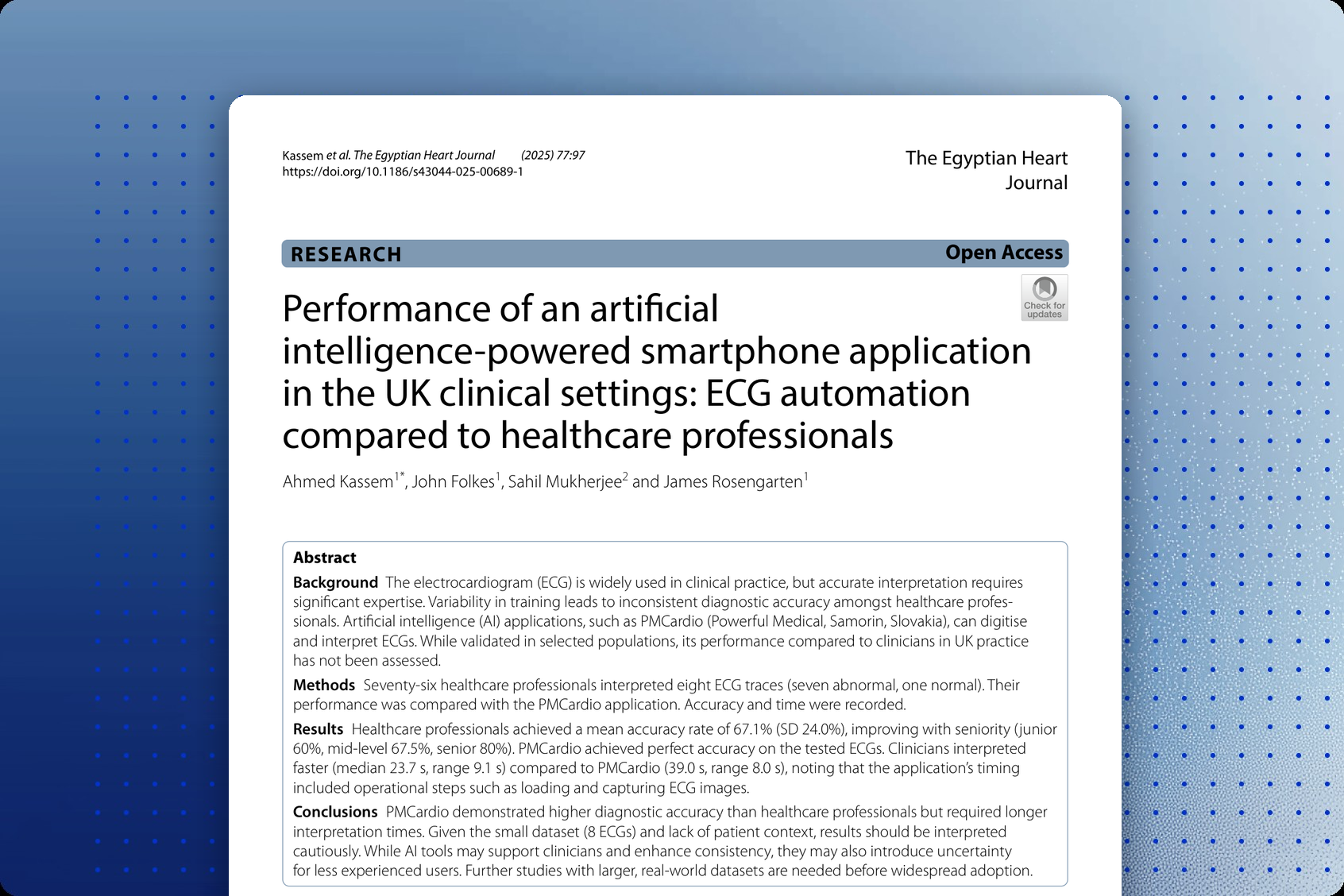
Accurate ECG interpretation requires significant expertise, and variable training leads to inconsistent diagnostic accuracy among healthcare professionals. This prospective, single-center study at a UK district general hospital compared the PMcardio smartphone application, which digitizes and interprets a photographed 12-lead ECG, with 76 doctors and paramedics who each interpreted the same 8 ECG traces (7 abnormal, 1 normal). PMcardio correctly interpreted all 8 ECGs, while the healthcare professionals achieved a mean accuracy of 67.1%, rising with seniority from 60% for junior to 80% for senior clinicians. Clinicians were faster (median 23.7 s vs 39.0 s), although the app's timing included loading the application and capturing the ECG image. Given the small ECG set and lack of clinical context, the authors call for larger, real-world studies.
Key findings
- PMcardio correctly interpreted all 8 test ECGs, while 76 healthcare professionals achieved a mean accuracy of 67.1% (SD 24.0%).
- Clinician accuracy rose with seniority, from 60% for junior to 67.5% for mid-level and 80% for senior clinicians.
- Clinicians most often missed left main coronary artery occlusion/STEMI (38.2% correct) and left bundle branch block (51.3% correct); PMcardio was correct on both.
- Median interpretation time was 39.0 s for PMcardio vs 23.7 s for clinicians, with the app's time including loading the application and capturing the ECG image.
Published in: The Egyptian Heart Journal
Published on: 16 October 2025
Background
The electrocardiogram (ECG) is widely used in clinical practice, but accurate interpretation requires significant expertise, and the lack of standardized ECG teaching leads to inconsistent diagnostic accuracy among healthcare professionals. PMcardio (Powerful Medical) is a CE-marked smartphone application that digitizes a photographed 12-lead ECG and provides a clinical interpretation. While it has been validated in selected chest pain populations, its performance compared with clinicians in UK practice had not been assessed.
Methods
This prospective, observational diagnostic accuracy study was conducted at a district general hospital in the UK (East Kent Hospitals University NHS Foundation Trust) between March and June 2024. Seventy-six healthcare professionals took part: 88% were doctors and 12% paramedics; 34% were junior-level, 42% mid-level and 24% senior-level. Each participant interpreted the same 8 ECG traces taken from an online ECG library — normal sinus rhythm, anterior STEMI, posterior STEMI, left main coronary artery occlusion/STEMI, left bundle branch block, complete heart block, atrial flutter and atrial fibrillation — without any accompanying clinical information, and each response was timed with a stopwatch. The same traces were run through the PMcardio application, and accuracy and interpretation time were compared.
Results
Healthcare professionals achieved a mean accuracy of 67.1% (SD 24.0%), improving with seniority: 60% for junior, 67.5% for mid-level and 80% for senior clinicians. PMcardio interpreted all 8 ECGs correctly, and its accuracy was significantly higher than the clinicians' for every ECG type (McNemar test, p < 0.05). Clinician accuracy was highest for anterior STEMI (92.1%) and normal sinus rhythm (88.2%) and lowest for left main coronary artery occlusion/STEMI (38.2%), left bundle branch block (51.3%) and atrial flutter (55.3%). Clinicians were faster, with a median interpretation time of 23.7 s compared with 39.0 s for PMcardio, whose timing included loading the application, capturing and formatting the ECG and processing the image. The authors note that the ECGs came from an online library that may have been used in training the application, which could have inflated its accuracy, and that the app's ranked list of possible diagnoses could confuse less experienced users.
Conclusion
PMcardio demonstrated higher diagnostic accuracy than healthcare professionals across all 8 test ECGs but required longer interpretation times, which included the operational steps of using the app. Given the small dataset and the lack of patient context, the results should be interpreted cautiously, and larger, real-world studies are needed before widespread adoption.
Share this article



About PMcardio
PMcardio is the market leader in AI-powered diagnostics, addressing the world’s leading cause of death – cardiovascular diseases. The innovative clinical assistant empowers healthcare professionals to detect up to 40 cardiovascular diseases. In the form of a smartphone application, the certified Class IIb medical device interprets any 12-lead ECG image in under 5 seconds to provide accurate diagnoses and individualized treatment recommendations tailored to each patient.

About Powerful Medical
Powerful Medical leads one of the most important shifts in modern medicine by augmenting human-made clinical decisions with artificial intelligence. Our primary focus is on cardiovascular diseases, the world’s leading cause of death.
Established in 2017, Powerful Medical has embarked on a mission to revolutionize the diagnosis and treatment of cardiovascular diseases. We are a medical company backed by 28 world-class cardiologists and led by our expert Scientific Board with decades of experience in daily patient care, clinical research, and medical devices. The results of our research are implemented, developed, certified, and brought to market by our 50+ strong interdisciplinary team of physicians, data scientists, AI experts, software engineers, regulatory specialists, and commercial teams.