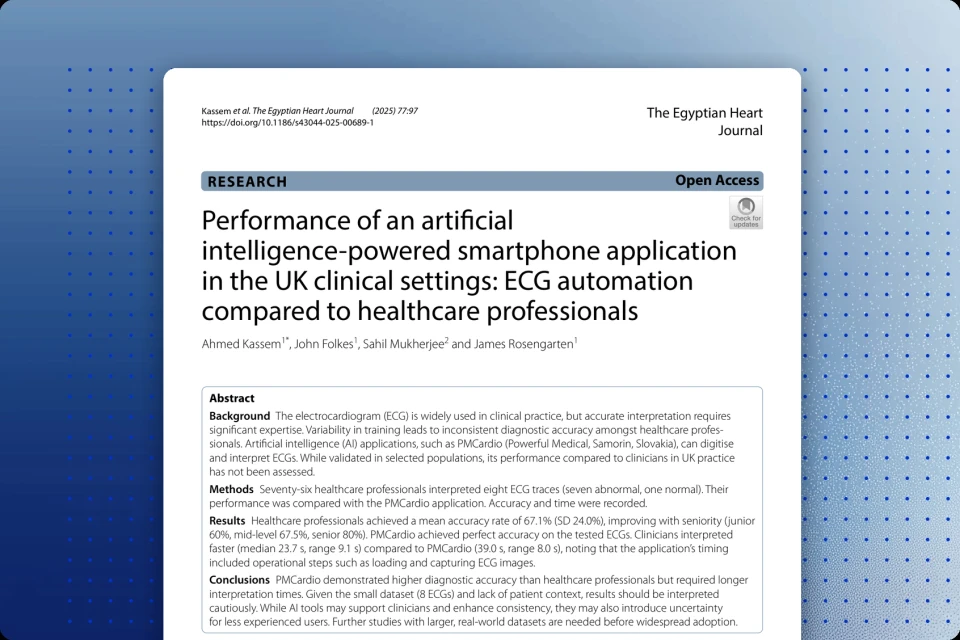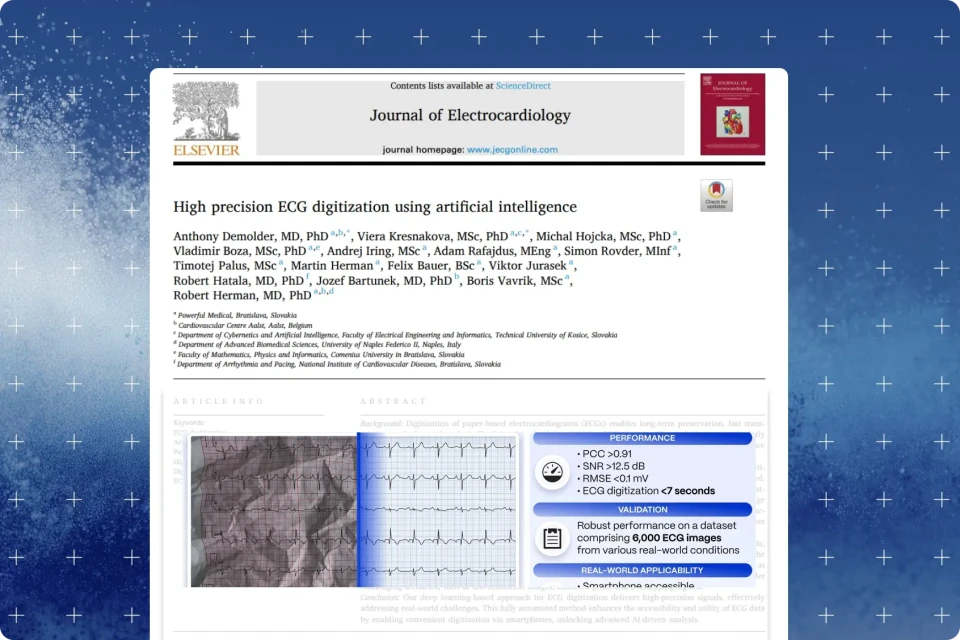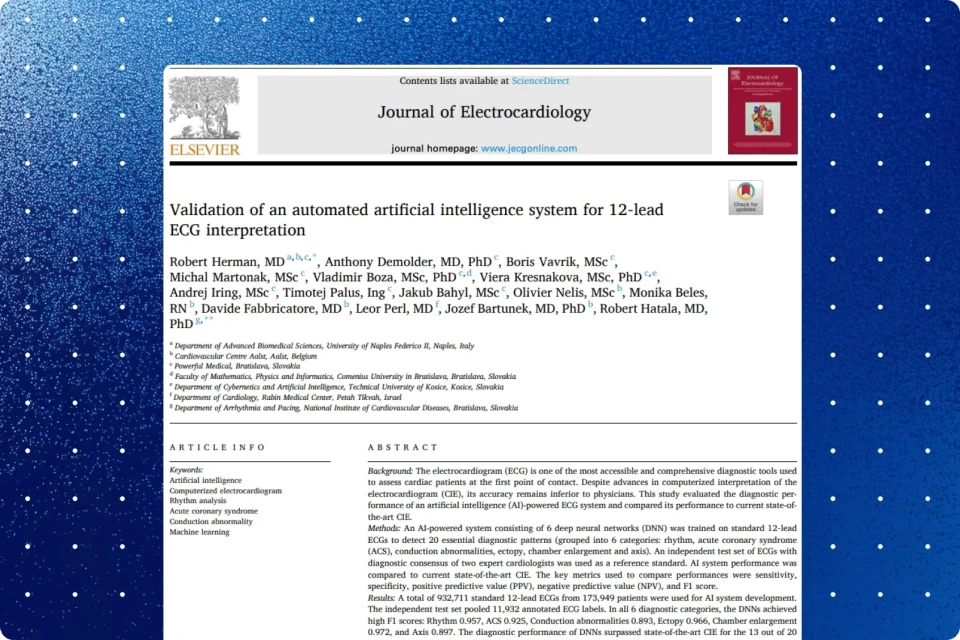

Large-scale deployment of AI-enhanced ECG interpretation in telemedicine
Overview
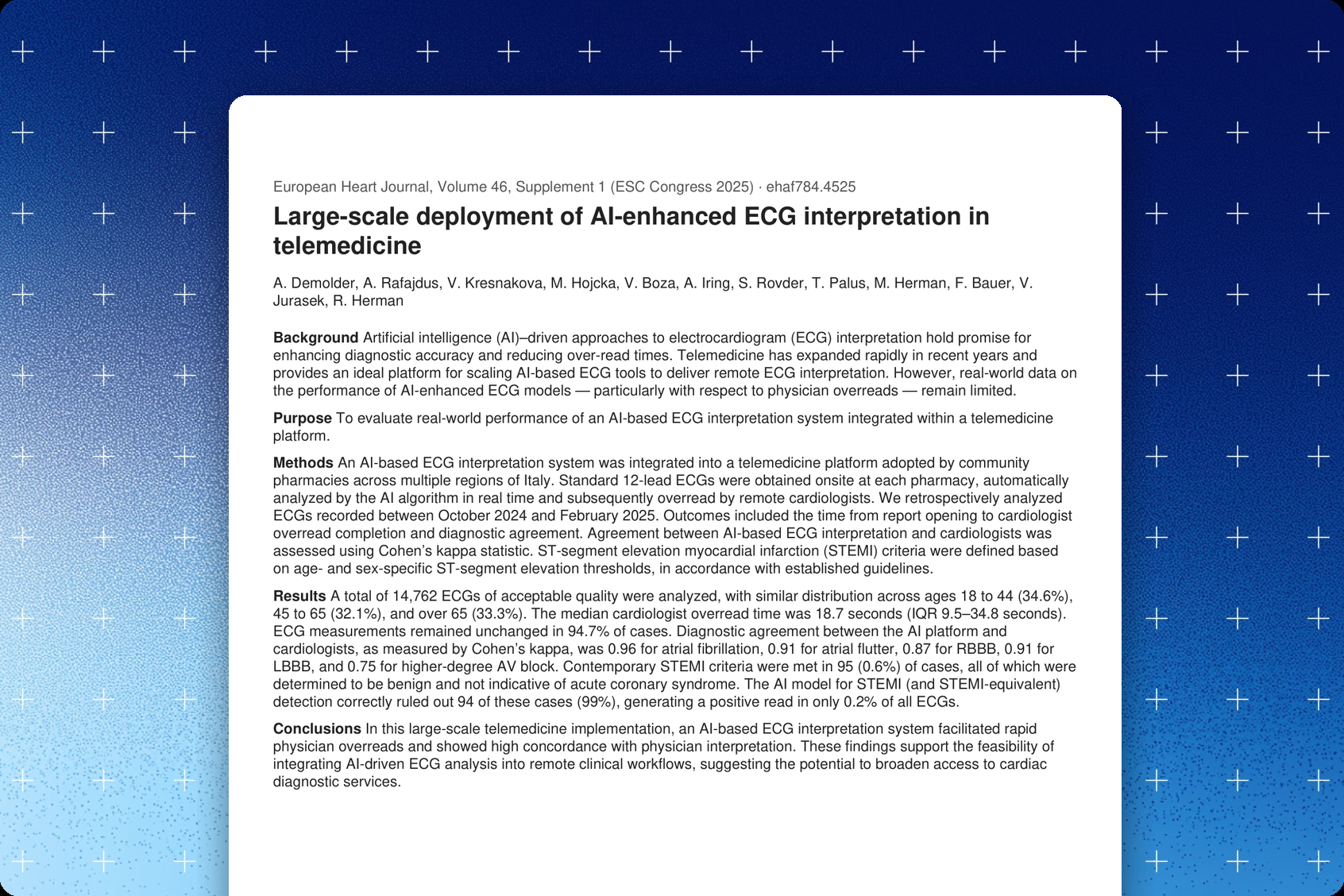
This retrospective analysis evaluated an AI-based ECG interpretation system (PMcardio Core Diagnostics, with the Queen of Hearts model for STEMI and STEMI-equivalent detection) integrated into a telemedicine platform used by community pharmacies across multiple regions of Italy. Each 12-lead ECG was analyzed by AI in real time and then overread by a remote cardiologist; 14,762 ECGs of acceptable quality recorded between October 2024 and February 2025 were analyzed. The median cardiologist overread time was 18.7 seconds, ECG measurements were left unchanged in 94.7% of cases, and agreement with cardiologists on major rhythm and conduction diagnoses was high (Cohen's kappa 0.75–0.96). Of 95 ECGs that met contemporary STEMI criteria, all of them benign, the AI STEMI model correctly ruled out 94 (99%).
Key findings
- Across 14,762 pharmacy-recorded ECGs, the median cardiologist overread time was 18.7 seconds (IQR 9.5–34.8), and ECG measurements remained unchanged in 94.7% of cases.
- Agreement between the AI platform and cardiologists (Cohen's kappa) was 0.96 for atrial fibrillation, 0.91 for atrial flutter, 0.87 for RBBB, 0.91 for LBBB and 0.75 for higher-degree AV block.
- Contemporary STEMI criteria were met in 95 ECGs (0.6%), all benign; the AI STEMI model correctly ruled out 94 of them (99%).
- The AI STEMI model generated a positive read in only 0.2% of all ECGs.
Published in: ESC Congress 2025 (European Heart Journal, Volume 46, Supplement 1)
Published on: 29 August 2025
Background
Artificial intelligence (AI)-driven approaches to electrocardiogram (ECG) interpretation hold promise for enhancing diagnostic accuracy and reducing overread times. Telemedicine has expanded rapidly in recent years and provides an ideal platform for scaling AI-based ECG tools to deliver remote ECG interpretation. However, real-world data on the performance of AI-enhanced ECG models, particularly with respect to physician overreads, remain limited. This study evaluated the real-world performance of an AI-based ECG interpretation system integrated within a telemedicine platform.
Methods
An AI-based ECG interpretation system was integrated into a telemedicine platform adopted by community pharmacies across multiple regions of Italy. Standard 12-lead ECGs were obtained onsite at each pharmacy, automatically analyzed by the AI algorithm in real time and subsequently overread by remote cardiologists. ECGs recorded between October 2024 and February 2025 were analyzed retrospectively. Outcomes included the time from report opening to completion of the cardiologist overread and diagnostic agreement. Agreement between the AI-based ECG interpretation and cardiologists was assessed using Cohen's kappa statistic. ST-segment elevation myocardial infarction (STEMI) criteria were defined using age- and sex-specific ST-segment elevation thresholds, in accordance with established guidelines.
Results
A total of 14,762 ECGs of acceptable quality were analyzed, with a similar distribution across ages 18 to 44 (34.6%), 45 to 65 (32.1%) and over 65 years (33.3%). The median cardiologist overread time was 18.7 seconds (IQR 9.5–34.8 seconds), and ECG measurements remained unchanged in 94.7% of cases. Diagnostic agreement between the AI platform and cardiologists, measured by Cohen's kappa, was 0.96 for atrial fibrillation, 0.91 for atrial flutter, 0.87 for right bundle branch block (RBBB), 0.91 for left bundle branch block (LBBB) and 0.75 for higher-degree AV block. Contemporary STEMI criteria were met in 95 (0.6%) cases, all of which were determined to be benign and not indicative of acute coronary syndrome. The AI model for STEMI (and STEMI-equivalent) detection correctly ruled out 94 of these cases (99%), generating a positive read in only 0.2% of all ECGs.
Conclusion
In this large-scale telemedicine implementation, an AI-based ECG interpretation system facilitated rapid physician overreads and showed high concordance with physician interpretation. These findings support the feasibility of integrating AI-driven ECG analysis into remote clinical workflows and suggest the potential to broaden access to cardiac diagnostic services.
Share this article



About PMcardio
PMcardio is the market leader in AI-powered diagnostics, addressing the world’s leading cause of death – cardiovascular diseases. The innovative clinical assistant empowers healthcare professionals to detect up to 40 cardiovascular diseases. In the form of a smartphone application, the certified Class IIb medical device interprets any 12-lead ECG image in under 5 seconds to provide accurate diagnoses and individualized treatment recommendations tailored to each patient.

About Powerful Medical
Powerful Medical leads one of the most important shifts in modern medicine by augmenting human-made clinical decisions with artificial intelligence. Our primary focus is on cardiovascular diseases, the world’s leading cause of death.
Established in 2017, Powerful Medical has embarked on a mission to revolutionize the diagnosis and treatment of cardiovascular diseases. We are a medical company backed by 28 world-class cardiologists and led by our expert Scientific Board with decades of experience in daily patient care, clinical research, and medical devices. The results of our research are implemented, developed, certified, and brought to market by our 50+ strong interdisciplinary team of physicians, data scientists, AI experts, software engineers, regulatory specialists, and commercial teams.