
High Precision ECG Digitization Using Artificial Intelligence
Overview
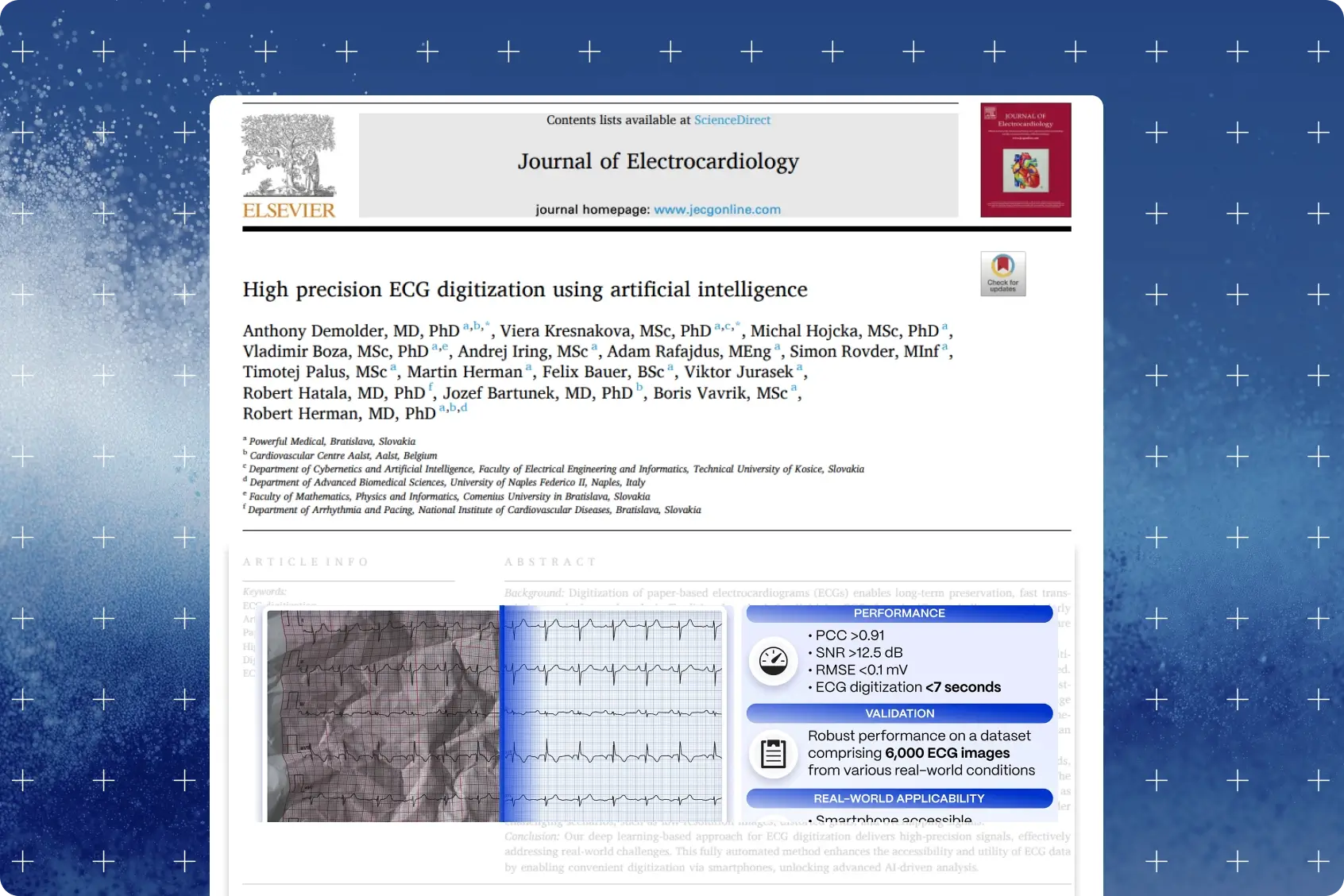
This study presents a fully automated AI solution for high-precision digitization of paper ECGs, including smartphone photos. It enables rapid ECG conversion in under 7 seconds, maintaining strong performance even in low-quality or distorted images. Ideal for use in ambulances, primary care, or low-resource settings, it bridges the gap to advanced AI interpretation and secure digital sharing when native digital ECGs are unavailable.
Key findings
- Digitizes paper ECGs, including smartphone photos, in under 7 seconds.
- Maintains performance on low-quality or distorted images.
- Bridges paper ECGs to AI interpretation and secure digital sharing.
Published in: Journal of Electrocardiology – presented at the annual ACC’25 conference Published Date: February 19, 2025
Background
Digitization of paper-based electrocardiograms (ECGs) enables long-term preservation, fast transmission, and advanced analysis. Traditional methods for digitizing ECGs face significant challenges, particularly
in real-world scenarios with varying image quality. State-of-the-art solutions often require manual input and are limited by their dependence on high-quality scans and standardized layouts.
Methods
This study introduces a fully automated, deep learning-based approach for high precision ECG digitization. In the normalization phase, a standardized grid structure is detected, and image distortions are corrected. Next, the reconstruction phase uses deep learning techniques to extract and digitize the leads, followed by post-processing to refine the signal. This approach was evaluated using the publicly available PMcardio ECG Image Database (PM-ECG-ID), comprising 6000 ECG images reflecting diverse real-world scenarios and smartphone-based image acquisitions. Performance was assessed using Pearson’s correlation coefficient (PCC), root mean squared error (RMSE), and signal-to-noise ratio (SNR).
Results
The ECG digitization solution demonstrated an average PCC consistently exceeding 0.91 across all leads, SNR above 12.5 dB and RMSE below 0.10 mV. The time to ECG digitization was consistently less than 7 s. The average failure rate was 6.62 % across leads, with most failures occurring under extreme conditions such as severe blurring or significant image degradation. The solution maintained robust performance even under challenging scenarios, such as low-resolution images, distorted grids, and overlapping signals.
Conclusion
Our deep learning-based approach for ECG digitization delivers high-precision signals, effectively addressing real-world challenges. This fully automated method enhances the accessibility and utility of ECG data by enabling convenient digitization via smartphones, unlocking advanced AI-driven analysis.
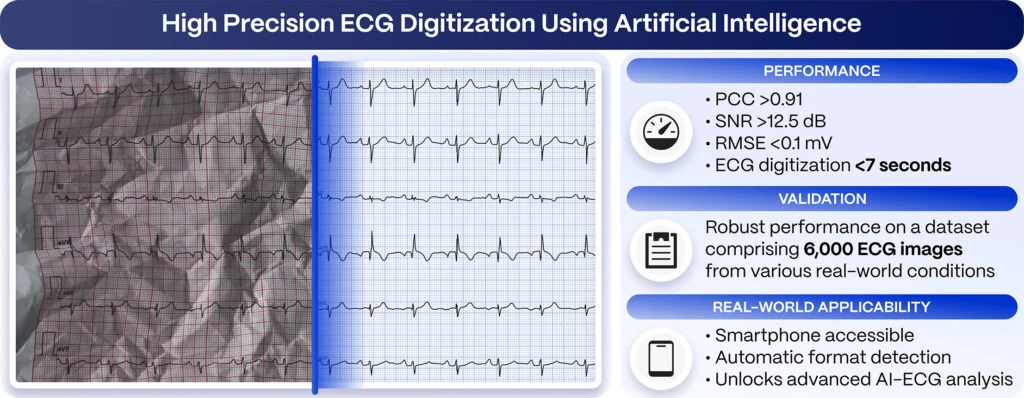
Graphical Abstract
Share this article



About PMcardio
PMcardio is the market leader in AI-powered diagnostics, addressing the world’s leading cause of death – cardiovascular diseases. The innovative clinical assistant empowers healthcare professionals to detect up to 40 cardiovascular diseases. In the form of a smartphone application, the certified Class IIb medical device interprets any 12-lead ECG image in under 5 seconds to provide accurate diagnoses and individualized treatment recommendations tailored to each patient.

About Powerful Medical
Powerful Medical leads one of the most important shifts in modern medicine by augmenting human-made clinical decisions with artificial intelligence. Our primary focus is on cardiovascular diseases, the world’s leading cause of death.
Established in 2017, Powerful Medical has embarked on a mission to revolutionize the diagnosis and treatment of cardiovascular diseases. We are a medical company backed by 28 world-class cardiologists and led by our expert Scientific Board with decades of experience in daily patient care, clinical research, and medical devices. The results of our research are implemented, developed, certified, and brought to market by our 50+ strong interdisciplinary team of physicians, data scientists, AI experts, software engineers, regulatory specialists, and commercial teams.