
PMcardio-Assisted ECG Interpretation in Non-ST-Elevation Acute Coronary Syndrome: A Case Report
Overview
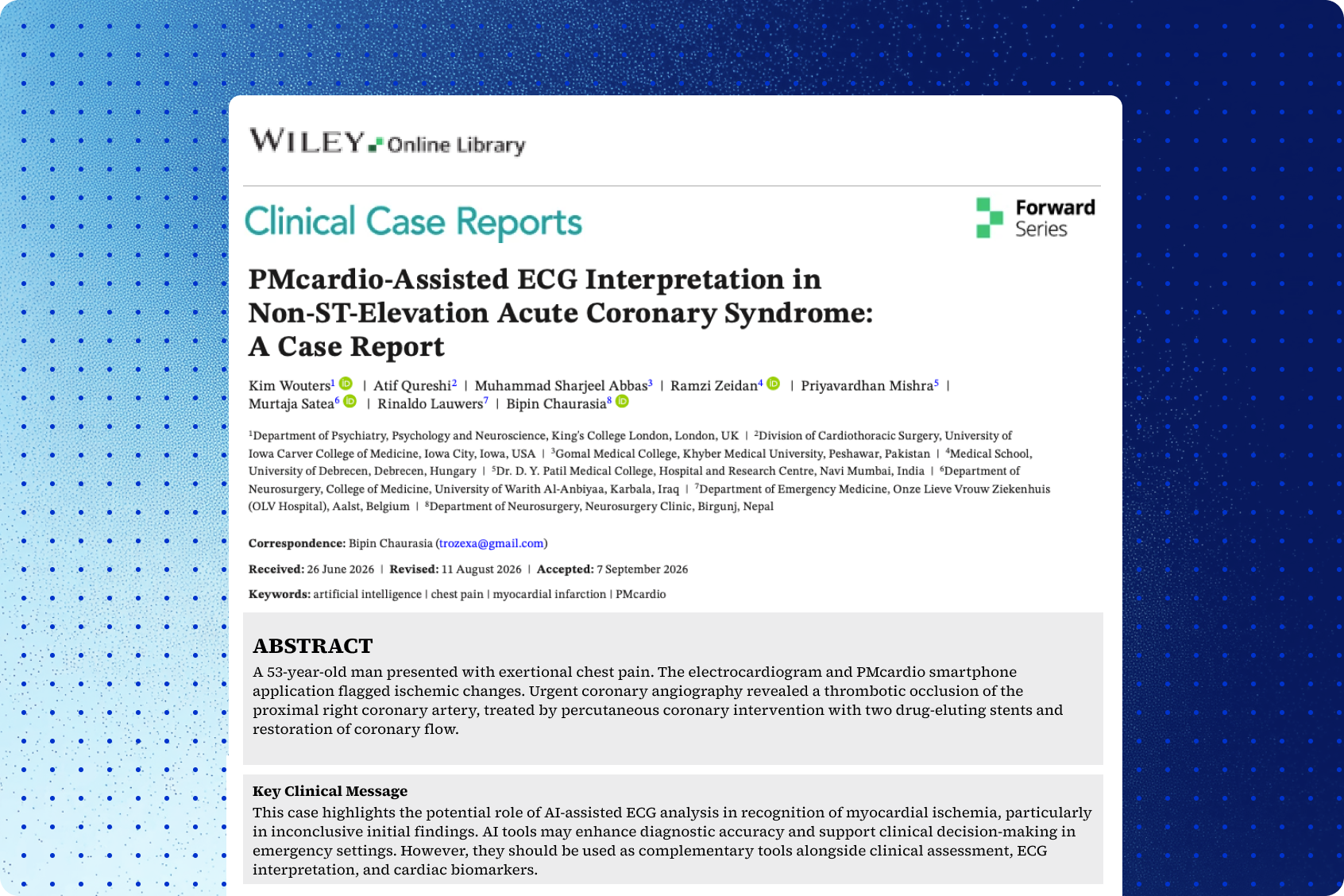
A 53-year-old man presented with exertional chest pain. The electrocardiogram and PMcardio smartphone application flagged ischemic changes. Urgent coronary angiography revealed a thrombotic occlusion of the proximal right coronary artery, treated by percutaneous coronary intervention with two drug-eluting stents and restoration of coronary flow. This case highlights the potential role of AI-assisted ECG analysis in recognition of myocardial ischemia, particularly in inconclusive initial findings. AI tools may enhance diagnostic accuracy and support clinical decision-making in emergency settings. However, they should be used as complementary tools alongside clinical assessment, ECG interpretation, and cardiac biomarkers.
Key findings
- Case: 53-year-old man with 2 weeks of progressive exertional chest pain; ECG showed inferior T-wave inversion and mild lateral ST-depression without ST-elevation.
- PMcardio flagged ischemic changes on the admission ECG, concordant with the treating team; hs-troponin T rose from 15.8 to 747.0 ng/L within 24 h.
- Urgent angiography found a thrombotic proximal right coronary artery occlusion, treated with PCI and two drug-eluting stents.
- Diagnosis was confirmed by angiography, not the algorithm; prospective studies are needed to show whether such tools improve timeliness and outcomes.
Published in: Clinical Case Reports
Published on: 11 September 2026
Background
Acute coronary syndrome (ACS) is one of the leading causes of death worldwide and one of the most common reasons for emergency department presentation, yet only about 5%–10% of patients presenting with chest pain are ultimately diagnosed with ACS. Diagnosis is especially difficult when ECG changes are slight and initial biomarkers are negative or only marginally positive — a common situation in non-ST-segment elevation ACS, where classic criteria may be absent despite coronary artery disease. AI-based diagnostic tools such as the PMcardio smartphone application, which analyzes a photographed 12-lead ECG, are increasingly seen as support for conventional diagnosis.
Methods
This single-patient case report, summarized chronologically in accordance with the CARE reporting guidance, describes a 53-year-old obese man with hypertension, hyperlipidemia, a prior NSTEMI and a family history of cardiac illness who presented to the emergency department with a 2-week history of progressive, squeezing exertional chest pain radiating to the left arm and jaw. On admission he was hypertensive (176/105 mmHg) with a heart rate of 66 beats per minute and oxygen saturation of 98% on room air, without signs of heart failure.
The 12-lead ECG showed sinus rhythm with T-wave inversion in the inferior leads (II, III, aVF) and mild ST-segment depression in the lateral leads (I, aVL, V5–V6), without ST-elevation. The PMcardio application flagged ischemic changes on this ECG, an output concordant with the treating team's interpretation. Initial high-sensitivity troponin T was 15.8 ng/L, marginally above the ~14 ng/L 99th-percentile upper reference limit.
Results
The presentation was categorized as high-risk non-ST-elevation ACS and an early invasive strategy was pursued. After intravenous heparin, an acetylsalicylic acid loading dose and premedication for a known contrast allergy, urgent coronary angiography demonstrated a thrombotic occlusion of the proximal right coronary artery, treated by percutaneous coronary intervention with two drug-eluting stents and restoration of coronary flow.
By 24 hours, high-sensitivity troponin T had risen to 747.0 ng/L and creatine kinase from 85 to 417 U/L, confirming acute myocardial infarction. Two episodes of nonsustained ventricular tachycardia were managed with bisoprolol. Transthoracic echocardiography showed preserved biventricular function, and the patient was discharged on dual antiplatelet and guideline-directed secondary-prevention therapy with early cardiac rehabilitation. Follow-up was limited to the index hospitalization.
The authors note that concordance in a single patient cannot demonstrate improved sensitivity, earlier reperfusion or better outcomes, and that the original on-screen report, confidence score and software version were not available.
Conclusion
This case illustrates a non-ST-elevation acute coronary syndrome in which an artificial-intelligence ECG output was concordant with the treating team's interpretation and the final angiographic diagnosis. It highlights the potential supportive role of tools such as PMcardio in emergency cardiology, while underscoring that the diagnosis was confirmed by angiography rather than by the algorithm. Prospective studies are needed to determine whether such tools improve diagnostic timeliness and patient outcomes, and how they perform across clinical settings.
Share this article



About PMcardio
PMcardio is the market leader in AI-powered diagnostics, addressing the world’s leading cause of death – cardiovascular diseases. The innovative clinical assistant empowers healthcare professionals to detect up to 40 cardiovascular diseases. In the form of a smartphone application, the certified Class IIb medical device interprets any 12-lead ECG image in under 5 seconds to provide accurate diagnoses and individualized treatment recommendations tailored to each patient.

About Powerful Medical
Powerful Medical leads one of the most important shifts in modern medicine by augmenting human-made clinical decisions with artificial intelligence. Our primary focus is on cardiovascular diseases, the world’s leading cause of death.
Established in 2017, Powerful Medical has embarked on a mission to revolutionize the diagnosis and treatment of cardiovascular diseases. We are a medical company backed by 28 world-class cardiologists and led by our expert Scientific Board with decades of experience in daily patient care, clinical research, and medical devices. The results of our research are implemented, developed, certified, and brought to market by our 50+ strong interdisciplinary team of physicians, data scientists, AI experts, software engineers, regulatory specialists, and commercial teams.