
Bringing artificial intelligence to the front lines: PMcardio for detecting occlusive myocardial infarction in STEMI and STEMI-equivalent activations
Overview
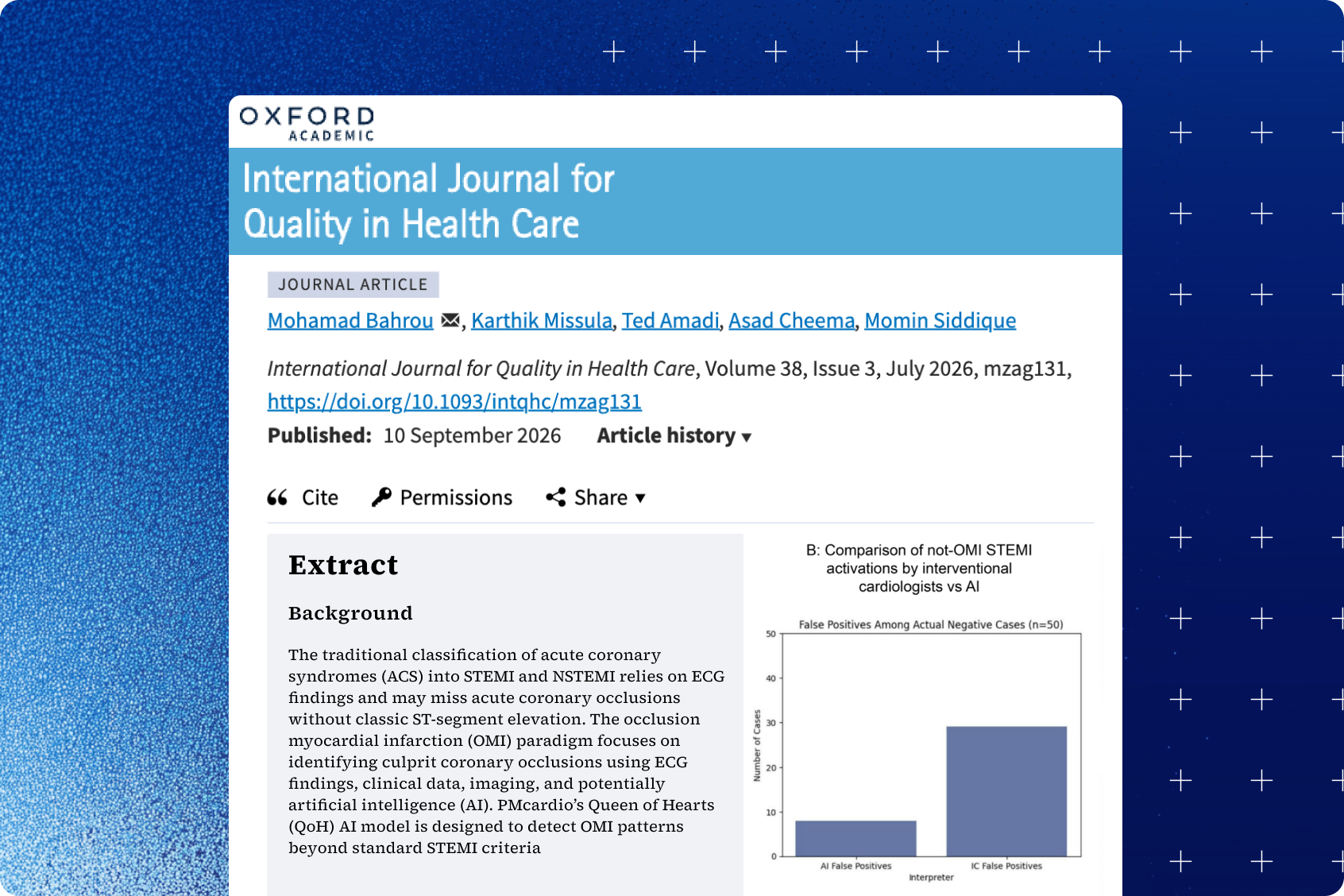
Catheterization lab activation based on ST-segment elevation criteria can miss acute coronary occlusions and generates many false-positive activations. This single-center retrospective quality-improvement study at Springfield Memorial Hospital (2023–2024) compared the PMcardio Queen of Hearts (QoH) AI model with interventional cardiologists' decisions in 216 STEMI and STEMI-equivalent activations, 166 of which were adjudicated as occlusion myocardial infarction (OMI). QoH matched the cardiologists' 98% sensitivity while doubling specificity (84% vs 42%), flagging 8 of 50 non-OMI activations as false positives versus 29 for the cardiologists. After the results were presented, hospital leadership decided to consider implementing the AI model in clinical workflows pending FDA approval.
Key findings
- Across 216 STEMI and STEMI-equivalent activations (166 adjudicated OMI, 50 non-OMI), QoH and interventional cardiologists both reached 98% sensitivity, each missing 3 true OMI cases.
- QoH specificity was 84% versus 42% for interventional cardiologists, with 8 of 50 non-OMI activations flagged as false positives by the AI versus 29 of 50 by the cardiologists.
- All 3 OMI cases missed by QoH showed borderline ST-segment elevation that did not meet traditional STEMI criteria but had flow-limiting coronary lesions on angiography.
- After the findings were presented to hospital leadership, the hospital decided to consider implementing the AI model in clinical workflows pending FDA approval.
Published in: International Journal for Quality in Health Care
Published on: 10 September 2026
Background
The traditional STEMI/NSTEMI classification of acute coronary syndromes relies on ECG findings and may miss acute coronary occlusions without classic ST-segment elevation, while false catheterization lab activations carry real clinical and financial costs. The occlusion myocardial infarction (OMI) paradigm instead focuses on identifying culprit coronary occlusions using ECG findings, clinical data, imaging, and potentially artificial intelligence. This quality-improvement project evaluated PMcardio's Queen of Hearts (QoH) AI model, designed to detect OMI patterns beyond standard STEMI criteria, against interventional cardiologists in real-world STEMI activations.
Methods
The authors conducted a single-center retrospective study of STEMI and STEMI-equivalent activations at Springfield Memorial Hospital (Southern Illinois University School of Medicine) during 2023–2024, spanning the emergency department, EMS, inpatient units, and hospital transfers. Activations included ECGs meeting standard STEMI criteria (≥1 mm ST-elevation in ≥2 contiguous leads, with sex- and age-adjusted thresholds for V2–V3) plus physician-identified STEMI equivalents; cases not considered STEMI or STEMI-equivalent, cardiac arrests unrelated to STEMI, and cases with missing ECGs were excluded. Deidentified ECGs were analyzed by the QoH model (aOMI version 1) and compared with interventional cardiologists' activation decisions. Discordant cases and cancellations were adjudicated by blinded cardiologists, who defined OMI using ECG findings, troponin trends, angiographic evidence of a culprit lesion in the ECG territory, TIMI flow grade, and overall clinical course.
Results
Of 241 STEMI activations reviewed, 216 cases were included in the final analysis: 166 adjudicated as OMI and 50 as non-OMI, including 32 true cancellations deemed inappropriate activations by the treating interventional cardiologist. QoH achieved a sensitivity of 98% and a specificity of 84%, while interventional cardiologists matched the 98% sensitivity but had a substantially lower specificity of 42%. Among the 50 non-OMI activations, QoH produced 8 false positives compared with 29 for the cardiologists. Both QoH and the cardiologists missed 3 true OMI cases; all 3 missed by the AI showed borderline ST-segment elevation that did not meet traditional STEMI criteria but were later confirmed to have flow-limiting coronary lesions on angiography, including one terminal left anterior descending artery dissection with subtle anterior ST changes. The findings were presented to hospital leadership, who decided to consider implementing the AI model in clinical workflows pending FDA approval.
Conclusion
The PMcardio Queen of Hearts AI model demonstrated similar sensitivity but substantially higher specificity than interventional cardiologists for OMI detection during STEMI and STEMI-equivalent activations, reducing false-positive catheterization laboratory activations. It may serve as a valuable triage adjunct, pending prospective validation.
Share this article



About PMcardio
PMcardio is the market leader in AI-powered diagnostics, addressing the world’s leading cause of death – cardiovascular diseases. The innovative clinical assistant empowers healthcare professionals to detect up to 40 cardiovascular diseases. In the form of a smartphone application, the certified Class IIb medical device interprets any 12-lead ECG image in under 5 seconds to provide accurate diagnoses and individualized treatment recommendations tailored to each patient.

About Powerful Medical
Powerful Medical leads one of the most important shifts in modern medicine by augmenting human-made clinical decisions with artificial intelligence. Our primary focus is on cardiovascular diseases, the world’s leading cause of death.
Established in 2017, Powerful Medical has embarked on a mission to revolutionize the diagnosis and treatment of cardiovascular diseases. We are a medical company backed by 28 world-class cardiologists and led by our expert Scientific Board with decades of experience in daily patient care, clinical research, and medical devices. The results of our research are implemented, developed, certified, and brought to market by our 50+ strong interdisciplinary team of physicians, data scientists, AI experts, software engineers, regulatory specialists, and commercial teams.