
Occlusion-Focused Triage vs Very-High-Risk NSTEMI Criteria: A DIFOCCULT-3 Substudy
Overview
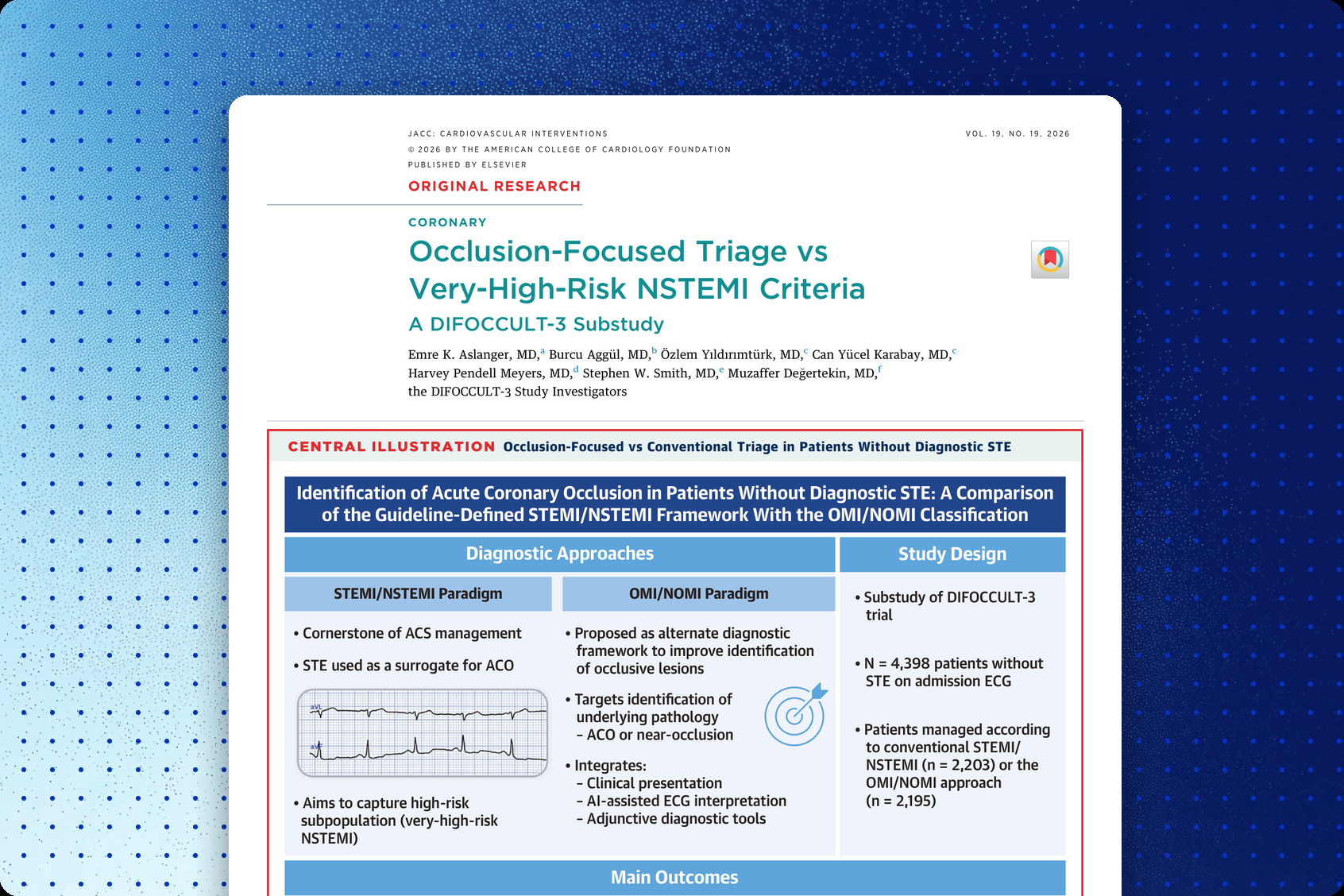
Acute coronary occlusion (ACO) can occur without diagnostic ST-segment elevation, and guideline very-high-risk NSTEMI criteria are meant to identify the patients who need immediate catheterization. This substudy of the cluster-randomized DIFOCCULT-3 trial compared that approach with occlusion-focused OMI/NOMI triage, supported by AI-assisted ECG interpretation with Queen of Hearts eOMI v1, in 4,398 patients without diagnostic ST elevation at 18 centers in Türkiye. Very-high-risk NSTEMI criteria flagged only 8.2% of patients in the conventional arm, and only 54.1% of them reached the cath lab within 2 hours. Under the OMI/NOMI approach, immediate invasive management (≤2 hours) rose from 21.4% to 43.7% and adjudicated ACO was identified within 2 hours in 35.1% vs 16.7% of patients, with no loss of angiographic yield (78.2% vs 75.2%).
Key findings
- Immediate invasive management within 2 hours occurred in 43.7% of patients under the OMI/NOMI approach versus 21.4% under STEMI/NSTEMI (absolute increase 22.3%; adjusted OR 2.37, 95% CI 1.93–2.90).
- Adjudicated acute coronary occlusion was identified within 2 hours in 35.1% vs 16.7% of patients (absolute increase 18.4%), about 1 additional early occlusion for every 6 patients managed under OMI/NOMI.
- Guideline very-high-risk NSTEMI criteria identified only 181 of 2,203 conventional-arm patients (8.2%), and only 54.1% of them received immediate invasive management.
- Angiographic yield was preserved: adjudicated occlusion was found in 78.2% vs 75.2% of patients undergoing immediate angiography (P = 0.201).
Published in: JACC Cardiovascular Interventions
Published on: 12 October 2026
Background
The STEMI/NSTEMI framework uses diagnostic ST-segment elevation (STE) to select patients for immediate reperfusion, but acute coronary occlusion (ACO) can occur without diagnostic STE and is then recognized and treated late. Guidelines recommend immediate invasive management for NSTEMI patients with very-high-risk features, yet these criteria are inconsistently applied in practice. The occlusion/non-occlusion myocardial infarction (OMI/NOMI) paradigm instead targets the underlying occlusion, integrating clinical presentation, subtle or dynamic ECG patterns, AI-assisted ECG interpretation and adjunctive testing. This substudy of the DIFOCCULT-3 trial asked whether the OMI/NOMI approach identifies patients with ACO earlier than guideline-defined very-high-risk NSTEMI criteria in patients without diagnostic STE.
Methods
DIFOCCULT-3 (NCT06570759) is a prospective, multicenter, modified cluster-randomized trial across 18 centers in Türkiye, in which interventional cardiology teams followed either the conventional STEMI/NSTEMI or the OMI/NOMI framework on rotating duty days. On OMI/NOMI days, teams actively assessed for ACO using a structured, hierarchical approach in which ECG evidence of occlusion, identified by the treating physician or supported by the AI application, was the principal trigger, with clinical features, very high troponin and bedside imaging as supportive triggers; all first responders had access to the Queen of Hearts eOMI v1 AI model (Powerful Medical), delivered as a smartphone application, which digitized ECGs and displayed "OMI" or "Not OMI". On STEMI/NSTEMI days the application was deactivated and standard practice was followed. This analysis included consecutive adults without diagnostic STE on the admission ECG (excluded by automated ECG analysis using universal thresholds). Very-high-risk NSTEMI was defined by European Society of Cardiology guidelines. The principal endpoints were immediate invasive management (first ECG-to-balloon time ≤2 hours) and adjudicated ACO identified within 2 hours; adjudicated ACO required TIMI flow grade 0–1, or grade 2 with acute culprit-lesion features, together with significant troponin elevation, reviewed by at least 2 interventional cardiologists. Team-clustered generalized estimating equations adjusted for age, sex, systolic blood pressure, heart rate, creatinine and hemoglobin.
Results
Of 6,007 patients enrolled in DIFOCCULT-3, 4,398 were included: 2,203 managed under STEMI/NSTEMI and 2,195 under OMI/NOMI. Immediate invasive management occurred in 472 of 2,203 patients (21.4%) in the STEMI/NSTEMI arm and 960 of 2,195 (43.7%) in the OMI/NOMI arm, an absolute increase of 22.3% (95% CI 19.6%–25.0%; P < 0.001; adjusted OR 2.37, 95% CI 1.93–2.90). In the conventional arm, 181 patients (8.2%) met very-high-risk NSTEMI criteria, of whom only 98 (54.1%) received immediate invasive management; a further 276 of the remaining 2,022 (13.6%) were taken for immediate catheterization as "suspected STEMI". Under OMI/NOMI, 997 of 2,195 patients (45.4%) were classified as OMI, with AI-assisted ECG interpretation by Queen of Hearts as the dominant diagnostic trigger in 817 of them (81.9%). Adjudicated ACO was identified within 2 hours in 355 of 2,128 patients (16.7%) under STEMI/NSTEMI and 751 of 2,138 (35.1%) under OMI/NOMI, an absolute increase of 18.4% (95% CI 15.9%–21.0%; P < 0.001), or roughly 1 additional early ACO for every 6 patients managed under OMI/NOMI. Per 1,000 patients, this corresponded to about 223 additional immediate invasive procedures and 184 additional ACOs detected within 2 hours. Angiographic yield did not fall: adjudicated ACO was found in 75.2% vs 78.2% of patients undergoing immediate angiography (P = 0.201). The authors note that the gain reflects the combined occlusion-focused strategy rather than AI alone.
Conclusion
In patients without diagnostic ST-segment elevation, guideline-defined very-high-risk NSTEMI criteria identified few patients and were inconsistently translated into immediate invasive management. The occlusion-focused OMI/NOMI approach was associated with substantially higher rates of immediate invasive management and earlier identification of patients with adjudicated acute coronary occlusion, without reducing angiographic yield. Whether this gain translates into better clinical outcomes awaits the planned 1-year outcome analysis of DIFOCCULT-3.
Share this article



About PMcardio
PMcardio is the market leader in AI-powered diagnostics, addressing the world’s leading cause of death – cardiovascular diseases. The innovative clinical assistant empowers healthcare professionals to detect up to 40 cardiovascular diseases. In the form of a smartphone application, the certified Class IIb medical device interprets any 12-lead ECG image in under 5 seconds to provide accurate diagnoses and individualized treatment recommendations tailored to each patient.

About Powerful Medical
Powerful Medical leads one of the most important shifts in modern medicine by augmenting human-made clinical decisions with artificial intelligence. Our primary focus is on cardiovascular diseases, the world’s leading cause of death.
Established in 2017, Powerful Medical has embarked on a mission to revolutionize the diagnosis and treatment of cardiovascular diseases. We are a medical company backed by 28 world-class cardiologists and led by our expert Scientific Board with decades of experience in daily patient care, clinical research, and medical devices. The results of our research are implemented, developed, certified, and brought to market by our 50+ strong interdisciplinary team of physicians, data scientists, AI experts, software engineers, regulatory specialists, and commercial teams.