
Improved Detection of Acute Coronary Occlusion Myocardial Infarction by an Artificial Intelligence Electrocardiogram Model in Swedish Emergency Departments
Overview
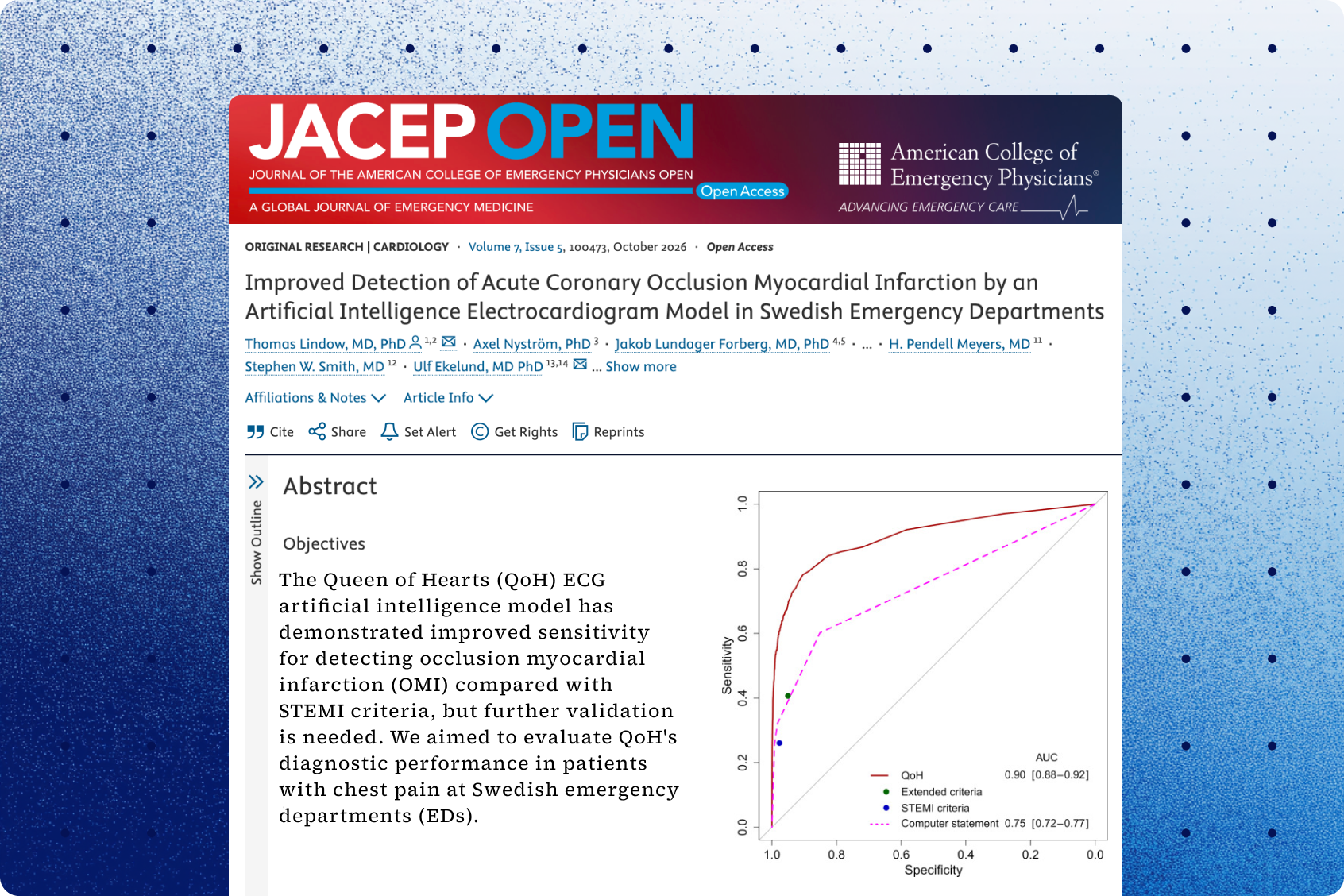
Conventional STEMI criteria miss a large share of acute coronary occlusion myocardial infarction (OMI), and large real-world validation of AI ECG models has been lacking. This retrospective diagnostic accuracy study, nested in the prospective ESC-TROP cohort, applied the Queen of Hearts (QoH) AI-ECG model to the first ECG of 24,511 consecutive chest pain patients presenting to five emergency departments in southern Sweden, 467 of whom (1.9%) had adjudicated OMI. QoH more than doubled sensitivity compared with conventional STEMI criteria (52% [47 to 57] vs 23% [19 to 27]) at similar specificity (99% vs 98%) and with a threefold higher positive predictive value (51% vs 17%), and it also outperformed extended STEMI criteria (41%) and the Glasgow computer statement (32%). Among the 360 OMI patients who did not meet STEMI criteria, QoH correctly identified 143 (40%).
Key findings
- Among 24,511 consecutive chest pain patients at 5 Swedish emergency departments, 467 (1.9%) had adjudicated occlusion myocardial infarction, and Queen of Hearts detected 52% (95% CI 47 to 57) of them versus 23% (19 to 27) for conventional STEMI criteria.
- Queen of Hearts increased sensitivity by 29 percentage points (22 to 35) over STEMI criteria, 12 percentage points (5 to 19) over extended STEMI criteria, and 21 percentage points (14 to 27) over the Glasgow computer statement.
- Specificity matched STEMI criteria (99% [99 to 99] vs 98% [98 to 98]) while positive predictive value tripled (51% [47 to 54] vs 17% [15 to 20]); the AUC for the continuous Queen of Hearts output was 0.90 (0.88 to 0.92).
- Among the 360 OMI patients who did not meet STEMI criteria, Queen of Hearts correctly identified 143 (40%), while incorrectly flagging only 188 of 23,540 (0.8%) STEMI-negative patients without OMI.
Published in: Journal of the American College of Emergency Physicians Open (JACEP Open)
Published on: 14 August 2026
Background
ST-segment elevation is an insensitive marker of acute coronary occlusion, so a substantial proportion of occlusion myocardial infarction (OMI) is not identified by conventional STEMI criteria. The Queen of Hearts (QoH) AI ECG model, developed from more than 18,000 ECGs using angiographic outcomes as the reference, has shown improved sensitivity for OMI compared with STEMI criteria, but further validation in large, unselected emergency department (ED) populations was needed. This study evaluated QoH's diagnostic performance in ED patients with chest pain in Sweden.
Methods
This retrospective diagnostic accuracy study was nested in the prospective ESC-TROP cohort and included consecutive patients with nontraumatic chest pain presenting to 5 EDs in southern Sweden between February and November of 2017 and 2018. Patients taken directly from the prehospital setting to the coronary care unit were not included. Of 26,545 unique patients, 24,511 with an acceptable first ECG and adequate register data were analyzed. OMI was classified by multistep adjudication blinded to all ECG results, using SCAAR and SWEDEHEART angiographic data (acute culprit lesion with TIMI flow 0 or 1) plus high-sensitivity troponin T criteria. The QoH software (aOMI v1) was applied by Powerful Medical, blinded to the adjudicated classification, and compared with conventional STEMI criteria, extended STEMI criteria (additional ECG leads, modified Sgarbossa criteria for left bundle branch block, and left ventricular hypertrophy criteria), and the Glasgow ECG Analysis Algorithm computer statement.
Results
Among 24,511 patients (mean age 59 ± 19 years, 52% male), 467 (1.9%) had OMI. QoH achieved higher sensitivity than STEMI criteria (52% [47 to 57] vs 23% [19 to 27]), similar specificity (99% [99 to 99] vs 98% [98 to 98]), higher positive predictive value (51% [47 to 54] vs 17% [15 to 20]), and similar negative predictive value (99% [99 to 99]). The Glasgow computer statement reached 32% (28 to 37) sensitivity and 26% (23 to 30) PPV, and the extended STEMI criteria 41% (36 to 45) sensitivity and 14% (12 to 15) PPV at 95% (95 to 96) specificity. QoH increased sensitivity by 29 percentage points (22 to 35) over STEMI criteria, 12 percentage points (5 to 19) over extended STEMI criteria, and 21 percentage points (14 to 27) over the computer statement, with the highest positive likelihood ratio (53 [45 to 62]) and diagnostic odds ratio (109 [87 to 136]) of all methods. Among the 360 OMI patients who did not meet STEMI criteria, QoH correctly identified 143 (40%), while incorrectly classifying 188 of 23,540 (0.8%) STEMI-negative patients without OMI. The AUC for the continuous QoH output was 0.90 (0.88 to 0.92), and 0.82 (0.76 to 0.89) in the subset with left ventricular hypertrophy, left bundle branch block, or a paced rhythm. Among the 243 OMI patients identified by QoH, only 21 underwent coronary angiography within 90 minutes of the ECG, with a median time from ECG to angiography of 2.8 hours (IQR 2.1 to 4.9) versus 19 hours (7 to 33) in QoH-negative OMI patients.
Conclusion
In ED patients with chest pain, Queen of Hearts improved sensitivity in OMI detection compared with currently available ECG criteria, with similar specificity. In one of the largest real-world validations of this technology to date, AI-powered ECG analysis has the potential to reduce the number of missed acute coronary occlusions in emergency care.
Share this article



About PMcardio
PMcardio is the market leader in AI-powered diagnostics, addressing the world’s leading cause of death – cardiovascular diseases. The innovative clinical assistant empowers healthcare professionals to detect up to 40 cardiovascular diseases. In the form of a smartphone application, the certified Class IIb medical device interprets any 12-lead ECG image in under 5 seconds to provide accurate diagnoses and individualized treatment recommendations tailored to each patient.

About Powerful Medical
Powerful Medical leads one of the most important shifts in modern medicine by augmenting human-made clinical decisions with artificial intelligence. Our primary focus is on cardiovascular diseases, the world’s leading cause of death.
Established in 2017, Powerful Medical has embarked on a mission to revolutionize the diagnosis and treatment of cardiovascular diseases. We are a medical company backed by 28 world-class cardiologists and led by our expert Scientific Board with decades of experience in daily patient care, clinical research, and medical devices. The results of our research are implemented, developed, certified, and brought to market by our 50+ strong interdisciplinary team of physicians, data scientists, AI experts, software engineers, regulatory specialists, and commercial teams.