
High epicardial fat volume is associated with atrial fibrillation recurrences after catheter ablation
Overview
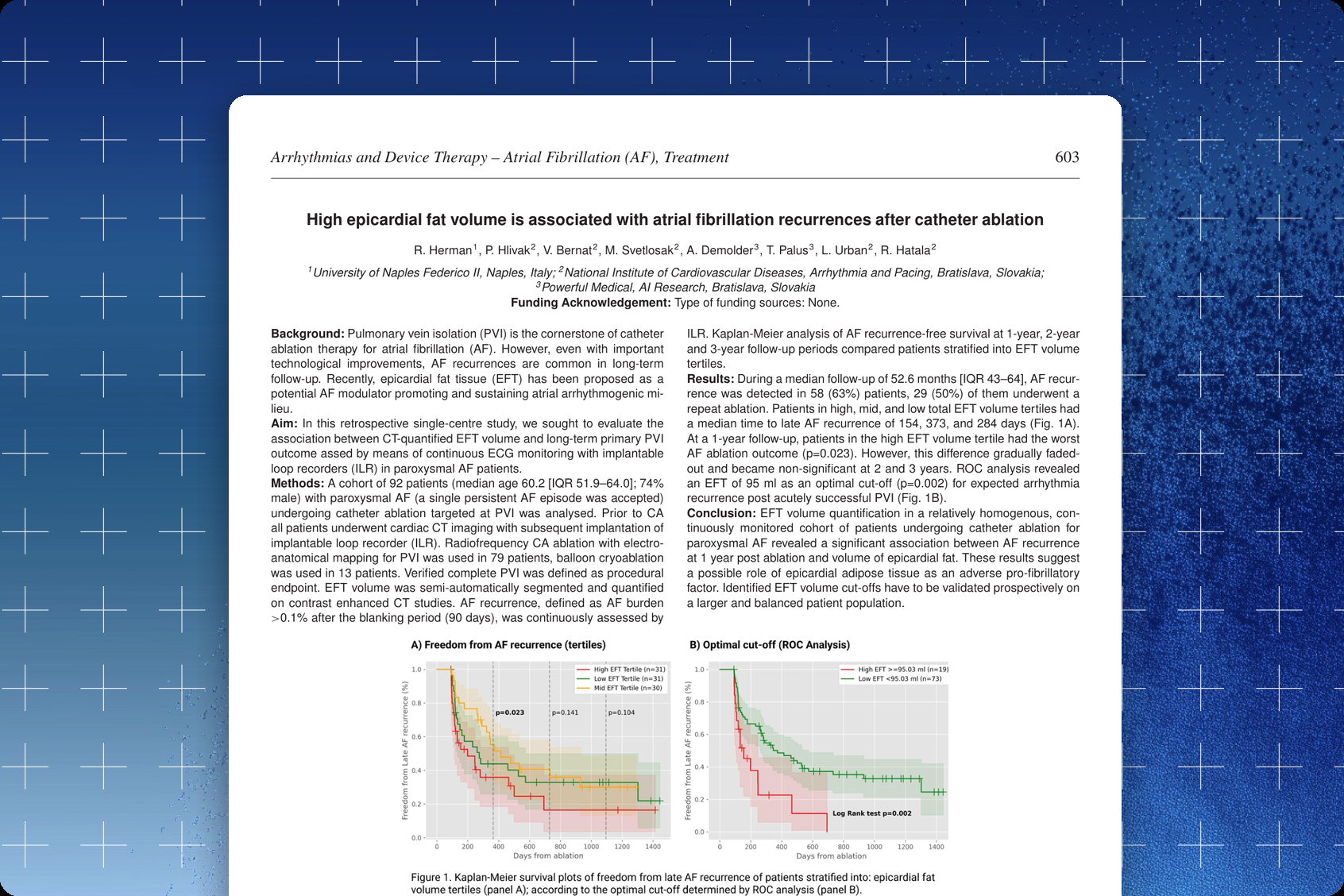
This retrospective single-center study, by investigators from the National Institute of Cardiovascular Diseases in Bratislava, Slovakia, and Powerful Medical, examined whether the volume of epicardial fat measured on cardiac CT is linked to atrial fibrillation (AF) recurrence after catheter ablation. All 92 patients with paroxysmal AF had cardiac CT and received an implantable loop recorder before pulmonary vein isolation, allowing continuous rhythm monitoring. Over a median follow-up of 52.6 months, AF recurred in 58 patients (63%), and those in the highest epicardial fat tertile had the worst outcome at 1 year (p=0.023), although the difference was no longer significant at 2 and 3 years. ROC analysis identified an epicardial fat volume of 95 ml as the optimal cut-off for predicting recurrence (p=0.002).
Key findings
- AF recurrence (AF burden >0.1% after a 90-day blanking period) was detected by implantable loop recorder in 58 of 92 patients (63%) over a median follow-up of 52.6 months; 29 of them (50%) underwent a repeat ablation.
- Median time to late AF recurrence was 154, 373 and 284 days in the high, mid and low epicardial fat volume tertiles, respectively.
- At 1 year, patients in the highest epicardial fat volume tertile had the worst ablation outcome (p=0.023); the difference faded and was no longer significant at 2 and 3 years.
- ROC analysis identified an epicardial fat volume of 95 ml as the optimal cut-off for expected AF recurrence after acutely successful pulmonary vein isolation (p=0.002).
Published in: ESC Congress 2022, Barcelona; abstract published in European Heart Journal, Volume 43, Supplement 2
Published on: 26 August 2022
Background
Pulmonary vein isolation (PVI) is the cornerstone of catheter ablation therapy for atrial fibrillation (AF). Even with important technological improvements, AF recurrences are common during long-term follow-up. Epicardial fat tissue has recently been proposed as a potential AF modulator that promotes and sustains an arrhythmogenic atrial milieu. In this retrospective single-center study, the authors evaluated the association between CT-quantified epicardial fat volume and the long-term outcome of a first PVI, assessed by continuous ECG monitoring with implantable loop recorders in patients with paroxysmal AF.
Methods
The study analyzed 92 patients (median age 60.2 years [IQR 51.9–64.0]; 74% male) with paroxysmal AF (a single persistent AF episode was accepted) undergoing catheter ablation targeting PVI. Before ablation, all patients underwent cardiac CT imaging followed by implantation of an implantable loop recorder. Radiofrequency ablation with electroanatomical mapping was used in 79 patients and balloon cryoablation in 13 patients, with verified complete PVI as the procedural endpoint. Epicardial fat volume was semi-automatically segmented and quantified on contrast-enhanced CT. AF recurrence, defined as an AF burden >0.1% after a 90-day blanking period, was continuously assessed by the loop recorder. Kaplan-Meier analysis compared AF recurrence-free survival at 1, 2 and 3 years between patients stratified into epicardial fat volume tertiles.
Results
During a median follow-up of 52.6 months (IQR 43–64), AF recurrence was detected in 58 patients (63%), and 29 of them (50%) underwent a repeat ablation. Patients in the high, mid and low total epicardial fat volume tertiles had a median time to late AF recurrence of 154, 373 and 284 days, respectively. At 1 year, patients in the high epicardial fat volume tertile had the worst ablation outcome (p=0.023); this difference gradually faded and became non-significant at 2 and 3 years. ROC analysis identified an epicardial fat volume of 95 ml as the optimal cut-off (p=0.002) for expected arrhythmia recurrence after acutely successful PVI.
Conclusion
In a relatively homogeneous, continuously monitored cohort of patients undergoing catheter ablation for paroxysmal AF, epicardial fat volume was significantly associated with AF recurrence at 1 year after ablation. These results suggest a possible role of epicardial adipose tissue as an adverse pro-fibrillatory factor. The identified epicardial fat volume cut-offs have to be validated prospectively in a larger and balanced patient population.
Share this article



About PMcardio
PMcardio is the market leader in AI-powered diagnostics, addressing the world’s leading cause of death – cardiovascular diseases. The innovative clinical assistant empowers healthcare professionals to detect up to 40 cardiovascular diseases. In the form of a smartphone application, the certified Class IIb medical device interprets any 12-lead ECG image in under 5 seconds to provide accurate diagnoses and individualized treatment recommendations tailored to each patient.

About Powerful Medical
Powerful Medical leads one of the most important shifts in modern medicine by augmenting human-made clinical decisions with artificial intelligence. Our primary focus is on cardiovascular diseases, the world’s leading cause of death.
Established in 2017, Powerful Medical has embarked on a mission to revolutionize the diagnosis and treatment of cardiovascular diseases. We are a medical company backed by 28 world-class cardiologists and led by our expert Scientific Board with decades of experience in daily patient care, clinical research, and medical devices. The results of our research are implemented, developed, certified, and brought to market by our 50+ strong interdisciplinary team of physicians, data scientists, AI experts, software engineers, regulatory specialists, and commercial teams.