
Deep learning for mortality prediction in patients with a de-novo or worsened heart failure
Overview
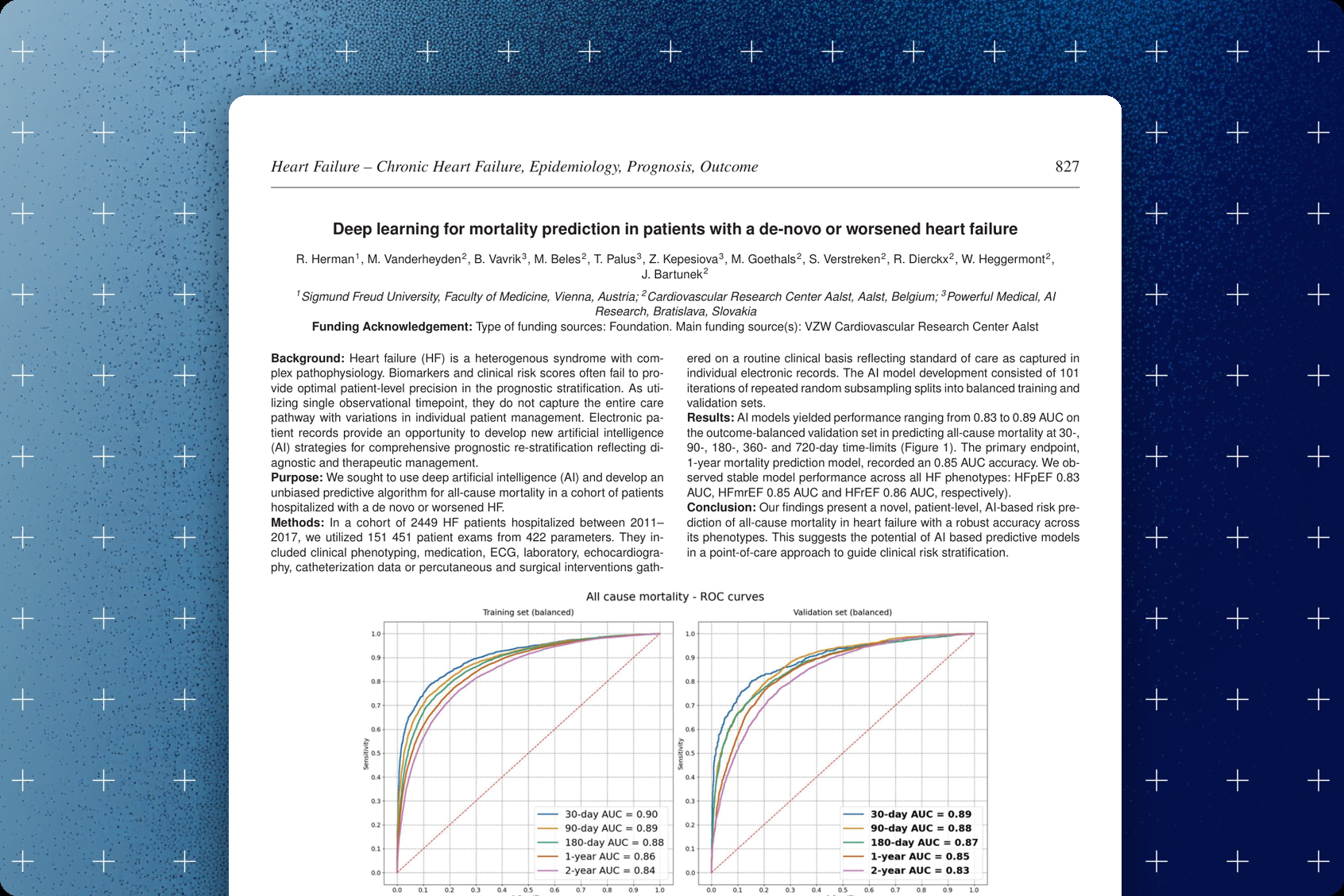
This study used deep learning on routine electronic patient records to predict all-cause mortality in 2,449 patients hospitalized with de novo or worsened heart failure between 2011 and 2017. The models drew on 151,451 patient exams covering 422 parameters, including clinical phenotyping, medication, ECG, laboratory, echocardiography and catheterization data, and percutaneous and surgical interventions. On an outcome-balanced validation set, the models predicted mortality at time limits from 30 days to 2 years with AUCs of 0.83 to 0.89, and the primary 1-year mortality model reached an AUC of 0.85. Performance was stable across heart failure phenotypes (HFpEF 0.83, HFmrEF 0.85 and HFrEF 0.86).
Key findings
- Deep-learning models predicted all-cause mortality at 30, 90, 180, 360 and 720 days with AUCs ranging from 0.83 to 0.89 on the outcome-balanced validation set.
- The primary endpoint model, predicting 1-year all-cause mortality, reached an AUC of 0.85.
- Performance was stable across heart failure phenotypes, with AUCs of 0.83 in HFpEF, 0.85 in HFmrEF and 0.86 in HFrEF.
- The models were built from 151,451 routine patient exams covering 422 parameters in 2,449 patients hospitalized with heart failure between 2011 and 2017.
Published in: ESC Congress 2021 – The Digital Experience; abstract published in European Heart Journal, Volume 42, Supplement 1
Published on: 27 August 2021
Background
Heart failure is a heterogeneous syndrome with complex pathophysiology. Biomarkers and clinical risk scores often fail to provide optimal patient-level precision in prognostic stratification: because they rely on a single observational timepoint, they do not capture the entire care pathway or the variations in individual patient management. Electronic patient records offer an opportunity to develop new artificial intelligence (AI) strategies for comprehensive prognostic re-stratification that reflect diagnostic and therapeutic management. The authors set out to use deep learning to develop an unbiased predictive algorithm for all-cause mortality in patients hospitalized with de novo or worsened heart failure.
Methods
The cohort included 2,449 patients with heart failure hospitalized between 2011 and 2017. The authors used 151,451 patient exams covering 422 parameters, including clinical phenotyping, medication, ECG, laboratory, echocardiography and catheterization data, and percutaneous and surgical interventions, all gathered on a routine clinical basis as standard of care and captured in individual electronic records. Model development consisted of 101 iterations of repeated random subsampling splits into balanced training and validation sets. Models were trained to predict all-cause mortality at 30, 90, 180, 360 and 720 days, with 1-year mortality as the primary endpoint.
Results
On the outcome-balanced validation set, the AI models predicted all-cause mortality at the 30-, 90-, 180-, 360- and 720-day time limits with AUCs ranging from 0.83 to 0.89. The primary endpoint model, predicting 1-year mortality, reached an AUC of 0.85. Model performance was stable across all heart failure phenotypes: AUC 0.83 in heart failure with preserved ejection fraction (HFpEF), 0.85 in heart failure with mildly reduced ejection fraction (HFmrEF) and 0.86 in heart failure with reduced ejection fraction (HFrEF).
Conclusion
These findings present a novel, patient-level, AI-based prediction of all-cause mortality in heart failure with robust accuracy across its phenotypes, suggesting the potential of AI-based predictive models in a point-of-care approach to guide clinical risk stratification.
Share this article



About PMcardio
PMcardio is the market leader in AI-powered diagnostics, addressing the world’s leading cause of death – cardiovascular diseases. The innovative clinical assistant empowers healthcare professionals to detect up to 40 cardiovascular diseases. In the form of a smartphone application, the certified Class IIb medical device interprets any 12-lead ECG image in under 5 seconds to provide accurate diagnoses and individualized treatment recommendations tailored to each patient.

About Powerful Medical
Powerful Medical leads one of the most important shifts in modern medicine by augmenting human-made clinical decisions with artificial intelligence. Our primary focus is on cardiovascular diseases, the world’s leading cause of death.
Established in 2017, Powerful Medical has embarked on a mission to revolutionize the diagnosis and treatment of cardiovascular diseases. We are a medical company backed by 28 world-class cardiologists and led by our expert Scientific Board with decades of experience in daily patient care, clinical research, and medical devices. The results of our research are implemented, developed, certified, and brought to market by our 50+ strong interdisciplinary team of physicians, data scientists, AI experts, software engineers, regulatory specialists, and commercial teams.