

AI-Enhanced ECG Detection of Left Ventricular Systolic Dysfunction in a German Cohort
Overview
Reduced left ventricular ejection fraction (LVEF) often goes undiagnosed until heart failure is advanced, because echocardiography is resource-intensive and not always at hand. Investigators at TUM Klinikum Munich externally validated two PMcardio LVsense AI-ECG models (Powerful Medical), for LVEF <50% and LVEF ≤40%, in an all-comer cohort of 5,012 adults with a 12-lead ECG and a transthoracic echocardiogram (TTE) within 7 days. The LVEF ≤40% model reached an AUC of 0.923 with 90.8% sensitivity and a negative predictive value of 99.1%, and the LVEF <50% model reached an AUC of 0.879. Performance held across most clinically relevant subgroups, supporting a rule-out and screening role, while positive results still need confirmatory echocardiography.
Key findings
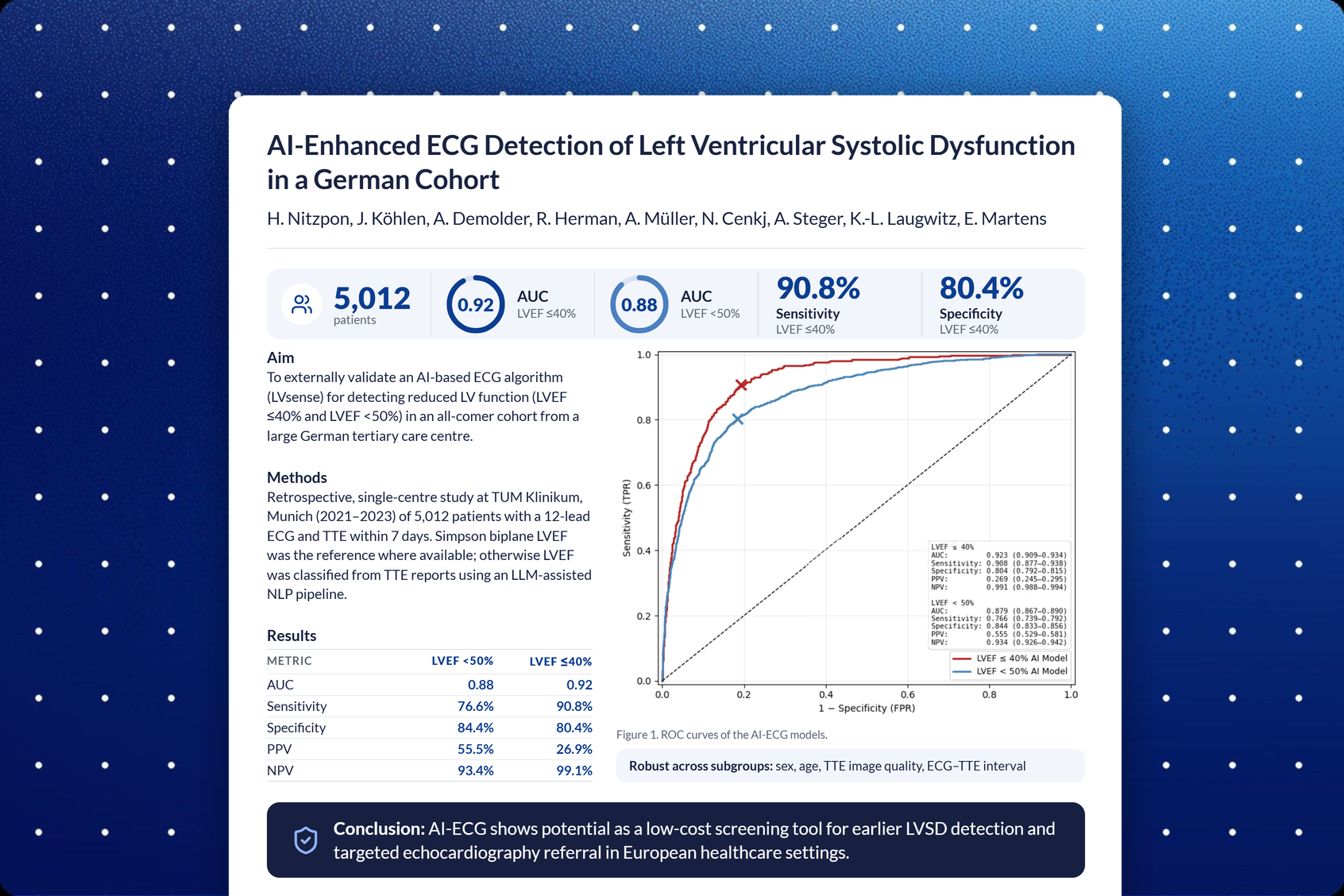
- The LVEF ≤40% model detected reduced ejection fraction with an AUC of 0.923 (95% CI 0.909–0.934), sensitivity 90.8% and specificity 80.4% in 5,012 patients.
- A negative AI-ECG result was correct 99.1% of the time for LVEF ≤40% and 93.4% of the time for LVEF <50%, supporting a rule-out role; PPV was 26.9% and 55.5% at a prevalence of 7.4% and 20.3%.
- The LVEF <50% model reached an AUC of 0.879 (95% CI 0.867–0.890), with sensitivity 76.6% and specificity 84.4%.
- Performance was similar in women and men (LVEF ≤40% AUC 0.927 vs 0.918) and held in patients aged 80 or older (AUC 0.895), in a real-world cohort with a mean age of 64.8 years.
Published in: 19th Annual Congress of the European Cardiac Arrhythmia Society (ECAS 2026), Munich
Published on: 11 May 2026
Background
Heart failure is a leading cause of morbidity and mortality, and left ventricular systolic dysfunction (LVSD) often remains undiagnosed until advanced stages. Echocardiographic measurement of left ventricular ejection fraction (LVEF) is central to the diagnosis, classification and treatment of heart failure, but it is resource-intensive and not universally accessible. Deep learning models can detect signs of reduced LVEF from the standard 12-lead ECG, yet external validation in European populations remains limited. This study externally validated the PMcardio LVsense AI-ECG models (Powerful Medical) for detecting reduced LVEF in an all-comer cohort from a large German tertiary care centre.
Methods
In this retrospective, single-centre study at TUM Klinikum (Munich, Germany), adults with a standard 12-lead ECG and a transthoracic echocardiogram (TTE) performed within 7 days of each other between 2021 and 2023 were included. Of 9,176 ECG–TTE pairs, those without a valid LVEF label or model prediction, or with insufficient ECG or TTE quality, were excluded, and one pair per patient (the shortest ECG–TTE interval) was kept, leaving 5,012 patients. LVEF measured by the Simpson biplane method was the reference standard where available (29.5%); otherwise, the LVEF category was taken from the visual assessment in the TTE report (70.5%), extracted from free-text reports with an LLM-assisted pipeline. Two models were tested: Model 1 for LVEF <50% and Model 2 for LVEF ≤40%. The primary endpoint was diagnostic accuracy (AUROC, sensitivity, specificity, PPV and NPV, with bootstrapped 95% CIs), and pre-specified subgroup analyses covered sex, age, reference standard, TTE image quality, ECG–TTE interval, referring department and ECG rhythm.
Results
The final cohort comprised 5,012 patients (mean age 64.8 ± 16.9 years; 40.2% female), of whom 1,015 (20.3%) had LVEF <50% and 370 (7.4%) had LVEF ≤40%. The LVEF ≤40% model achieved an AUC of 0.923 (95% CI 0.909–0.934), sensitivity 90.8% (87.7–93.8%), specificity 80.4% (79.2–81.5%), PPV 26.9% (24.5–29.5%) and NPV 99.1% (98.8–99.4%). The LVEF <50% model achieved an AUC of 0.879 (0.867–0.890), sensitivity 76.6% (73.9–79.2%), specificity 84.4% (83.3–85.6%), PPV 55.5% (52.9–58.1%) and NPV 93.4% (92.6–94.2%). Performance was consistent between women and men (LVEF ≤40% AUC 0.927 vs 0.918) and across age groups, including patients aged 80 or older (AUC 0.895), and remained high in the subset with Simpson biplane measurements (LVEF ≤40% AUC 0.868; LVEF <50% AUC 0.863). In patients referred for a pre-chemotherapy or pre-radiotherapy check (n = 486), NPV for LVEF ≤40% was 99.6%.
Conclusion
AI-ECG shows potential as a low-cost screening tool for earlier LVSD detection and targeted echocardiography referral in European healthcare settings.
Share this article



About PMcardio
PMcardio is the market leader in AI-powered diagnostics, addressing the world’s leading cause of death – cardiovascular diseases. The innovative clinical assistant empowers healthcare professionals to detect up to 40 cardiovascular diseases. In the form of a smartphone application, the certified Class IIb medical device interprets any 12-lead ECG image in under 5 seconds to provide accurate diagnoses and individualized treatment recommendations tailored to each patient.

About Powerful Medical
Powerful Medical leads one of the most important shifts in modern medicine by augmenting human-made clinical decisions with artificial intelligence. Our primary focus is on cardiovascular diseases, the world’s leading cause of death.
Established in 2017, Powerful Medical has embarked on a mission to revolutionize the diagnosis and treatment of cardiovascular diseases. We are a medical company backed by 28 world-class cardiologists and led by our expert Scientific Board with decades of experience in daily patient care, clinical research, and medical devices. The results of our research are implemented, developed, certified, and brought to market by our 50+ strong interdisciplinary team of physicians, data scientists, AI experts, software engineers, regulatory specialists, and commercial teams.