
AI-ECG Detection of Reduced Ejection Fraction After Acute Coronary Syndrome: A Prospective Multicentre Validation of LVsense
Overview
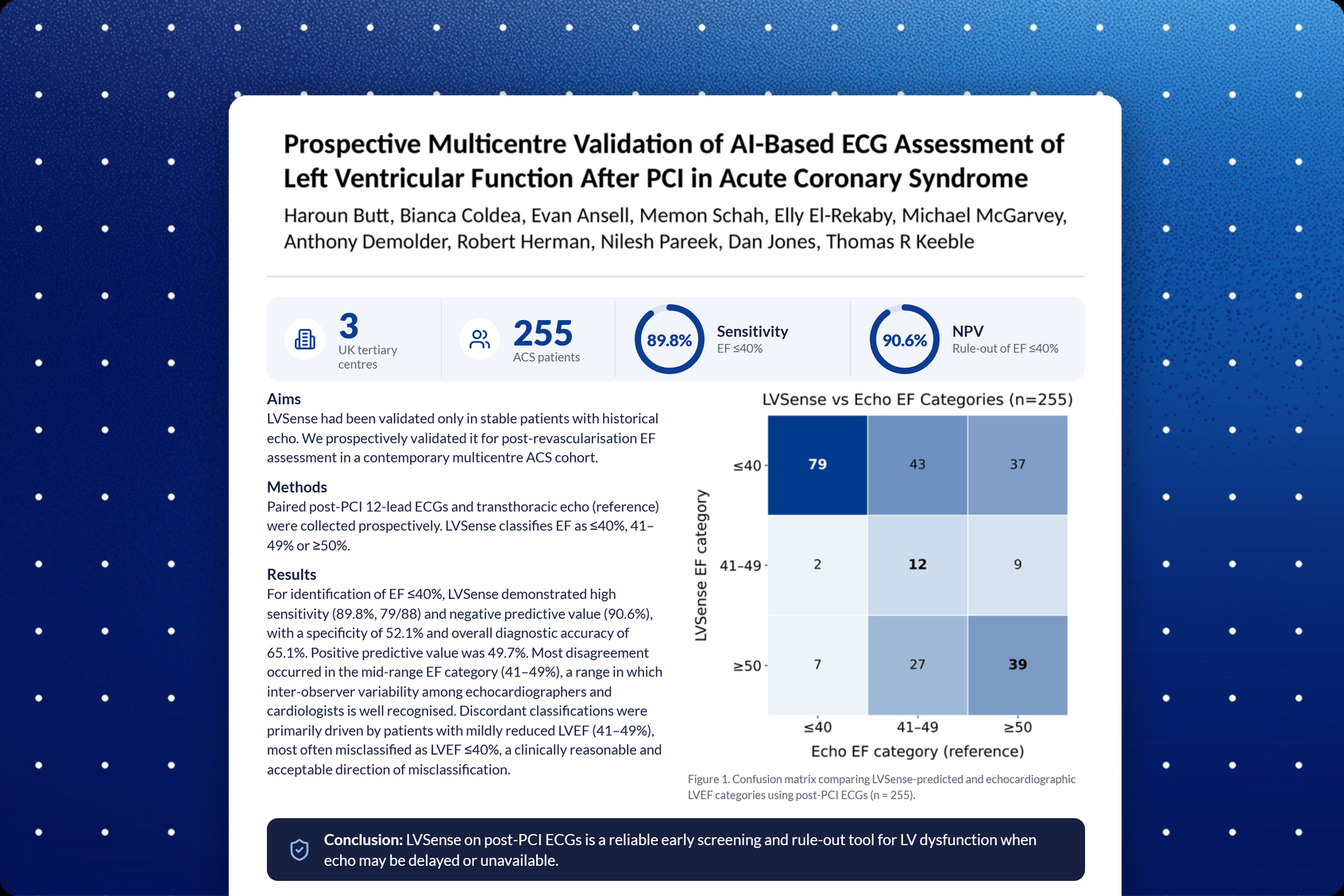
Finding out early which patients have a weakened heart after an acute coronary syndrome (ACS) guides treatment and follow-up, but echocardiography is not always available straight away. This prospective study at three high-volume UK cardiac centres applied the PMcardio LVsense AI-ECG model to the 12-lead ECG recorded after coronary stenting (PCI) in 255 ACS patients and compared it with echocardiography. For identifying an ejection fraction (EF) of 40% or lower, LVsense had a sensitivity of 89.8% and a negative predictive value of 90.6%, with a specificity of 52.1%. Most disagreements were patients with mildly reduced EF (41–49%) classified as ≤40%, supporting LVsense as an early screening and rule-out tool after revascularisation.
Key findings
- LVsense identified 79 of 88 patients with EF ≤40% on echocardiography (sensitivity 89.8%).
- A negative LVsense result was correct in 90.6% of cases (NPV), supporting its use as a rule-out tool after PCI.
- Specificity was 52.1%, PPV 49.7% and overall accuracy 65.1% for EF ≤40%.
- Agreement across all three EF categories was fair (quadratic weighted κ 0.36, 95% CI 0.26–0.46), with most disagreement in the 41–49% range.
Published in: EuroPCR 2026
Published on: 19 May 2026
Background
Timely identification of left ventricular (LV) dysfunction after an acute coronary syndrome (ACS) is critical: it allows early start and optimisation of guideline-directed medical therapy, informs inpatient management and guides follow-up planning. LVsense is an artificial intelligence–based ECG tool developed by PMcardio to estimate LV function, but its performance had previously been validated only in stable patient populations with historical echocardiography. This study aimed to prospectively validate LVsense for post-revascularisation ejection fraction (EF) assessment in a contemporary multicentre ACS cohort.
Methods
At three high-volume tertiary cardiac centres in the United Kingdom, paired post-percutaneous coronary intervention (PCI) 12-lead ECGs and transthoracic echocardiograms were collected prospectively in patients presenting with ACS. The LVsense AI-ECG algorithm was applied to the post-PCI ECGs and compared with echocardiographic left ventricular ejection fraction (EF) as the reference standard. LVsense stratifies EF into three categories: ≤40%, 41–49% and ≥50%.
Results
A total of 255 patients with paired post-PCI ECG and echocardiographic EF were included. Seventy-five percent presented with ST-elevation myocardial infarction, 73% were male, the median peak troponin was 1,479 ng/L (IQR 303–5,454), and the left anterior descending artery was the culprit vessel in 37%. About one-third of patients (88) had impaired LV function (EF ≤40%) on echocardiography.
For identification of EF ≤40%, LVsense had a sensitivity of 89.8% (79/88) and a negative predictive value of 90.6%, with a specificity of 52.1%, a positive predictive value of 49.7% and an overall diagnostic accuracy of 65.1%. Agreement between LVsense and echocardiography across all three EF categories was fair (quadratic weighted Cohen's κ = 0.36, 95% CI 0.26–0.46). Most disagreement occurred in the mid-range EF category (41–49%), a range in which inter-observer variability among echocardiographers and cardiologists is well recognised. Discordant classifications were driven mainly by patients with mildly reduced EF (41–49%), most often classified by LVsense as EF ≤40%, a clinically acceptable direction of misclassification.
Conclusion
In a prospective multicentre ACS cohort, LVsense applied to post-PCI ECGs showed high sensitivity and negative predictive value for identifying clinically significant LV dysfunction. These findings support its role as an early screening and rule-out tool after coronary revascularisation. Future studies should assess whether apparent misclassifications represent true error or instead provide prognostic insight into later recovery or deterioration of LV function.
Share this article



About PMcardio
PMcardio is the market leader in AI-powered diagnostics, addressing the world’s leading cause of death – cardiovascular diseases. The innovative clinical assistant empowers healthcare professionals to detect up to 40 cardiovascular diseases. In the form of a smartphone application, the certified Class IIb medical device interprets any 12-lead ECG image in under 5 seconds to provide accurate diagnoses and individualized treatment recommendations tailored to each patient.

About Powerful Medical
Powerful Medical leads one of the most important shifts in modern medicine by augmenting human-made clinical decisions with artificial intelligence. Our primary focus is on cardiovascular diseases, the world’s leading cause of death.
Established in 2017, Powerful Medical has embarked on a mission to revolutionize the diagnosis and treatment of cardiovascular diseases. We are a medical company backed by 28 world-class cardiologists and led by our expert Scientific Board with decades of experience in daily patient care, clinical research, and medical devices. The results of our research are implemented, developed, certified, and brought to market by our 50+ strong interdisciplinary team of physicians, data scientists, AI experts, software engineers, regulatory specialists, and commercial teams.