
Artificial intelligence enhanced ECG to detect reduced LVEF: clinical significance of false positive and false negative AI-ECG classifications
Overview
This retrospective study from Sapienza University of Rome, the Cardiovascular Research Center Aalst and Powerful Medical examined what happens to patients whose AI-ECG result for reduced left ventricular ejection fraction (LVEF below 50%) disagrees with echocardiography. Using a previously validated AI-ECG algorithm (PMcardio LVsense), 528 patients were selected into four matched groups of true negatives, false positives, false negatives and true positives and followed for a median of 4.5 years. Cardiovascular death or heart failure hospitalization occurred in 59 patients (13%) and was least frequent in true negatives. Among patients with normal LVEF at baseline, 37% of false positives versus 9% of true negatives went on to develop LVEF below 50%, and the AI-ECG classification independently predicted this decline (HR 3.78), whereas global longitudinal strain did not.
Key findings
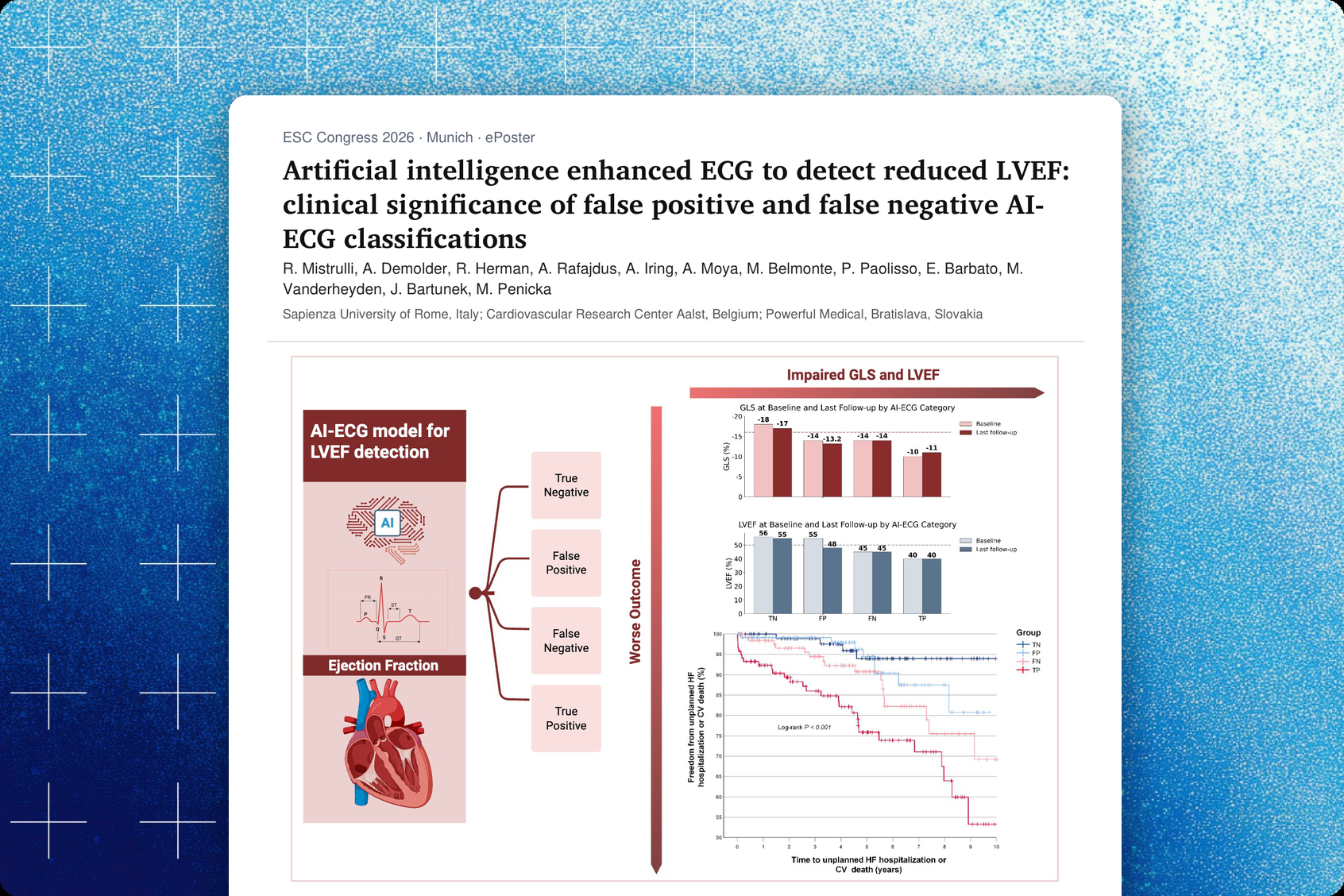
- Over a median follow-up of 4.5 years, the composite of cardiovascular death and heart failure hospitalization occurred in 59 of 528 patients (13%), with a significantly lower incidence in true negatives than in the other three groups (log-rank p<0.001).
- Among patients with normal baseline LVEF, 49 of 131 false positives (37%) versus 12 of 130 true negatives (9%) developed overt systolic dysfunction with LVEF below 50% (p<0.001).
- AI-ECG classification independently predicted a future drop in LVEF (HR 3.78, 95% CI 1.74–8.23, p=0.001), whereas global longitudinal strain did not.
- Global longitudinal strain at baseline was preserved only in true negatives (18%) and worsened progressively across false positives (14%), false negatives (14%) and true positives (10%) (p<0.001).
Published in: ESC Congress 2026 – presented as a moderated ePoster
Published on: 28 August 2026
Background
Artificial intelligence has been shown to enhance the diagnostic capabilities of the electrocardiogram (AI-ECG), enabling the detection of reduced left ventricular ejection fraction (LVEF). This study investigated the clinical and prognostic implications of AI-ECG misclassifications, that is, false positive (FP) and false negative (FN) results, of a previously validated AI-ECG algorithm detecting reduced LVEF (below 50%) on echocardiography.
Methods
The study population was an independent retrospective cohort of 528 patients (median age 68 [56–77] years, 40% women) made up of four matched groups defined by the agreement between paired AI-ECG predictions (PMcardio LVsense) and Simpson's biplane LVEF assessments: true negative (TN), FP, FN and true positive (TP). Outcomes were a composite of cardiovascular death and hospitalization for heart failure and, in patients with normal LVEF at baseline (FP and TN), the development of reduced LVEF (below 50%) during follow-up.
Results
At baseline, LVEF was normal in FP (55%) and TN (56%) patients and impaired in FN (45%) and TP (40%) patients (p<0.001). In contrast, global longitudinal strain (GLS) was preserved only in TN patients (18%) and progressively worsened across FP (14%), FN (14%) and TP (10%) patients (p<0.001). During a median follow-up of 4.5 years (IQR 2.8–6.5), the composite endpoint occurred in 59 patients (13%), with a significantly lower incidence in the TN group than in the other three groups (log-rank p<0.001). In multivariable Cox analysis, impaired LVEF or GLS and higher age were the only independent predictors of the composite endpoint (all p<0.05). During follow-up, 49 of 131 FP patients (37%) versus only 12 of 130 TN patients (9%) developed overt systolic dysfunction with LVEF below 50% (p<0.001). The main causes of LVEF decline were valvular heart disease (28.6%), atrial fibrillation (26.8%) and coronary artery disease (23.2%). In Cox regression analysis, the AI-ECG classification was an independent predictor of a future drop in LVEF (HR 3.78, 95% CI 1.74–8.23, p=0.001), whereas GLS was not.
Conclusion
AI-ECG misclassifications are clinically relevant. Patients with a false-positive result have an increased risk of developing overt left ventricular dysfunction with adverse outcomes, warranting close clinical follow-up. A false-negative classification is associated with worse outcomes driven by left ventricular dysfunction not recognized by the AI-ECG, but the prevalence of false negatives is low.
Share this article



About PMcardio
PMcardio is the market leader in AI-powered diagnostics, addressing the world’s leading cause of death – cardiovascular diseases. The innovative clinical assistant empowers healthcare professionals to detect up to 40 cardiovascular diseases. In the form of a smartphone application, the certified Class IIb medical device interprets any 12-lead ECG image in under 5 seconds to provide accurate diagnoses and individualized treatment recommendations tailored to each patient.

About Powerful Medical
Powerful Medical leads one of the most important shifts in modern medicine by augmenting human-made clinical decisions with artificial intelligence. Our primary focus is on cardiovascular diseases, the world’s leading cause of death.
Established in 2017, Powerful Medical has embarked on a mission to revolutionize the diagnosis and treatment of cardiovascular diseases. We are a medical company backed by 28 world-class cardiologists and led by our expert Scientific Board with decades of experience in daily patient care, clinical research, and medical devices. The results of our research are implemented, developed, certified, and brought to market by our 50+ strong interdisciplinary team of physicians, data scientists, AI experts, software engineers, regulatory specialists, and commercial teams.