
AI-enhanced ECG screening for LV systolic dysfunction in the Framingham Heart Study
Overview
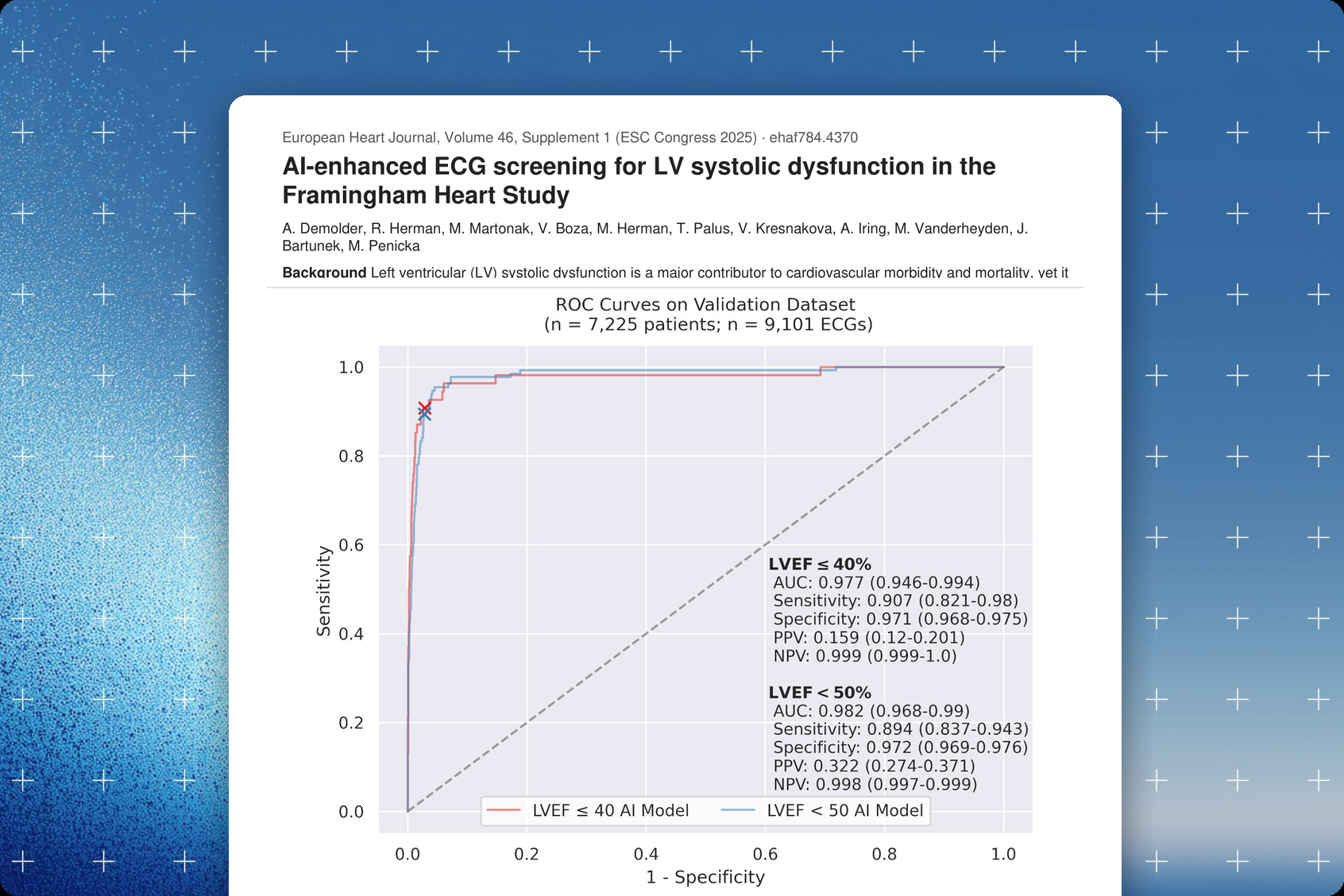
This retrospective study validated two AI-ECG models (PMcardio LVsense) that detect reduced left ventricular ejection fraction (LVEF) in the community-based Framingham Heart Study, with echocardiographically measured LVEF as the reference standard. The analysis included 7,225 participants (9,101 study visits) with paired ECG and echocardiographic data, among whom 1.5% had LVEF <50% and 0.6% had LVEF ≤40%. For LVEF <50%, the model achieved an AUC of 0.982 with 89.4% sensitivity and 97.2% specificity, and for LVEF ≤40% an AUC of 0.977 with 90.7% sensitivity and 97.1% specificity. Negative predictive values were 99.8% and 99.9%, and performance was consistent across age and sex subgroups.
Key findings
- For LVEF <50%, the AI-ECG model achieved an AUC of 0.982 (95% CI 0.968–0.99), with 89.4% sensitivity and 97.2% specificity.
- For LVEF ≤40%, the model achieved an AUC of 0.977 (95% CI 0.946–0.994), with 90.7% sensitivity and 97.1% specificity.
- With a low prevalence of reduced LVEF (1.5% for LVEF <50%), the NPV was 99.8% and the PPV 32.2%.
- Model performance remained consistent across age and sex subgroups in 7,225 participants (9,101 visits).
Published in: ESC Congress 2025 (European Heart Journal, Volume 46, Supplement 1)
Published on: 29 August 2025
Background
Left ventricular (LV) systolic dysfunction is a major contributor to cardiovascular morbidity and mortality, yet it often remains undiagnosed until advanced stages. Artificial intelligence (AI) applied to 12-lead electrocardiography (ECG) offers a promising, noninvasive method for rapid, population-level screening for LV systolic dysfunction, but its performance in community-based settings had not been validated. This study aimed to validate an AI-enhanced ECG model for detecting LV systolic dysfunction in the large, community-based cohort of the Framingham Heart Study.
Methods
Framingham Heart Study participants who underwent routine ECG and echocardiographic examinations during scheduled study visits were included in this retrospective analysis. LV systolic dysfunction was assessed using two AI models that detect LVEF <50% and LVEF ≤40% on the 12-lead ECG. Model performance was evaluated using the area under the receiver operating characteristic curve (AUC), sensitivity, specificity, positive predictive value (PPV) and negative predictive value (NPV), with echocardiographically measured ejection fraction as the reference standard.
Results
A total of 7,225 participants (9,101 visits; 46% male; mean age 62.2 ± 12.6 years) with paired ECG and echocardiographic data were analyzed. The echocardiographic prevalence of LVEF <50% and LVEF ≤40% was 1.5% and 0.6%, respectively. For detecting LVEF <50%, the AI-enhanced ECG model achieved an AUC of 0.982 (95% CI 0.968–0.99), sensitivity of 89.4% (83.7–94.3%), specificity of 97.2% (96.9–97.6%), PPV of 32.2% (27.4–37.1%) and NPV of 99.8% (99.7–99.9%). For detecting LVEF ≤40%, the model yielded an AUC of 0.977 (95% CI 0.946–0.994), sensitivity of 90.7% (82.1–98%), specificity of 97.1% (96.8–97.5%), PPV of 15.9% (12–20.1%) and NPV of 99.9% (99.9–100%). Model performance remained consistent across subgroups stratified by age and sex.
Conclusion
This study provides validation of an AI-ECG model for detecting reduced LVEF in a large, well-characterized, community-based cohort. The high accuracy and ease of application suggest that AI-augmented ECG analysis may serve as an effective, scalable screening tool for early detection of LV dysfunction in the general population.
Share this article



About PMcardio
PMcardio is the market leader in AI-powered diagnostics, addressing the world’s leading cause of death – cardiovascular diseases. The innovative clinical assistant empowers healthcare professionals to detect up to 40 cardiovascular diseases. In the form of a smartphone application, the certified Class IIb medical device interprets any 12-lead ECG image in under 5 seconds to provide accurate diagnoses and individualized treatment recommendations tailored to each patient.

About Powerful Medical
Powerful Medical leads one of the most important shifts in modern medicine by augmenting human-made clinical decisions with artificial intelligence. Our primary focus is on cardiovascular diseases, the world’s leading cause of death.
Established in 2017, Powerful Medical has embarked on a mission to revolutionize the diagnosis and treatment of cardiovascular diseases. We are a medical company backed by 28 world-class cardiologists and led by our expert Scientific Board with decades of experience in daily patient care, clinical research, and medical devices. The results of our research are implemented, developed, certified, and brought to market by our 50+ strong interdisciplinary team of physicians, data scientists, AI experts, software engineers, regulatory specialists, and commercial teams.