
Med Mal Reviewer Analyzes Legal Misconduct Case Using OMI AI Model

In a recent article on Med Mal Reviewer, Eric Funk, editor of the Expert Witness Newsletter, revisited a challenging chest pain case leveraging the PMcardio OMI AI ECG model. It accurately identified the Occlusive MI, showcasing its capability to enhance diagnostic accuracy.
PMcardio OMI AI Model, also widely known as the Queen of Hearts (QOH) continues to demonstrate unrivaled ability in diagnosing Occlusion Myocardial Infarction (OMI). In a recent article on Med Mal Reviewer, Eric Funk, editor of the Expert Witness Newsletter, revisited a challenging chest pain case leveraging the QOH tool. Despite traditional interpretations missing the diagnosis, QOH accurately identified the OMI, showcasing its capability to enhance diagnostic accuracy.
Following the case, Dr. Smith’s ECG Blog provided an in-depth analysis of the QOH’s performance. The tool’s AI-driven technology offers a reliable second opinion, which is crucial in emergency settings where rapid and accurate diagnosis can save lives. By using advanced algorithms trained on extensive ECG data sets, QOH assists physicians in identifying critical yet often overlooked signs of myocardial infarction.
Who is the Med Mal Reviewer?
Since 2018, Med Mal Reviewer has actively reviewed real medical malpractice cases to improve medical care and documentation. Their work introduces expert witness opinions written by physicians retained as experts in medical malpractice cases.
Medical malpractice cases from nearly every specialty with real-life expert witness opinions used in the lawsuit.
Check it out:t.co/2t45W33RYm
— medmalreviewer (@medmalreviewer) November 4, 2021
Thanks to @smithECGBlog for writing up his summary of my recent OMI case!
Check it out 👇 t.co/sNnJrNa1nf
— medmalreviewer (@medmalreviewer) June 13, 2024
Their Substack newsletter, Expert Witness Newsletter, publishes expert witness opinions written by these expert physicians. By subscribing, you will gain extensive experience in reviewing expert witness opinions. A new case is published every week, providing physicians with an inside look into the work of expert witnesses—a perspective that typically takes decades to acquire.

Subscribe to Med Mal Reviewer and start your journey into the world of medical expert witnesses.
Expert Witness Newsletter case #215: Occlusion Myocardial Infarction [Queen of Hearts Algorithm]
This case was posted by Eric Funk, editor of the Expert Witness Newsletter, and it followed case #11, revisiting a complex malpractice case involving a missed OMI diagnosis. The case detailed a 58-year-old woman presenting with chest pain who was misdiagnosed and subsequently discharged, leading to fatal cardiac events. Under case #215, The QOH tool was retrospectively applied, accurately identifying subtle ECG changes indicative of OMI, which were overlooked in the initial assessment.
Occlusion Myocardial Infarction [Queen of Hearts Algorithm] by Med Mal Reviewer
Case #215
Physicians who do not recognize STEMI equivalents, or even better discharge patients based on a single negative Troponin, should start saving up now!
What a terrible (yet preventable) case from 2011, written by @medmalreviewer: t.co/dX1sqfadkL pic.twitter.com/7RLEiE2KC7
— Robert Herman, MD (@RobertHermanMD) June 10, 2024
Dr. Smith’s ECG Blog Analysis and Model Assessment
Following the case, Dr. Smith published his assessment of the tool’s AI-driven algorithms and performance. Several cases were further discussed where QOH’s diagnostic suggestions significantly enhanced decision-making, potentially preventing adverse outcomes. The blog underscored the importance of AI tools in complementing clinical expertise, particularly in diagnosing conditions with nuanced presentations such as OMI.
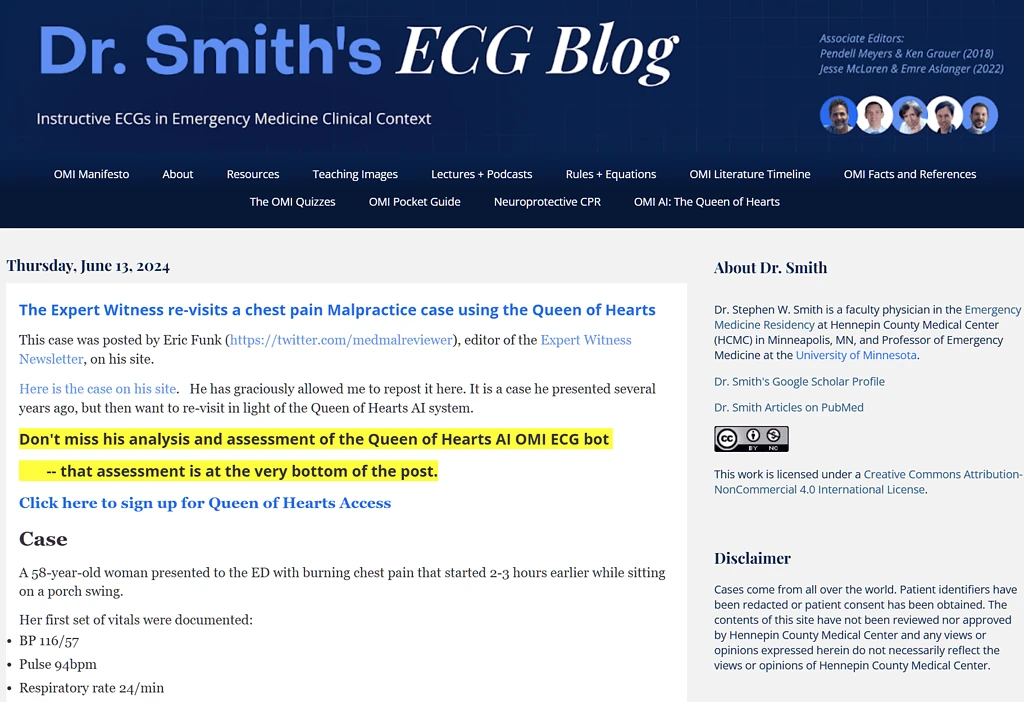
Dr. Smith’s analysis and assessment of the Queen of Hearts AI ECG performance in case #215
Can Sex Also Play a Role in Misdiagnosis?
One of the significant advantages of the OMI AI Model tool is its ability to mitigate biases, such as gender bias, in cardiovascular diagnosis. It is well-documented that females are often underserved when it comes to the diagnosis and treatment of cardiovascular diseases (CVD) such as ACS3,4. To address this issue, we actively research the impact of gender bias on misdiagnosis and the subsequent delays in treatment.
Women’s Health and Cardiac Care: A Call to Action for Healthcare Providers
The Model aims to close this gap by ensuring that diagnostic accuracy is consistent across genders. This will help prevent misdiagnoses and reduce the time to treatment that can be prolonged by such errors.
Conclusion
The Queen of Hearts tool represents a significant advancement in cardiology, offering a robust solution for diagnosing OMI. These insights from recent case studies and expert analyses underscore its potential to transform clinical practice, enhance diagnostic accuracy, and improve patient outcomes. As healthcare continues to embrace AI-driven tools, the QOH stands at the forefront of this innovation, paving the way for a new era in cardiac care6.
Share this article



About PMcardio
PMcardio features FDA-authorized and CE-marked AI ECG models that interpret any 12-lead ECG — from a photo or a digital file — in seconds. It detects 50+ ECG findings, including occlusion myocardial infarction (OMI) — the acute coronary occlusions that conventional STEMI criteria miss in over half of cases. Its Queen of Hearts™ OMI model holds FDA Breakthrough Device Designation, and PMcardio is already used by 100,000+ clinicians who have analyzed more than 2.5 million ECGs.

About Powerful Medical
Powerful Medical is a medical-technology company using artificial intelligence to transform how cardiovascular disease — the world’s leading cause of death — is diagnosed. Founded in 2017, it built PMcardio, the world’s first AI medical device to detect acute coronary occlusion (OMI) from an ECG. Its research is published in the European Heart Journal – Digital Health and validated across 25+ clinical studies, and its Queen of Hearts™ model earned FDA Breakthrough Device Designation. To date, PMcardio has supported the detection of 120,000+ heart attacks across 150+ hospital deployments worldwide.