
FDA Clears AI-ECG Algorithm for Acute MI Detection — Thank Goodness (This Week in Cardiology, by Dr. John Mandrola)
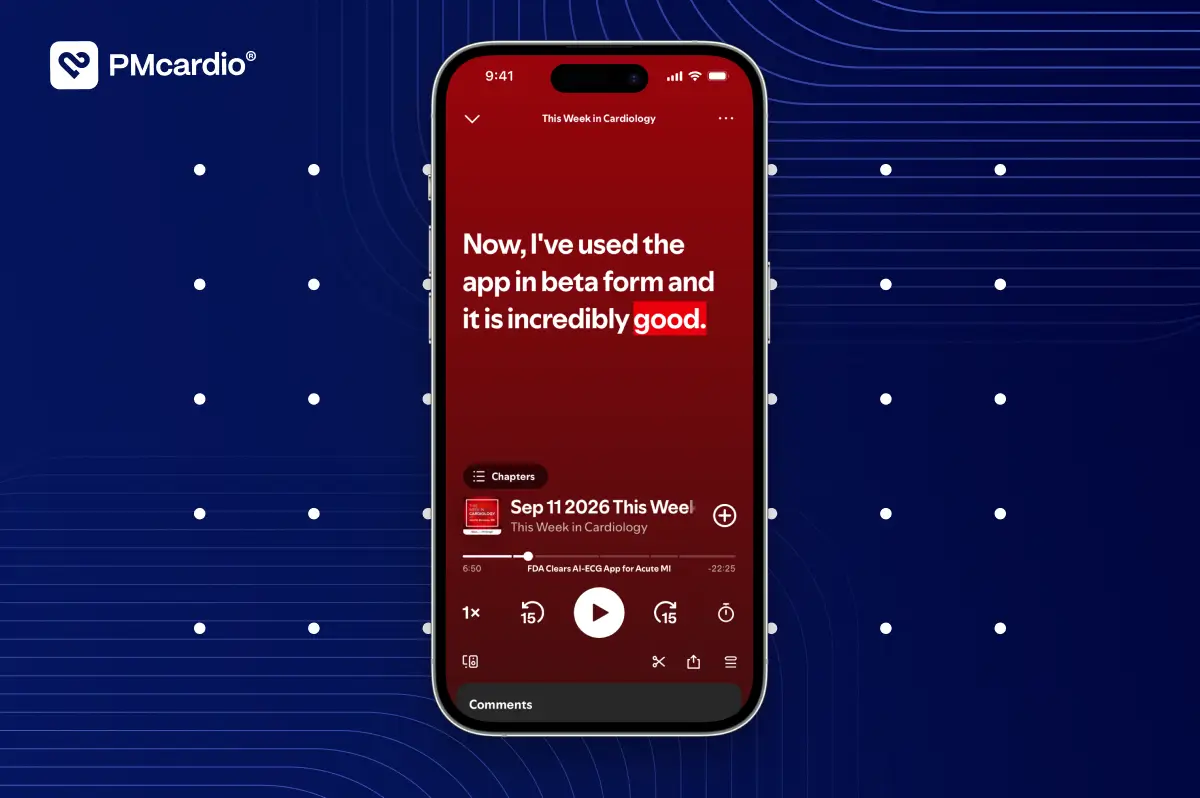
Dr. John Mandrola devotes a breaking-news segment of This Week in Cardiology to the FDA De Novo authorization of PMcardio’s Queen of Hearts™ AI ECG model. Drawing on two recent studies, he calls it a genuine advance for the cases clinicians miss most — the subtle STEMI equivalents — and tells listeners it will make them better ECG readers.
About the Podcast
This Week in Cardiology is hosted by Dr. John Mandrola, a practicing cardiologist, writer, and educator known for his sharp commentary on clinical studies and cardiovascular care. The podcast highlights recent research and real-world cases that shape modern cardiology practice.
Summary of the Episode
In the September 11, 2026 episode, Dr. Mandrola opens with a breaking story: the FDA has granted De Novo authorization to an AI-ECG algorithm for acute MI detection — the Queen of Hearts™ AI ECG model — following the Breakthrough Device designation it received in March 2025. “Thank goodness,” as he puts it.
- He frames why the ECG is the decisive step: a patient arrives at the ED or is picked up by an ambulance, the ECG is the first tool used to risk-stratify — and it has to be read correctly.
- He points to a multicenter U.S. registry published in JACC: Cardiovascular Interventions in October 2025 — a retrospective review of roughly 1,000 suspected STEMIs that triggered emergent cath lab activation — where the AI “really beat standard triage techniques.”
- He also revisits the Shroyer et al. paper in the American Journal of Emergency Medicine, in which 18 ECGs were shown to emergency physicians, cardiologists, and the AI — and the algorithm bested them all. He highlights that the paper publishes the ECGs themselves, so readers can test themselves. (He reviewed this same study in a previous episode.)
- He describes where the Queen of Hearts can help most: STEMI mimics and equivalents — cases without classic ST elevation, where the only clues are hyperacute T waves or subtle ST elevation noticed only by reading ST depression in the reciprocal leads. These are the presentations at the centre of the occlusion MI paradigm.
- His reason for being “super positive” is institutional, not theoretical: in two decades on his hospital’s peer review committee, the number one cause of missed STEMIs is poor ECG reading.
“This is an advance […] I think it will make you a better ECG reader.”— Dr. John Mandrola, This Week in Cardiology
🎧 Listen to the episode: Official page | Spotify | Apple Podcasts
Want to try it for yourself? See how PMcardio works for individual clinicians. Queen of Hearts™ is now available to U.S. hospitals and health systems through PMcardio for Organizations.
Share this article



About PMcardio
PMcardio features FDA-authorized and CE-marked AI ECG models that interpret any 12-lead ECG — from a photo or a digital file — in seconds. It detects 50+ ECG findings, including occlusion myocardial infarction (OMI) — the acute coronary occlusions that conventional STEMI criteria miss in over half of cases. Its Queen of Hearts™ OMI model holds FDA Breakthrough Device Designation, and PMcardio is already used by 100,000+ clinicians who have analyzed more than 2.5 million ECGs.

About Powerful Medical
Powerful Medical is a medical-technology company using artificial intelligence to transform how cardiovascular disease — the world’s leading cause of death — is diagnosed. Founded in 2017, it built PMcardio, the world’s first AI medical device to detect acute coronary occlusion (OMI) from an ECG. Its research is published in the European Heart Journal – Digital Health and validated across 25+ clinical studies, and its Queen of Hearts™ model earned FDA Breakthrough Device Designation. To date, PMcardio has supported the detection of 120,000+ heart attacks across 150+ hospital deployments worldwide.