
Powerful Medical Receives €40 Million IPCEI Grant — read the full story

Powerful Medical
1. August 2025

AI vs MD ECG-Reading for Cath Lab Activation (This Week in Cardiology, by Dr. John Mandrola)
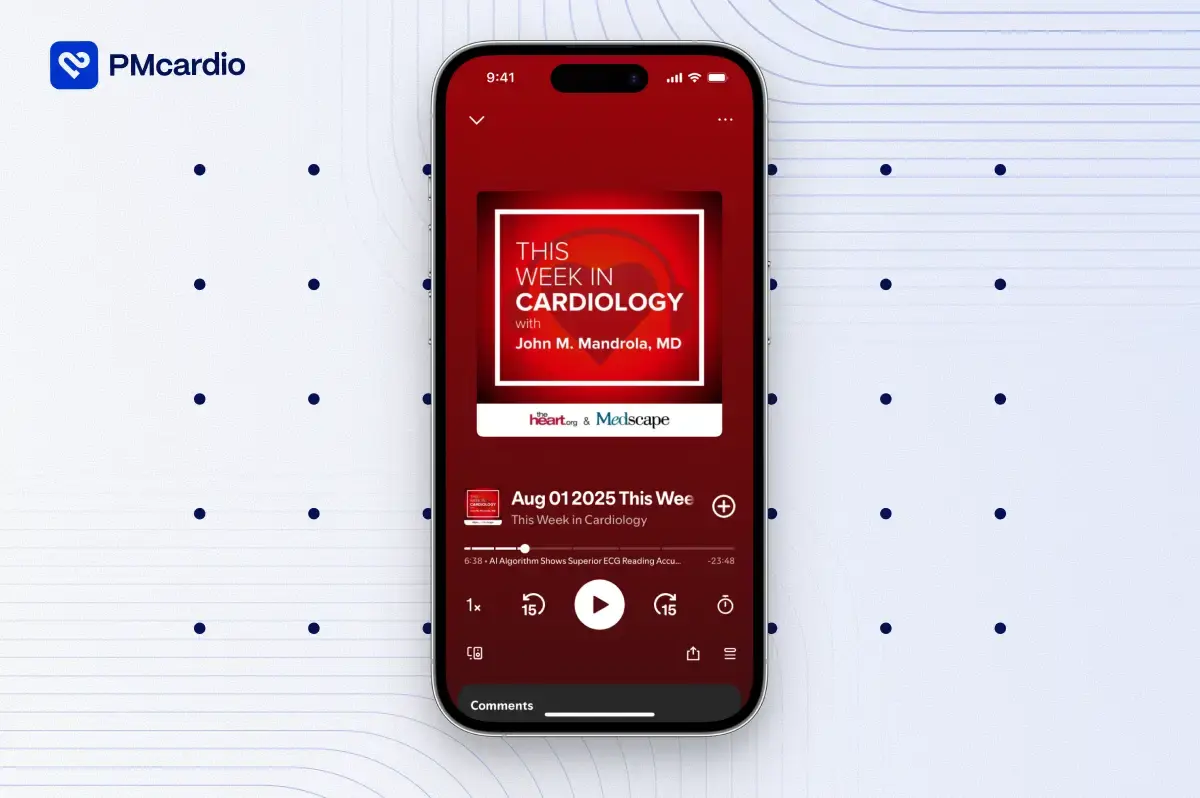
Smartphone showing This Week in Cardiology podcast episode featuring PMcardio Queen of Hearts™ AI outperforming physicians in ECG interpretation

About the Podcast

This Week in Cardiology is hosted by Dr. John Mandrola, a practicing cardiologist, writer, and educator known for his sharp commentary on clinical studies and cardiovascular care. The podcast highlights recent research and real-world cases that shape modern cardiology practice.

Summary of the Episode

In this episode, Dr. Mandrola reviews a study comparing physicians to PMcardio’s Queen of Hearts™ AI ECG model for identifying STEMI equivalents and mimics in critical ECGs. Conducted in San Antonio across community hospitals and EDs, the study presented 18 complex ECG cases to emergency physicians, cardiologists, and the AI.

  • Results: Physicians (both EM doctors and cardiologists) achieved ~66% accuracy, while the AI reached 89% accuracy in determining when to activate the cath lab.
  • The AI outperformed clinicians, particularly in subtle cases like de Winter pattern, transient STEMI, hyperacute T-waves, and bundle branch block presentations.
  • Dr. Mandrola emphasized that while no one misses obvious STEMIs, it’s the subtle cases where AI can make a life-saving difference.

“No one misses the 3–4 mm tombstone ST elevations. It’s the subtle STEMI mimics that are tough. If you’re a patient with an occluded artery but not a conclusive ECG, you hope either for luck, a master ECG reader, or a really good AI algorithm.”
— Dr. John Mandrola, This Week in Cardiology

🎧 Listen to the episode: Official page | Spotify | Apple Podcasts

Powerful Medical

Powerful Medical leads one of the most important shifts in modern medicine by augmenting human-made clinical decisions with artificial intelligence. Our primary focus is on cardiovascular diseases, the world’s leading cause of death.
About PMcardio:

PMcardio is a CE-certified AI that reads ECGs and offers a complex assessment of 49 cardiac conditions. Clinically validated in 15+ studies and trusted by over 100,000 clinicians, it delivers rapid, expert‑level interpretations, empowering emergency physicians, GPs, nurses, paramedics, and cardiologists to act with confidence at the point of care. Available for Individuals and Organizations.

Share this article

Don't miss these

Powerful Medical team receiving the MedTech Innovator 2025 Mid-Stage Grand Prize award on stage, holding a large winner’s check.

Powerful Medical Wins MedTech Innovator 2025

Powerful Medical has been named MedTech Innovator 2025, winning MTI’s Mid-Stage Grand Finals—top honor from the world’s largest medtech accelerator. The award recognizes PMcardio and its FDA Breakthrough-designated Queen of Hearts™ AI ECG technology, which doubles sensitivity for detecting severe heart attacks and significantly cuts ECG-to-balloon time in large clinical trials.

PMcardio Reports Positive RCT Results and Late-Breaking Clinical Science for STEMI Detection

PMcardio’s AI-powered ECG technology delivers breakthrough results at TCT 2025—improving heart attack detection, reducing false activations, and enabling faster treatment across major clinical trials, including the landmark DIFOCCULT-3 RCT.

Join over 100,000 healthcare professionals who are already taking advantage of AI

Dr. Jozef Bartunek, MD, PhD

Co-founder and VP Clinical Strategy

Interventional cardiologist and Co-director of the Cardiovascular Center in Aalst, Belgium — one of the world’s leading heart centers. A Fogarty International NIH Fellow at Harvard Medical School and visiting Professor of Medicine at Catholic University Leuven, he has authored more than 240 peer-reviewed publications in heart failure and structural heart disease, and anchors Powerful Medical’s clinical and research strategy.

Simon Rovder

Co-founder and CTO

Simon began his engineering career at Microsoft and holds a Master’s in Informatics from the University of Edinburgh. He built Powerful Medical’s technology organization from zero, scaling it to a 20+ engineer team and leading the platform architecture that powers a CE-certified Class IIb medical device used in hospitals across Europe.

Viktor Jurasek

Co-founder and CPO

Viktor has spent over a decade designing digital products across healthcare and software and has been the design and product force behind PMcardio since the first prototype. He sets the bar for how a clinical-grade product should feel in a physician’s hands — fast, clear, and trustworthy at the point of care.

Felix Bauer

Co-founder and COO

Felix studied at the Technical University of Munich and was part of the TUM Hyperloop team that repeatedly competed and won in Elon Musk’s SpaceX Hyperloop Pod Competition. He brings a rare combination of engineering rigor, regulatory discipline, and operational excellence to the company, leading operations, compliance, certification, quality management, and global market access since day one.

Dr. Robert Herman, MD, PhD

Co-founder and Chief Medical Officer

Robert is a physician-scientist, served on the Research, Digital and Innovation Committee of the European Society of Cardiology. He bridges the worlds of medicine and artificial intelligence, connecting clinicians, AI researchers, and regulators to translate algorithms into clinical practice. Forbes 30 Under 30 Europe 2024.

Martin Herman

Co-founder and CEO

Martin started coding at 14 and moved to Silicon Valley at 18, founding several companies including a US-based startup before returning to Europe with his brother Robert to build Powerful Medical. He comes from a family of doctors, which shaped his conviction that AI belongs wherever it can genuinely save lives. Forbes 30 Under 30 (Europe 2024).

Heart Attacks are #1 cause of death world-wide and killing about 12 milions people a year.

Clinical Definition of Problem

Contrary to popular belief, a heart attacks isn’t a blockage inside of the heart. A heart attack is a blockage of the coronary arteries supplying the heart muscle with oxygenated blood.

So let’s assume you get a blood clot here — it blocks the blood flow downstream, meaning the heart muscle doesn’t get oxygenated blood and heart tissue downstream starts to die.

Clinical Solution​

The way to fix it is relatively simple – doctors put in a stent that opens up the artery and renews blood flow. The latest clinical practice guidelines recommend that this “stenting” happens within 90 minutes from symptom onset.

If you don’t, even if you put in the stent in later, the heart tissue downstream has already been permanently damaged, which reduces the heart’s ability to pump blood. This is the leading cause of heart failure and increases 1-year mortality by two-fold.

Time is muscle.

You have just 90 minutes to diagnose the patient, bring them to the hospital and put in the stent, otherwise there is permanent damage. So problem is, that 1 in 2 heart attacks get initially misdiagnosed at the first point of contact.

Discover the future of medical work with us.

Lorem ipsum dolor sit amet, consectetur adipiscing elit. Ut elit tellus, luctus nec ullamcorper mattis, pulvinar dapibus leo.