
Powerful Medical Receives €40 Million IPCEI Grant — read the full story

Powerful Medical
2. February 2023

AI-Augmented ECG Interpretation Using Smartphone Technology (Mayo Clinic Cardiovascular CME Podcast, by Dr. Anthony Kashou)
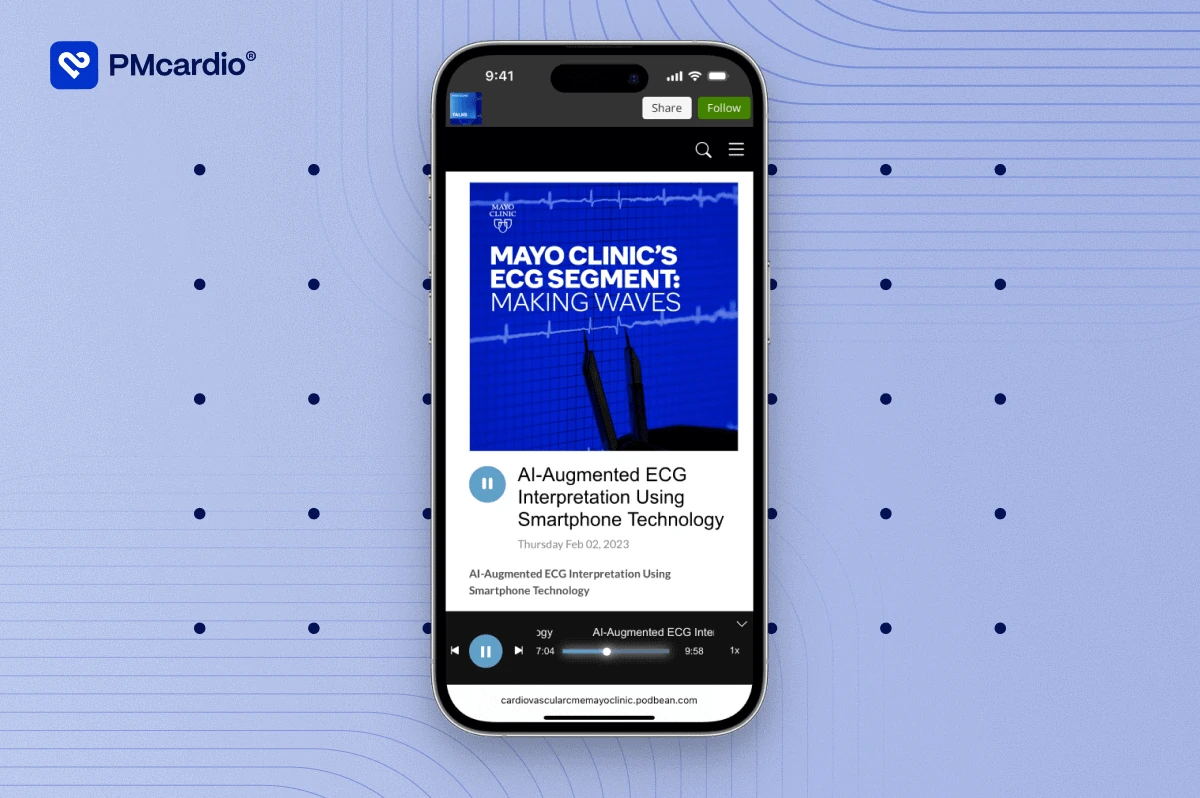
Smartphone displaying Mayo Clinic Cardiovascular CME podcast episode “AI-Augmented ECG Interpretation Using Smartphone Technology” featuring Dr. Robert Herman

About the Podcast

The Mayo Clinic Cardiovascular CME Podcast delivers expert-led discussions on cutting-edge advances in electrocardiography. Hosted by Dr. Anthony H. Kashou, it provides practical education on the latest diagnostic tools, technologies, and best practices in cardiovascular care.

Summary of the Episode

In this episode, Dr. Kashou welcomes Dr. Robert Herman, Chief Medical Officer and co-founder of Powerful Medical, to discuss the development and validation of PMcardio, a web- and smartphone-based AI medical device for ECG interpretation.

  • AI-powered digitization pipeline: Converts any ECG image — regardless of format, quality, or manufacturer — into a fully digital waveform ready for AI analysis.
  • Current challenges in ECG interpretation: Lack of standardization, noise sensitivity in non-AI algorithms, limited datasets, and insufficient integration of patient context.
  • PMcardio validation: Tested on over 12,000 ECGs and benchmarked against general practitioners and cardiologists. Results showed superiority over non-specialists and non-inferiority to cardiologists.
  • Clinical impact: In a randomized controlled trial across 58 primary care centers with >800 patients, PMcardio improved arrhythmia detection fivefold and enhanced acute MI detection while supporting appropriate referral decisions.
  • Future directions: Moving beyond subjective labels toward outcome-based training, predictive risk modeling, raw ECG data analysis, and expanding applications to heart failure, electrophysiology, and sudden cardiac death.

“In validation, PMcardio consistently outperformed non-specialists and matched the accuracy of cardiologists across all major diagnoses.”
— Dr. Robert Herman, Mayo Clinic Cardiovascular CME

🎧 Listen to the episode: Official page

Powerful Medical

Powerful Medical leads one of the most important shifts in modern medicine by augmenting human-made clinical decisions with artificial intelligence. Our primary focus is on cardiovascular diseases, the world’s leading cause of death.
About PMcardio:

PMcardio is a CE-certified AI that reads ECGs and offers a complex assessment of 49 cardiac conditions. Clinically validated in 15+ studies and trusted by over 100,000 clinicians, it delivers rapid, expert‑level interpretations, empowering emergency physicians, GPs, nurses, paramedics, and cardiologists to act with confidence at the point of care. Available for Individuals and Organizations.

Share this article

Don't miss these

Powerful Medical team receiving the MedTech Innovator 2025 Mid-Stage Grand Prize award on stage, holding a large winner’s check.

Powerful Medical Wins MedTech Innovator 2025

Powerful Medical has been named MedTech Innovator 2025, winning MTI’s Mid-Stage Grand Finals—top honor from the world’s largest medtech accelerator. The award recognizes PMcardio and its FDA Breakthrough-designated Queen of Hearts™ AI ECG technology, which doubles sensitivity for detecting severe heart attacks and significantly cuts ECG-to-balloon time in large clinical trials.

PMcardio Reports Positive RCT Results and Late-Breaking Clinical Science for STEMI Detection

PMcardio’s AI-powered ECG technology delivers breakthrough results at TCT 2025—improving heart attack detection, reducing false activations, and enabling faster treatment across major clinical trials, including the landmark DIFOCCULT-3 RCT.

Join over 100,000 healthcare professionals who are already taking advantage of AI

Dr. Tom De Potter, MD

Cardiologist at the Cardiac Center Aalst

Cardiologist specializing in Pacemaker Device Therapy and Electrophysiology. Leads the electrophysiology unit at the Heart Center in Aalst, holds an executive board position at the European Heart Academy, and serves as EHRA scientific program committee co-chair.

Dr. Martin Penicka, MD, PhD

Cardiologist at the Cardiac Center Aalst

Cardiologist at the Cardiac Center Aalst since 2009, specializing in non-invasive imaging and valvular disease. Fellow of the European Society of Cardiology (FESC) and the European Association of Cardiovascular Imaging (FEACVI).

Dr. Ward Heggermont, MD, PhD

Co-director at the Cardiovascular Center

Co-director at the Cardiovascular Center of Aalst Hospital, specializing in heart failure. Research focus at the intersection of cardiology, virology, and metabolism.

Prof. Dr. Robert Hatala, PhD

Co-founder and Chief Scientist

Head of the Arrhythmia and Pacing department at the National Institute of Cardiovascular Diseases in Slovakia. More than 150 publications and 10,000 citations. Contributor to ESC clinical practice guidelines and executive editor of the European Heart Journal since 2020.

Arieh Levy

Head of PMcardio for Individuals

Arieh leads the PMcardio for Individuals product at Powerful Medical, guiding its development as a clinical tool for emergency physicians, cardiologists, and primary care physicians. He holds a First Class MEng in Biomedical Engineering from Imperial College London, where he specialised in AI for cardiology, building physics-informed neural networks to model atrial electrical properties, giving him a background that bridges the clinical and technical demands of building a certified AI medical device used at the bedside every day.

Dr. Dave Pearson, MD​

Chief Medical Officer

Academic emergency medicine physician, entrepreneur, investor, and researcher with nearly two decades at Atrium Health, one of US largest health systems. Brings expertise at the intersection of clinical care, healthcare innovation, and strategic leadership.

Prof. Stephen W. Smith, MD

Professor of Emergency Medicine

Faculty physician in Emergency Medicine at Hennepin County Medical Center and Professor of Emergency Medicine at the University of Minnesota. Co-inventor of the OMI paradigm and editor of Dr. Smith’s ECG Blog, the most-visited US-based ECG interpretation blog.

Prof. Emanuele Barbato, MD, PhD

President of EAPCI

Interventional cardiologist specializing in coronary artery disease and coronary physiology. Acting president of the European Association of Percutaneous Cardiovascular Interventions (EAPCI) and contributor to the clinical practice guidelines for STEMI care.

Scott Sharkey, MD

Chief Medical Officer

Chief Medical Officer of the Minneapolis Heart Institute Foundation and practicing cardiologist at Allina Health Minneapolis Heart Institute. Co-founder of the STEMI Midwest consortium and Takotsubo cardiomyopathy research program and a widely published clinical investigator in STEMI care.

Prof. Dr. Leor Perl, MD

Director of Cardiac Catheterization Institute

Director of Complex Cardiac Interventions and Chief Innovation Officer at Rabin Medical Center. Graduate of the Stanford Biodesign Program.

Suzanne J. Baron, MD, MSc

Director of Interventional Cardiology Research

Director of Interventional Cardiology Research at Massachusetts General Hospital. Holds a Master’s degree in health economics from Harvard School of Public Health. Expert in cardiovascular device impact on healthcare costs and patient-reported outcomes.

Prof. Marco Valgimigli, MD

Deputy Chief Cardiocentro Ticino Institute

Head of Cardiology at Cardiocentro Ticino and Principal Investigator of the TITAN-OMI randomized controlled trial. His research has shaped both European and US clinical practice guidelines on coronary stents, antithrombotic therapy, and vascular access.

Timothy D. Henry, MD

Medical Director of The Carl and Edyth Lindner Center

Leading expert in interventional cardiology and STEMI treatment. Co-founder and principal investigator of the Midwest STEMI Consortium, a registry of more than 20,000 consecutive STEMI activations. Presenting author for the TCT 2025 Late-Breaking Clinical Science on Queen of Hearts.

Matus Horvath

Head of People

Matus leads hiring strategy and culture at Powerful Medical. He previously ran the People Team at Slido, the Slovak SaaS startup later acquired by Cisco — an experience that informs how he builds a high-performing, values-driven team through rapid scaling.

Dr. Timea Kisova, MD

Clinical Research Lead

Timea leads Powerful Medical’s global external validation studies, including the multi-country AI ECG TIMI Study. With a background in biomedical sciences and a medical degree from Barts and The London School of Medicine and Dentistry, she brings the clinical discipline required to generate the prospective, real-world evidence behind every PMcardio module.

Dr. Anthony Demolder, MD, PhD

HF Pathway Lead

Research physician with a PhD on arrhythmias in heritable thoracic aortic disease. He has led international studies at the intersection of cardiology and AI — including earlier work on atrial fibrillation at AZ Sint-Jan Brugge — and now drives Powerful Medical’s heart failure pathway and LVsense™ AI model development.

Dr. Pendell Meyers, MD

ACS Pathway Lead

Emergency medicine physician, prolific educator, and Co-Editor of Dr. Smith’s ECG Blog. He is one of the leading voices behind the Occlusion Myocardial Infarction (OMI) paradigm, the clinical framework that reshaped how heart attacks are identified from the ECG — and which sits at the core of the Queen of Hearts™ model.

Adam Dej

Head of PMcardio for Organizations Engineering

Adam leads engineering for PMcardio for Organizations at Powerful Medical, driving platform architecture, backend systems, and infrastructure behind one of the company’s key growth products. He began programming at 13, entered professional IT at 17, and studied computer security at Comenius University’s Faculty of Mathematics, Physics and Informatics. Known for technical depth across distributed systems, infrastructure, and security, he builds scalable and resilient software with a sharp focus on customer impact. He also champions responsible use of AI and LLMs as force multipliers for modern engineering teams.

Gabriela Rovder Sklencarova

Head of Infrastructure

Gabriela designs the scalable, secure, distributed systems that keep PMcardio running around the clock for clinicians worldwide. She joined from Google, where she was a senior software engineer building core libraries that kept Google’s services resilient against billions of requests, and holds a BA and MA in Computer Science from the University of Cambridge.

Arezou Azar

VP Regulatory

Arezou leads Powerful Medical’s global regulatory strategy across the FDA, EU MDR, and international frameworks. She has been part of nearly every major breakthrough in AI cardiology and is an expert in US and global regulatory strategy, SaMD/digital health launches, with experience at Eko Health, Verily, AliveCor, Cardiologs, and Apple. She specializes in regulatory strategy in high-paced global organizations.

Adam Rafajdus

Head of AI

Adam grew into the Head of AI role from MLOps Engineer over six years at Powerful Medical, bringing deep expertise in deep learning and production-grade system deployment. He leads the team behind the Queen of Hearts™ AI ECG models and was awarded Best Poster at ISCE 2025 for the company’s ECG digitization pipeline.

Mike Wall

VP of Sales

Mike brings more than twenty years at UnitedHealth Group to the table, where he served health plans, employer groups, and public-sector entities as a consultative healthcare sales executive. He combines market intelligence, clinical insight, and financial acumen — the three ingredients needed to bring AI-powered diagnostics into US health systems at scale.

Amani Farid

Head of Strategic Partnerships

Amani leads partnership strategy with a hands-on approach to integration, unlocking long-term value through collaboration and scale. A University of Chicago Law School-trained attorney and former M&A and capital markets associate at two top international law firms, she brings the rare combination of legal precision and commercial execution refined across nearly a decade at Stryker and as VP of Corporate Development at RapidAI — spanning medtech, digital health, and AI-driven diagnostics.

Michal Martonak

Commercial Lead

A mathematician by training, Michal leads commercial strategy, go-to-market, and strategic partnerships with healthcare providers and clinical institutions worldwide. He previously built Powerful Medical’s data and clinical partnerships function, acquiring the large-scale clinical datasets that underpin the company’s certified AI models.

Dr. Jozef Bartunek, MD, PhD

Co-founder and VP Clinical Strategy

Interventional cardiologist and Co-director of the Cardiovascular Center in Aalst, Belgium — one of the world’s leading heart centers. A Fogarty International NIH Fellow at Harvard Medical School and visiting Professor of Medicine at Catholic University Leuven, he has authored more than 240 peer-reviewed publications in heart failure and structural heart disease, and anchors Powerful Medical’s clinical and research strategy.

Simon Rovder

Co-founder and CTO

Simon began his engineering career at Microsoft and holds a Master’s in Informatics from the University of Edinburgh. He built Powerful Medical’s technology organization from zero, scaling it to a 20+ engineer team and leading the platform architecture that powers a CE-certified Class IIb medical device used in hospitals across Europe.

Viktor Jurasek

Co-founder and CPO

Viktor has spent over a decade designing digital products across healthcare and software and has been the design and product force behind PMcardio since the first prototype. He sets the bar for how a clinical-grade product should feel in a physician’s hands — fast, clear, and trustworthy at the point of care.

Felix Bauer

Co-founder and COO

Felix studied at the Technical University of Munich and was part of the TUM Hyperloop team that repeatedly competed and won in Elon Musk’s SpaceX Hyperloop Pod Competition. He brings a rare combination of engineering rigor, regulatory discipline, and operational excellence to the company, leading operations, compliance, certification, quality management, and global market access since day one.

Dr. Robert Herman, MD, PhD

Co-founder and Chief Medical Officer

Robert is a physician-scientist, served on the Research, Digital and Innovation Committee of the European Society of Cardiology. He bridges the worlds of medicine and artificial intelligence, connecting clinicians, AI researchers, and regulators to translate algorithms into clinical practice. Forbes 30 Under 30 Europe 2024.

Martin Herman

Co-founder and CEO

Martin started coding at 14 and moved to Silicon Valley at 18, founding several companies including a US-based startup before returning to Europe with his brother Robert to build Powerful Medical. He comes from a family of doctors, which shaped his conviction that AI belongs wherever it can genuinely save lives. Forbes 30 Under 30 (Europe 2024).

Heart Attacks are #1 cause of death world-wide and killing about 12 milions people a year.

Clinical Definition of Problem

Contrary to popular belief, a heart attacks isn’t a blockage inside of the heart. A heart attack is a blockage of the coronary arteries supplying the heart muscle with oxygenated blood.

So let’s assume you get a blood clot here — it blocks the blood flow downstream, meaning the heart muscle doesn’t get oxygenated blood and heart tissue downstream starts to die.

Clinical Solution​

The way to fix it is relatively simple – doctors put in a stent that opens up the artery and renews blood flow. The latest clinical practice guidelines recommend that this “stenting” happens within 90 minutes from symptom onset.

If you don’t, even if you put in the stent in later, the heart tissue downstream has already been permanently damaged, which reduces the heart’s ability to pump blood. This is the leading cause of heart failure and increases 1-year mortality by two-fold.

Time is muscle.

You have just 90 minutes to diagnose the patient, bring them to the hospital and put in the stent, otherwise there is permanent damage. So problem is, that 1 in 2 heart attacks get initially misdiagnosed at the first point of contact.

Discover the future of medical work with us.

Lorem ipsum dolor sit amet, consectetur adipiscing elit. Ut elit tellus, luctus nec ullamcorper mattis, pulvinar dapibus leo.