
Utilizing Longitudinal Data in Assessing All-Cause Mortality in Patients Hospitalized with Heart Failure
Overview
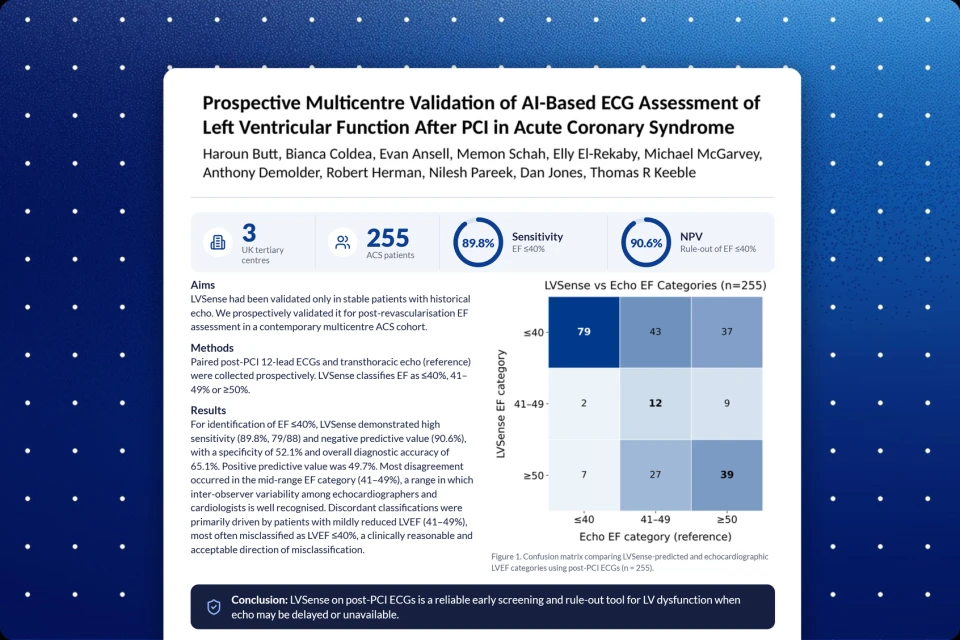
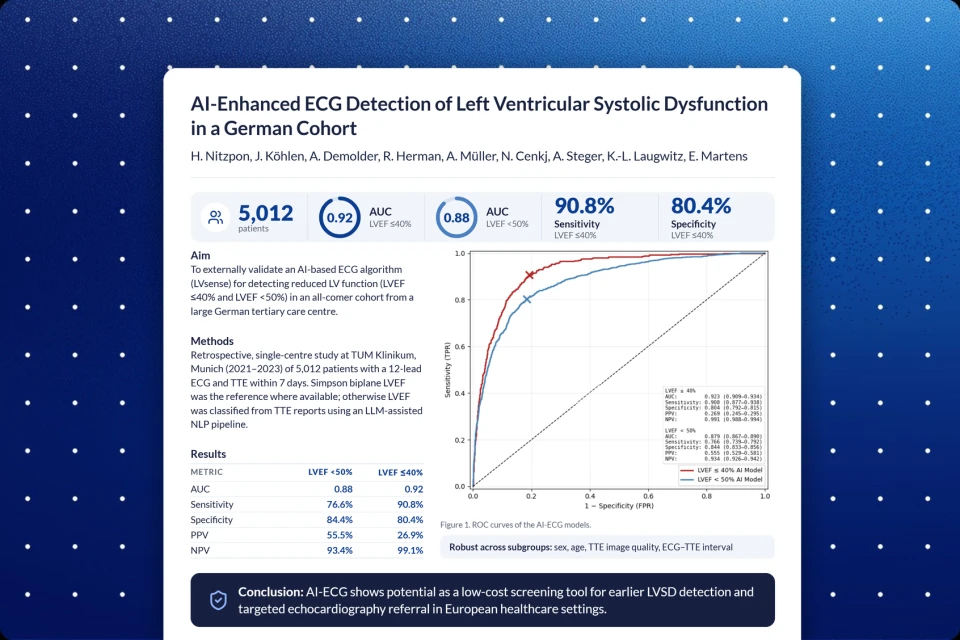
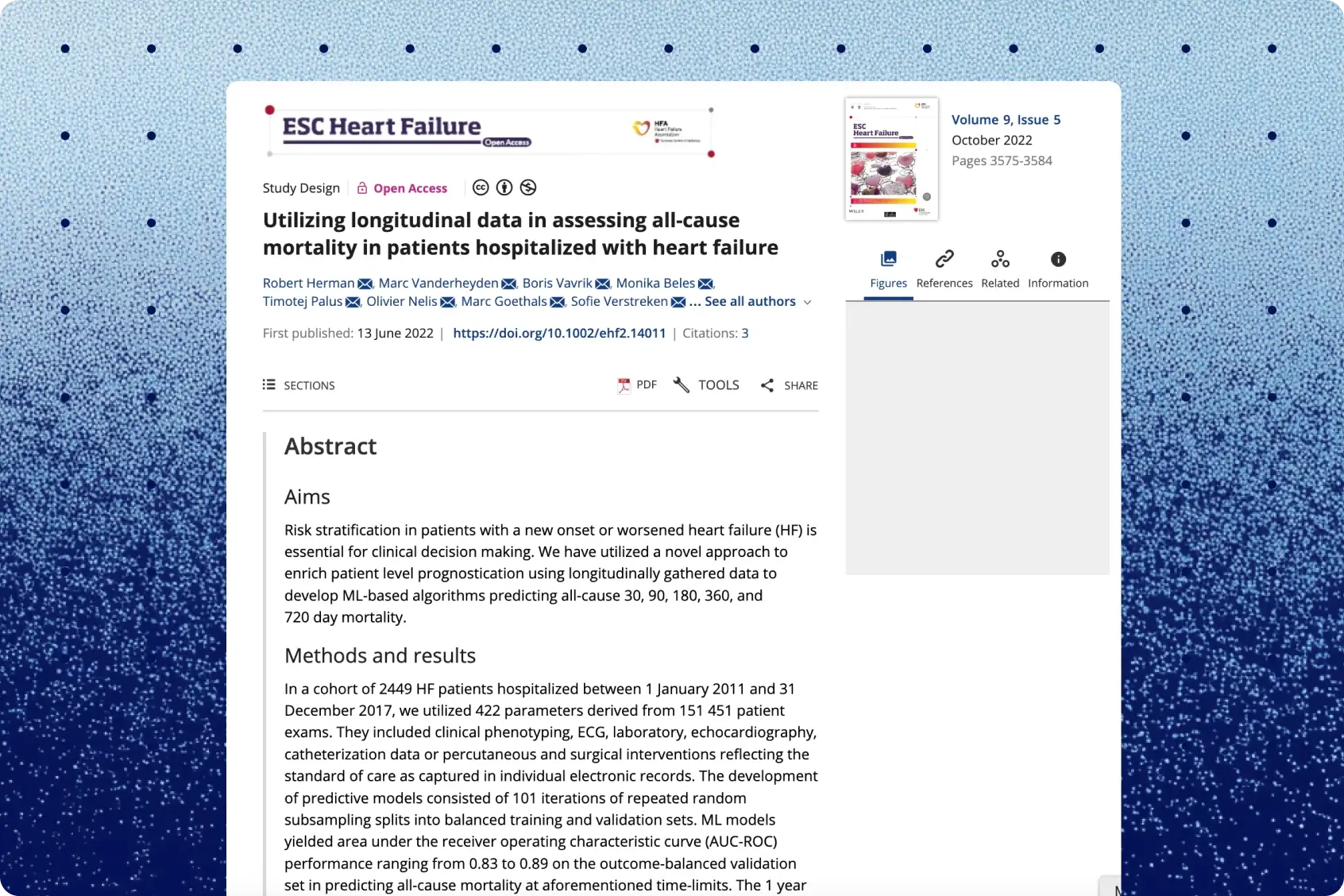
In collaboration with the Cardiovascular Center Aalst in Belgium, Powerful Medical developed a machine learning algorithm to improve risk stratification in patients hospitalized with new or worsening heart failure. Trained on 2,449 patients and 151,451 exams, the model accurately predicts mortality across multiple time points (AUC-ROC 0.83–0.89), enabling proactive, yet personalized clinical interventions.
Key findings
- Trained on 2,449 patients and 151,451 exams (Cardiovascular Center Aalst).
- Predicts all-cause mortality across multiple time points at AUC-ROC 0.83–0.89.
- Enables proactive, personalized risk stratification in heart failure.
Published in: ESC Heart Failure
Published on: June 13, 2022
Aims
Risk stratification in patients with a new onset or worsened heart failure (HF) is essential for clinical decision making. We have utilized a novel approach to enrich patient level prognostication using longitudinally gathered data to develop ML-based algorithms predicting all-cause 30, 90, 180, 360, and 720 day mortality.
Methods
In a cohort of 2,449 HF patients hospitalized between 1 January 2011 and 31 December 2017, we utilized 422 parameters derived from 151,451 patient exams. They included clinical phenotyping, ECG, laboratory, echocardiography, catheterization data or percutaneous and surgical interventions reflecting the standard of care as captured in individual electronic records. The development of predictive models consisted of 101 iterations of repeated random subsampling splits into balanced training and validation sets.
Results
ML models yielded area under the receiver operating characteristic curve (AUC-ROC) performance ranging from 0.83 to 0.89 on the outcome-balanced validation set in predicting all-cause mortality at aforementioned time-limits. The 1 year mortality prediction model recorded an AUC of 0.85. We observed stable model performance across all HF phenotypes: HFpEF 0.83 AUC, HFmrEF 0.85 AUC, and HFrEF 0.86 AUC, respectively. Model performance improved when utilizing data from more hospital contacts compared with only data collected at baseline.
Conclusion
Our findings present a novel, patient-level, comprehensive ML-based algorithm for predicting all-cause mortality in new or worsened heart failure. Its robust performance across phenotypes throughout the longitudinal patient follow-up suggests its potential in point-of-care clinical risk stratification.
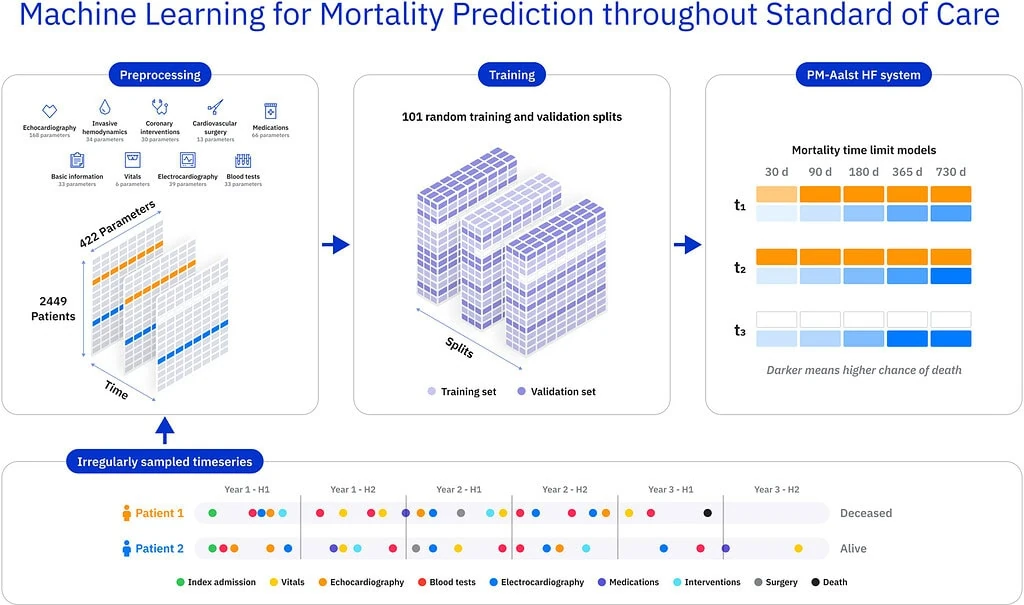
Figure 1: ML methodology in utilizing electronic records over time reflecting longitudinal clinical care. Bottom panel shows an example of two irregular time series of exams and endpoints for two different patients. Left panel shows the dimensionality of the preprocessed dataset created from different sources of data gathered in the electronic health records of both patients. In the centre, model training with 101 cross validation splits of training and validation sets. On the right, recalibrated predictions of the PM-Aalst HF system are shown at three different follow-up patient contacts for both example patients.
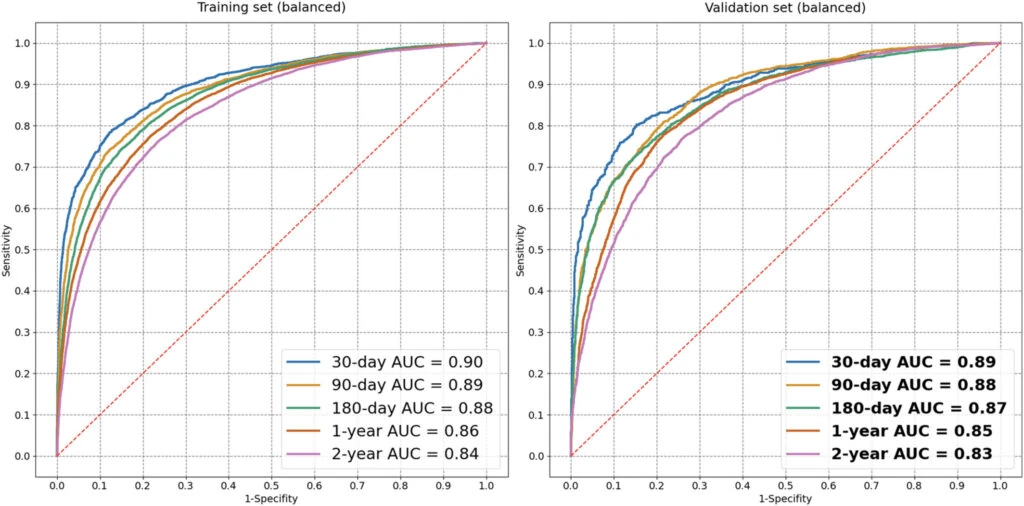
Figure 2: Receiver operating characteristic curves (ROC) for individual ML models predicting 30 day, 90 day, 180 day, 1 year, and 2 year all-cause mortality. Left panel: training set. Right panel validation set. AUC, area under curve.
Share this article



About PMcardio
PMcardio is the market leader in AI-powered diagnostics, addressing the world’s leading cause of death – cardiovascular diseases. The innovative clinical assistant empowers healthcare professionals to detect up to 40 cardiovascular diseases. In the form of a smartphone application, the certified Class IIb medical device interprets any 12-lead ECG image in under 5 seconds to provide accurate diagnoses and individualized treatment recommendations tailored to each patient.

About Powerful Medical
Powerful Medical leads one of the most important shifts in modern medicine by augmenting human-made clinical decisions with artificial intelligence. Our primary focus is on cardiovascular diseases, the world’s leading cause of death.
Established in 2017, Powerful Medical has embarked on a mission to revolutionize the diagnosis and treatment of cardiovascular diseases. We are a medical company backed by 28 world-class cardiologists and led by our expert Scientific Board with decades of experience in daily patient care, clinical research, and medical devices. The results of our research are implemented, developed, certified, and brought to market by our 50+ strong interdisciplinary team of physicians, data scientists, AI experts, software engineers, regulatory specialists, and commercial teams.