
Unveiling Hidden Risks: Enhancing Detection of Totally Occluded Arteries in Non-ST-Elevation Myocardial Infarction Patients with Artificial Intelligence
Overview
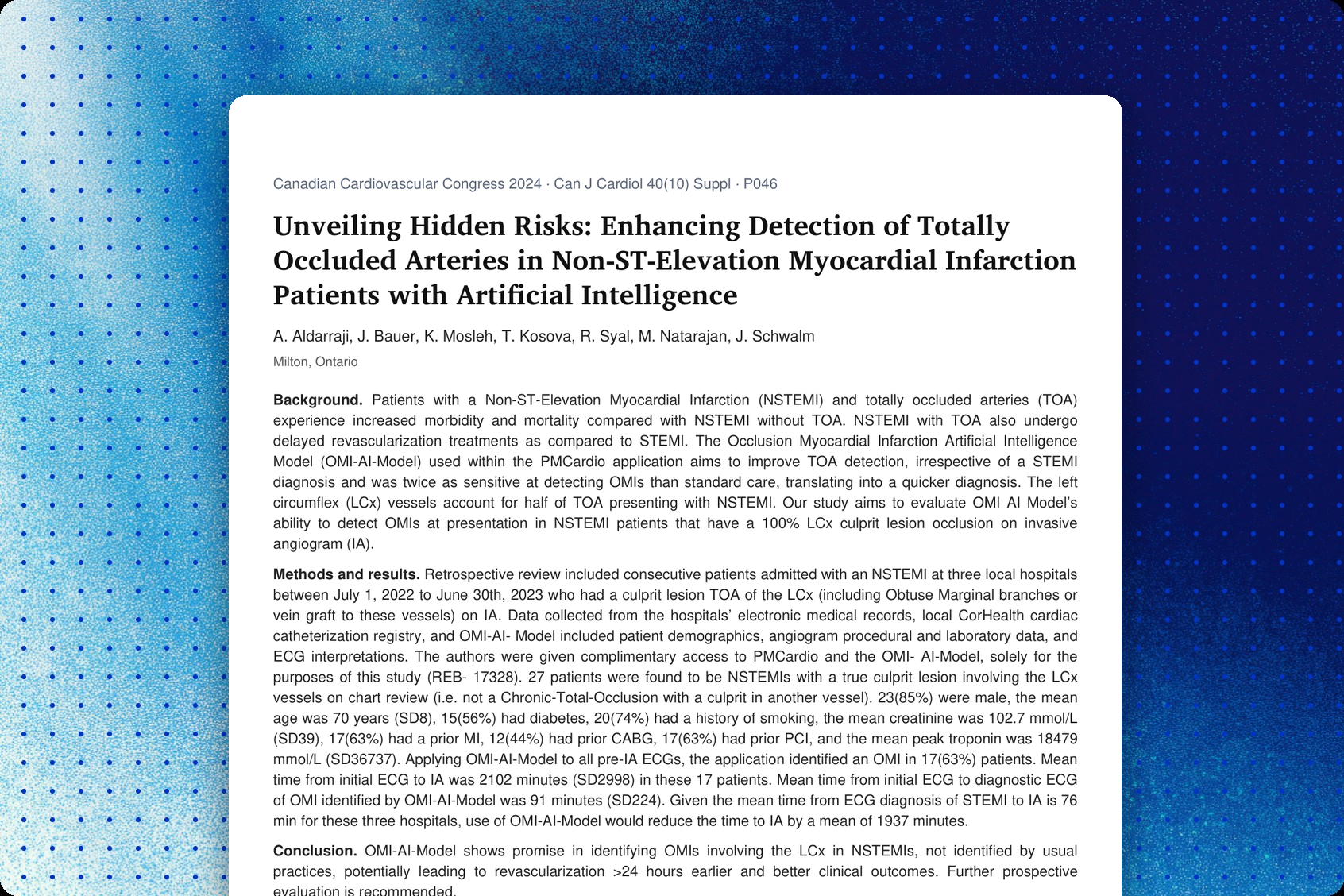
In this retrospective study from three hospitals in Ontario, Canada, investigators applied the PMcardio Queen of Hearts OMI AI model (eOMI v1) to the pre-angiography ECGs of 27 consecutive patients admitted with non-ST-elevation myocardial infarction (NSTEMI) between July 2022 and June 2023 whose culprit lesion was a total occlusion of the left circumflex (LCx) territory. NSTEMI patients with totally occluded arteries have higher morbidity and mortality and are revascularized later than STEMI patients. The AI model identified an occlusion myocardial infarction (OMI) in 17 of the 27 patients (63%). In these 17 patients, the mean time from initial ECG to angiography was 2,102 minutes, while the AI flagged OMI a mean of 91 minutes after the initial ECG; the authors estimate that AI-guided activation could have reduced time to angiography by a mean of 1,937 minutes.
Key findings
- Applied retrospectively to all pre-angiography ECGs, the AI model identified OMI in 17 of 27 NSTEMI patients (63%) with a totally occluded LCx culprit lesion.
- In these 17 patients, the mean time from initial ECG to invasive angiography was 2,102 minutes (SD 2,998), whereas the mean time from initial ECG to the first AI-positive ECG was 91 minutes (SD 224).
- Based on the three hospitals' mean STEMI ECG-to-angiography time of 76 minutes, AI-guided activation would have reduced time to angiography by a mean of 1,937 minutes, potentially enabling revascularization more than 24 hours earlier.
- The cohort was high risk: 85% were male, the mean age was 70 years, 56% had diabetes, 63% had a prior myocardial infarction and 44% had prior CABG.
Published in: Canadian Cardiovascular Congress 2024 – abstract P046; published in the Canadian Journal of Cardiology, Volume 40, Issue 10 (Supplement). The same abstract was also presented at the Canadian Society of Internal Medicine (CSIM) Annual Meeting 2024
Published on: 24 October 2024
Background
Patients with non-ST-elevation myocardial infarction (NSTEMI) and totally occluded arteries have higher morbidity and mortality than NSTEMI patients without an occluded artery, and they undergo revascularization later than patients with STEMI. The left circumflex (LCx) artery accounts for half of the totally occluded arteries presenting as NSTEMI. The Occlusion Myocardial Infarction AI model used within the PMcardio application (Queen of Hearts, eOMI v1) aims to improve detection of totally occluded arteries irrespective of a STEMI diagnosis, and was previously reported to be twice as sensitive as standard care at detecting OMI. This study evaluated the model's ability to detect OMI at presentation in NSTEMI patients with a 100% LCx culprit lesion occlusion on invasive angiography.
Methods
The authors retrospectively reviewed consecutive patients admitted with NSTEMI at three local hospitals between July 1, 2022 and June 30, 2023 whose culprit lesion was a total occlusion of the LCx, including obtuse marginal branches or vein grafts to these vessels, on invasive angiography. Data were collected from the hospitals' electronic medical records, the local CorHealth cardiac catheterization registry and the AI model, and included patient demographics, angiographic procedural and laboratory data, and ECG interpretations. The AI model was applied to all ECGs recorded before angiography. The authors were given complimentary access to PMcardio and the AI model solely for the purposes of this study.
Results
On chart review, 27 patients had NSTEMI with a true culprit lesion in the LCx territory (that is, not a chronic total occlusion with a culprit in another vessel). Of these, 23 (85%) were male, the mean age was 70 years (SD 8), 15 (56%) had diabetes, 20 (74%) had a history of smoking, 17 (63%) had a prior myocardial infarction, 12 (44%) had prior CABG and 17 (63%) had prior PCI. Applied to all pre-angiography ECGs, the AI model identified OMI in 17 patients (63%). In these 17 patients, the mean time from initial ECG to invasive angiography was 2,102 minutes (SD 2,998), while the mean time from initial ECG to the diagnostic ECG on which the AI model identified OMI was 91 minutes (SD 224). Given that the mean time from ECG diagnosis of STEMI to angiography at these three hospitals is 76 minutes, use of the AI model would have reduced the time to angiography by a mean of 1,937 minutes.
Conclusion
The OMI AI model shows promise in identifying OMIs involving the LCx in NSTEMI patients that were not identified by usual practice, potentially leading to revascularization more than 24 hours earlier and better clinical outcomes. Further prospective evaluation is recommended.
Share this article



About PMcardio
PMcardio is the market leader in AI-powered diagnostics, addressing the world’s leading cause of death – cardiovascular diseases. The innovative clinical assistant empowers healthcare professionals to detect up to 40 cardiovascular diseases. In the form of a smartphone application, the certified Class IIb medical device interprets any 12-lead ECG image in under 5 seconds to provide accurate diagnoses and individualized treatment recommendations tailored to each patient.

About Powerful Medical
Powerful Medical leads one of the most important shifts in modern medicine by augmenting human-made clinical decisions with artificial intelligence. Our primary focus is on cardiovascular diseases, the world’s leading cause of death.
Established in 2017, Powerful Medical has embarked on a mission to revolutionize the diagnosis and treatment of cardiovascular diseases. We are a medical company backed by 28 world-class cardiologists and led by our expert Scientific Board with decades of experience in daily patient care, clinical research, and medical devices. The results of our research are implemented, developed, certified, and brought to market by our 50+ strong interdisciplinary team of physicians, data scientists, AI experts, software engineers, regulatory specialists, and commercial teams.