
How to suspect occlusion myocardial infarction in the absence of STEMI criteria
Overview
This Italian state-of-the-art review explains how to suspect occlusion myocardial infarction (OMI) in patients with acute coronary syndrome who do not meet conventional STEMI criteria. It summarizes evidence that about a quarter of patients classified as NSTEMI have an acutely occluded culprit artery, and that STEMI criteria identify only a minority of OMIs (pooled sensitivity 43%, versus 78% with the OMI/NOMI approach at similar specificity). The authors describe the subtle and dynamic ECG patterns that can reveal an ongoing occlusion, from hyperacute T waves and posterior OMI to the de Winter pattern and the Smith-modified Sgarbossa criteria. They also discuss the supportive role of AI-ECG tools such as the PMcardio Queen of Hearts model, which reached 88.9% accuracy in one comparison with emergency physicians (65.6%) and cardiologists (65.5%). The review adds no new patient data.
Key findings
- A meta-analysis cited in the review found that STEMI criteria identify OMI with a sensitivity of only 43%, compared with 78% for the OMI/NOMI paradigm at similar specificity (96% vs 94%).
- About 25% of 40,777 patients classified as NSTEMI had a totally occluded culprit artery (TIMI 0 flow), which was associated with higher mortality and more major adverse cardiovascular events.
- In the DOMI ARIGATO study of 808 patients, predefined OMI ECG findings reached 86% sensitivity, 91% specificity and 89% accuracy, compared with 41%, 94% and 77% for STEMI criteria.
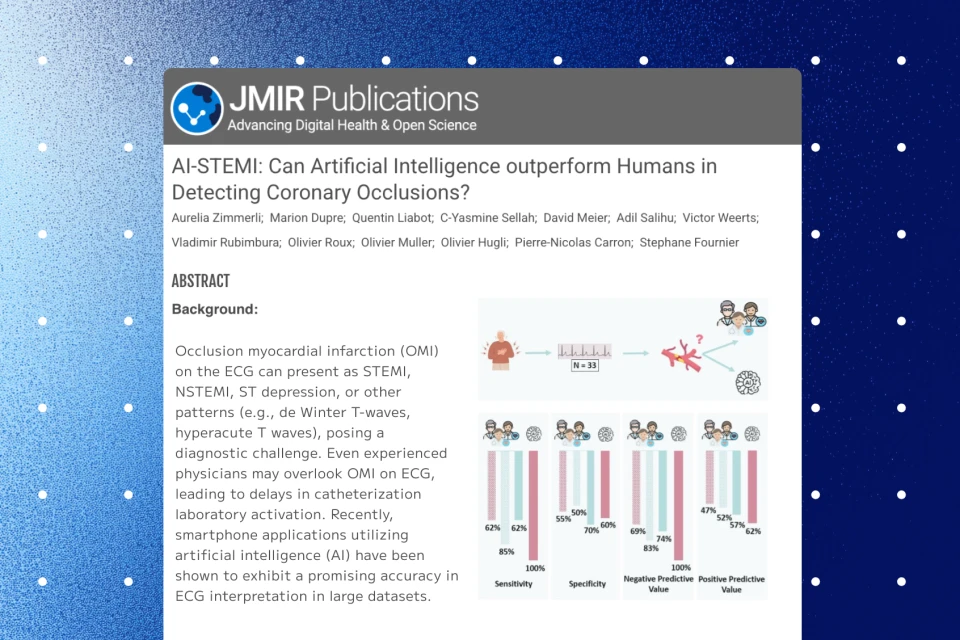
- In a study distinguishing OMI, STEMI-equivalent patterns and STEMI mimics, the Queen of Hearts AI model reached 88.9% diagnostic accuracy, compared with 65.6% for emergency physicians and 65.5% for cardiologists.
Published in: Giornale Italiano di Cardiologia, 2026;27(10) – state-of-the-art review (translated from Italian)
Published on: 1 October 2026
Original title: Come sospettare un infarto miocardico occlusivo in assenza dei criteri STEMI
Background
The management of acute coronary syndromes (ACS) is still largely based on the STEMI/NSTEMI classification, a binary framework that gives ST-segment elevation a central role in guiding urgent revascularization. This model took shape in the fibrinolysis era and was not built on systematic angiographic verification of acute coronary occlusion. Yet a substantial proportion of patients classified as NSTEMI have an acute coronary occlusion, with a risk of delayed recognition and adverse outcomes. This narrative review focuses on how to suspect occlusion myocardial infarction (OMI) in the absence of conventional STEMI criteria, with emphasis on subtle and dynamic ECG findings, and discusses the emerging OMI/NOMI paradigm and the role of artificial intelligence (AI)-powered ECG analysis.
Key points
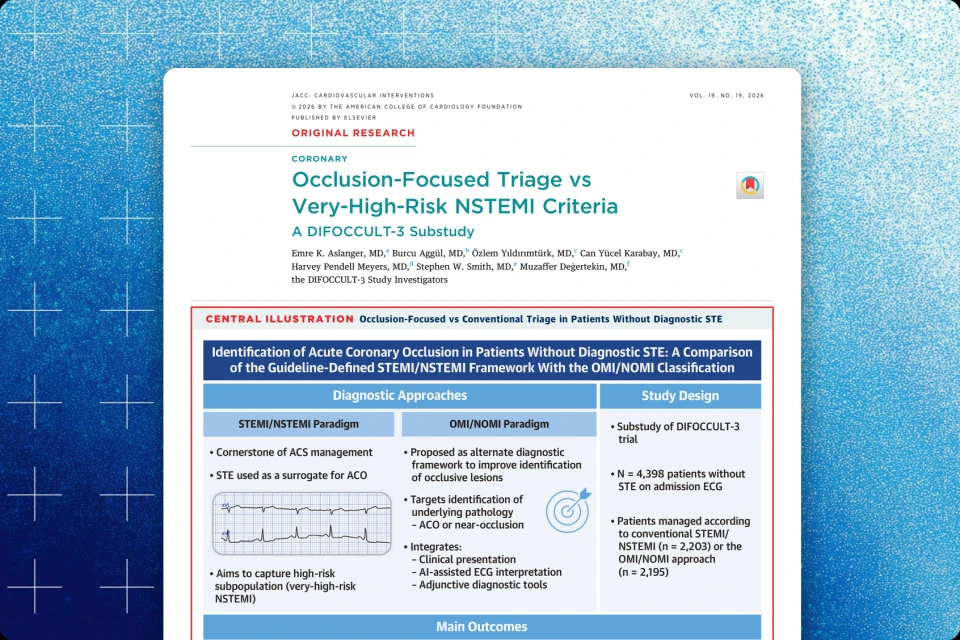
- Limits of the STEMI/NSTEMI paradigm. A meta-analysis found that STEMI criteria identify OMI with a pooled sensitivity of 43% (95% CI 34.7–52.9%), whereas the OMI/NOMI approach raised sensitivity to 78% with similar specificity (96% vs 94%). About 25% of 40,777 patients classified as NSTEMI had a totally occluded culprit artery with TIMI 0 flow, and a meta-analysis of 25 studies with more than 60,000 NSTEMI patients found an occluded culprit artery in about 34%, both associated with worse outcomes. In the DIFOCCULT study, blinded ECG review by two expert cardiologists identified an acute coronary occlusion in 28% of patients initially classified as NSTEMI, with high inter-observer agreement (κ=0.834).
- Defining OMI. OMI is a clinical diagnosis of acute ischemia caused by an occlusive or near-occlusive lesion of an epicardial coronary artery without adequate collateral flow. Because the culprit vessel can reopen, between 19% and 36% of OMI patients who meet STEMI criteria have a patent culprit vessel at angiography. An operational definition combines reduced TIMI flow (TIMI 0–2) or TIMI 3 flow with a marked rise in peak troponin, and diagnosis requires dynamic assessment of serial ECGs in the clinical context.
- ECG findings beyond STEMI criteria. In the DOMI ARIGATO study (808 patients, 265 with OMI), predefined OMI ECG findings reached 86% sensitivity, 91% specificity and 89% accuracy, compared with 41%, 94% and 77% for STEMI criteria, and 55% of OMIs were recognized earlier with the OMI patterns. Repolarization changes must always be read in proportion to the QRS complex, and reciprocal changes, for example in lead aVL, can precede or be more evident than the direct ischemic changes.
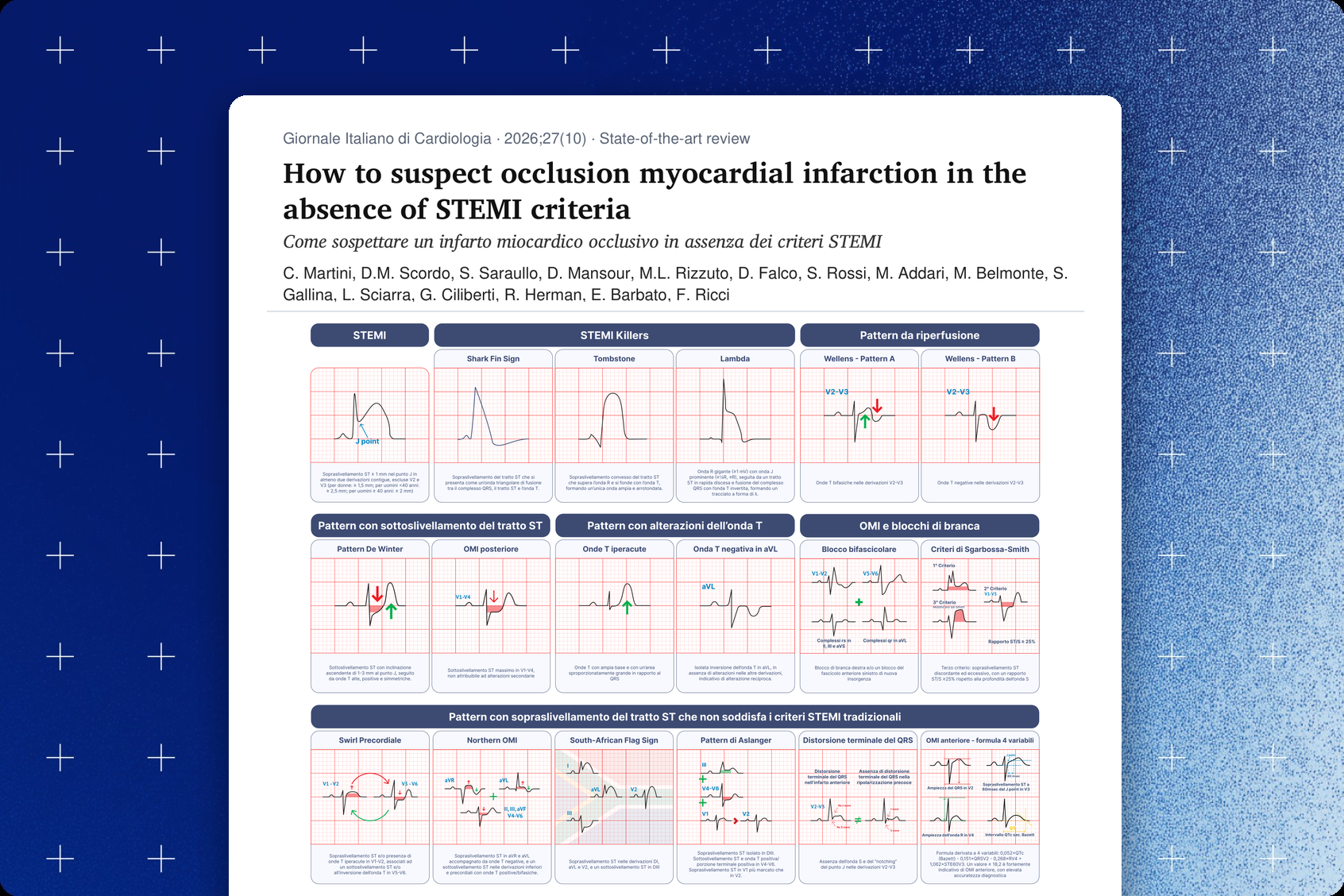
- Patterns to recognize. The review describes reperfusion patterns (Wellens syndrome), ST-depression patterns (de Winter pattern and posterior OMI, where maximal ST depression in V1–V4, even below 1 mm, was 97% specific for OMI), T-wave patterns (hyperacute T waves, for which a quantitative score showed 97% specificity), ST elevation that does not meet traditional criteria (Aslanger pattern, South African flag sign, terminal QRS distortion and quantitative formulas versus early repolarization, precordial swirl with 98% specificity, and Northern OMI), bundle branch blocks (new bifascicular block and the Smith-modified Sgarbossa criteria), high-risk "killer" patterns, ST elevation in aVR, and STEMI mimics, which lead to inappropriate catheterization laboratory activations in 15% to 36% of cases.
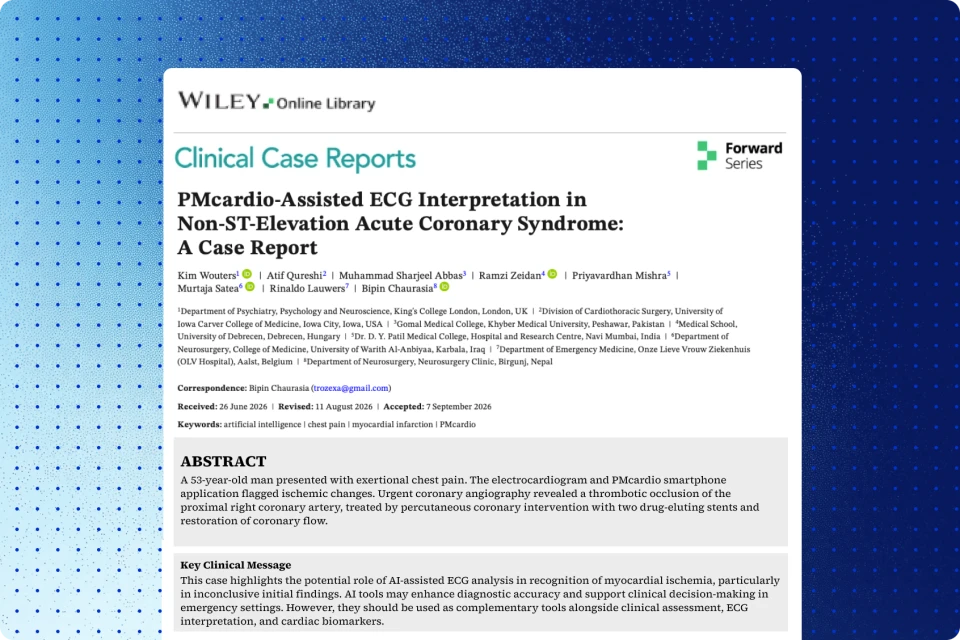
- Supportive role of AI. A deep neural network model, the PMcardio Queen of Hearts OMI AI-ECG model, outperformed guideline STEMI criteria and performed comparably to expert ECG readers; in a DOMI ARIGATO sub-analysis it detected 100% of acute LAD occlusions, matching the ECG expert. In another study it reached 88.9% accuracy in distinguishing OMI, STEMI-equivalent patterns and STEMI mimics, compared with 65.6% for emergency physicians and 65.5% for cardiologists. In 224 high-risk patients with non-ST-elevation ACS, the model showed 78% specificity and a 78% positive predictive value for ruling in OMI, with 58% sensitivity, and an AI-enhanced triage strategy reduced false positives from 42% to 22% compared with standard care. The authors stress that AI should support, not replace, clinical judgment.
- Ongoing trials. The DIFOCCULT-3 trial (NCT06570759; at least 6,000 patients at 18 centers in Turkey) is comparing the OMI/NOMI and STEMI/NSTEMI paradigms, and the prospective AI-ECG TIMI registry (NCT06528821; 709 patients at 9 European centers) is designed to validate an AI model that detects an actively occluded culprit artery (TIMI 0–1 flow) on a single ECG recorded at the time of coronary angiography.
Conclusion
The STEMI/NSTEMI paradigm does not reliably identify the full spectrum of acute coronary occlusions, and a clinically relevant share of OMI patients do not meet STEMI criteria and risk delayed angiography and reperfusion. Recognizing ECG patterns suggestive of OMI, interpreted dynamically alongside the clinical picture, biomarkers, echocardiography and the evolution of symptoms, should complement rather than replace STEMI criteria. AI can make OMI recognition more reproducible and timely, especially where expert ECG interpretation is not immediately available, but current evidence supports it as a tool to support clinical judgment; ongoing prospective studies, including DIFOCCULT-3 and AI-ECG TIMI, will clarify whether the OMI/NOMI paradigm and AI tools reduce reperfusion delays, infarct size and adverse events.
Share this article



About PMcardio
PMcardio is the market leader in AI-powered diagnostics, addressing the world’s leading cause of death – cardiovascular diseases. The innovative clinical assistant empowers healthcare professionals to detect up to 40 cardiovascular diseases. In the form of a smartphone application, the certified Class IIb medical device interprets any 12-lead ECG image in under 5 seconds to provide accurate diagnoses and individualized treatment recommendations tailored to each patient.

About Powerful Medical
Powerful Medical leads one of the most important shifts in modern medicine by augmenting human-made clinical decisions with artificial intelligence. Our primary focus is on cardiovascular diseases, the world’s leading cause of death.
Established in 2017, Powerful Medical has embarked on a mission to revolutionize the diagnosis and treatment of cardiovascular diseases. We are a medical company backed by 28 world-class cardiologists and led by our expert Scientific Board with decades of experience in daily patient care, clinical research, and medical devices. The results of our research are implemented, developed, certified, and brought to market by our 50+ strong interdisciplinary team of physicians, data scientists, AI experts, software engineers, regulatory specialists, and commercial teams.