
Time for diagnostic paradigm shift from ST-elevation/non-ST-elevation to occlusive/non-occlusive myocardial infarction: The DIFOCCULT-3 Trial
Overview
DIFOCCULT-3 is a multicenter, modified cluster-randomized, open-label trial at 18 centers in Turkey that compares the occlusion myocardial infarction (OMI/NOMI) paradigm with the standard STEMI/NSTEMI approach in approximately 6,000 adults with suspected myocardial infarction. In the OMI/NOMI arm, physicians actively searched for acute coronary occlusion (ACO) using clinical gestalt, AI-assisted ECG interpretation (the PMcardio OMI AI-ECG model), bedside echocardiography or a markedly elevated initial troponin, followed by catheterization within 2 hours. In the secondary endpoints presented at TCT 2025, the OMI/NOMI arm detected adjudicated ACO with higher sensitivity (72.3% vs 49.5%) and diagnostic accuracy (74.1% vs 64.2%) but lower specificity (77.2% vs 89.1%). First ECG-to-balloon time was 60 versus 90 minutes overall, and 64 versus 358 minutes in NSTEMI patients with OMI. Results for the primary 1-year endpoint are expected in October 2026.
Key findings
- Against adjudicated acute coronary occlusion, the OMI/NOMI arm had higher sensitivity (72.3% vs 49.5%), NPV (60.9% vs 50.8%) and diagnostic accuracy (74.1% vs 64.2%) than the STEMI/NSTEMI arm, with lower specificity (77.2% vs 89.1%) and PPV (84.9% vs 88.5%).
- The OMI/NOMI approach detected about 14–15 more occlusions per 100 patients at the cost of about 4–5 additional early catheterizations in patients without ACO.
- First ECG-to-balloon time was 60 versus 90 minutes in the whole cohort (p<0.001) and 64 versus 358 minutes in the NSTEMI-OMI subgroup (p<0.001), a difference of 4 hours 54 minutes.
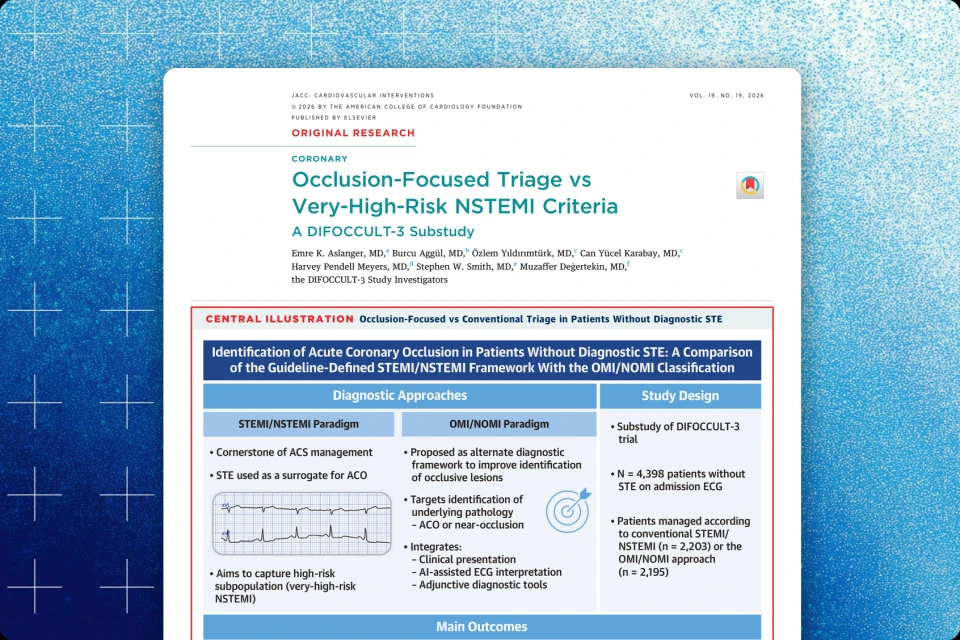
- The paradigm change affected a substantial share of patients: 45.5% were classified as OMI in the OMI/NOMI arm, compared with 35.3% classified as STEMI in the STEMI/NSTEMI arm (P<0.001).
Published in: TCT 2025 – presented as an oral presentation
Published on: 25 October 2025
Background
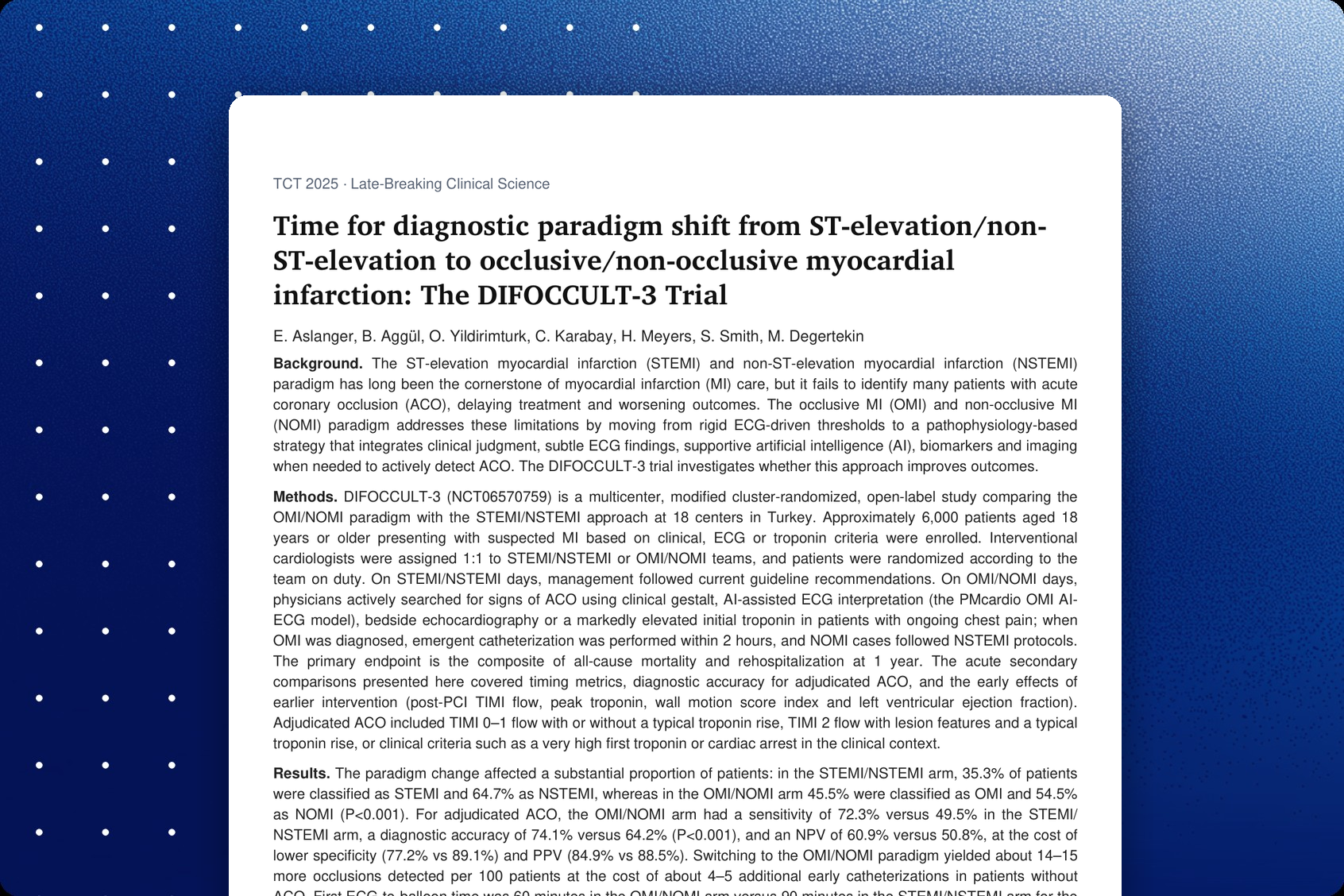
The ST-elevation myocardial infarction (STEMI) and non-ST-elevation myocardial infarction (NSTEMI) paradigm has long been the cornerstone of myocardial infarction (MI) care, but it fails to identify many patients with acute coronary occlusion (ACO), delaying treatment and worsening outcomes. The occlusive MI (OMI) and non-occlusive MI (NOMI) paradigm addresses these limitations by moving from rigid ECG-driven thresholds to a pathophysiology-based strategy that integrates clinical judgment, subtle ECG findings, supportive artificial intelligence (AI), biomarkers and imaging when needed to actively detect ACO. The DIFOCCULT-3 trial investigates whether this approach improves outcomes.
Methods
DIFOCCULT-3 (NCT06570759) is a multicenter, modified cluster-randomized, open-label study comparing the OMI/NOMI paradigm with the STEMI/NSTEMI approach at 18 centers in Turkey. Approximately 6,000 patients aged 18 years or older presenting with suspected MI based on clinical, ECG or troponin criteria were enrolled. Interventional cardiologists were assigned 1:1 to STEMI/NSTEMI or OMI/NOMI teams, and patients were randomized according to the team on duty. On STEMI/NSTEMI days, management followed current guideline recommendations. On OMI/NOMI days, physicians actively searched for signs of ACO using clinical gestalt, AI-assisted ECG interpretation (the PMcardio OMI AI-ECG model), bedside echocardiography or a markedly elevated initial troponin in patients with ongoing chest pain; when OMI was diagnosed, emergent catheterization was performed within 2 hours, and NOMI cases followed NSTEMI protocols. The primary endpoint is the composite of all-cause mortality and rehospitalization at 1 year. The acute secondary comparisons presented here covered timing metrics, diagnostic accuracy for adjudicated ACO, and the early effects of earlier intervention (post-PCI TIMI flow, peak troponin, wall motion score index and left ventricular ejection fraction). Adjudicated ACO included TIMI 0–1 flow with or without a typical troponin rise, TIMI 2 flow with lesion features and a typical troponin rise, or clinical criteria such as a very high first troponin or cardiac arrest in the clinical context.
Results
The paradigm change affected a substantial proportion of patients: in the STEMI/NSTEMI arm, 35.3% of patients were classified as STEMI and 64.7% as NSTEMI, whereas in the OMI/NOMI arm 45.5% were classified as OMI and 54.5% as NOMI (P<0.001). For adjudicated ACO, the OMI/NOMI arm had a sensitivity of 72.3% versus 49.5% in the STEMI/NSTEMI arm, a diagnostic accuracy of 74.1% versus 64.2% (P<0.001), and an NPV of 60.9% versus 50.8%, at the cost of lower specificity (77.2% vs 89.1%) and PPV (84.9% vs 88.5%). Switching to the OMI/NOMI paradigm yielded about 14–15 more occlusions detected per 100 patients at the cost of about 4–5 additional early catheterizations in patients without ACO. First ECG-to-balloon time was 60 minutes in the OMI/NOMI arm versus 90 minutes in the STEMI/NSTEMI arm for the whole cohort (p<0.001), and 64 versus 358 minutes in the NSTEMI-OMI subgroup (p<0.001), a difference of 4 hours 54 minutes. Early outcome measures (wall motion score index, left ventricular ejection fraction, post-PCI TIMI 3 flow and peak troponin) hinted at better early outcomes with the OMI/NOMI approach. The investigators noted as limitations that full adoption of the OMI approach still needs improvement, that standardizing different troponin assays might have obscured the biological picture, that LVEF and wall motion were measured too early to distinguish stunned from infarcted myocardium, and that the definition of adjudicated ACO is not universally agreed.
Conclusion
Switching from the STEMI/NSTEMI paradigm to the OMI/NOMI approach affected a substantial population, improved diagnostic precision for acute coronary occlusion, shortened time to reperfusion and hinted at better early outcomes. Long-term results on mortality and rehospitalization are expected in October 2026.
Share this article



About PMcardio
PMcardio is the market leader in AI-powered diagnostics, addressing the world’s leading cause of death – cardiovascular diseases. The innovative clinical assistant empowers healthcare professionals to detect up to 40 cardiovascular diseases. In the form of a smartphone application, the certified Class IIb medical device interprets any 12-lead ECG image in under 5 seconds to provide accurate diagnoses and individualized treatment recommendations tailored to each patient.

About Powerful Medical
Powerful Medical leads one of the most important shifts in modern medicine by augmenting human-made clinical decisions with artificial intelligence. Our primary focus is on cardiovascular diseases, the world’s leading cause of death.
Established in 2017, Powerful Medical has embarked on a mission to revolutionize the diagnosis and treatment of cardiovascular diseases. We are a medical company backed by 28 world-class cardiologists and led by our expert Scientific Board with decades of experience in daily patient care, clinical research, and medical devices. The results of our research are implemented, developed, certified, and brought to market by our 50+ strong interdisciplinary team of physicians, data scientists, AI experts, software engineers, regulatory specialists, and commercial teams.