
Temporal Trends in the Presentation and Management of ST-Segment Elevation Myocardial Infarction (STEMI)
Overview
This retrospective analysis of the chest pain registry at a tertiary referral center (AZORG, Belgium) examined when emergency chest-pain presentations cluster over the year and over the week. Among 562 patients who presented to the emergency department and underwent catheterization between January 2023 and December 2024 (mean age 68.2 years, 69.6% male), 165 (29.4%) were diagnosed with STEMI. Presentations were not evenly distributed: they peaked in April and were lowest in October (p=0.003), and they were highest on Mondays and Fridays and lowest at weekends (p=0.016). Median door-to-cathlab time was significantly shorter in 2024 than in 2023 (p<0.001).
Key findings
- Of 562 chest-pain patients who presented to the emergency department and underwent catheterization, 165 (29.4%) were diagnosed with STEMI.
- Presentations peaked in April and were lowest in October (p=0.003), with consistent monthly patterns across both years (p=0.30).
- Admissions were highest on Mondays and Fridays and lowest at weekends (p=0.016), a weekly pattern that held across all months (p=0.329).
- Among STEMI patients, the shortest median door-to-cathlab time was observed in April (0.4 hours), although the difference versus other months was not significant (p=0.158).
Published in: 45th International Symposium on Intensive Care and Emergency Medicine (ISICEM) 2026 – presented as a poster
Published on: 20 March 2026
Background
Despite advances in acute coronary care, temporal variations in ST-segment elevation myocardial infarction (STEMI) presentation rates and management patterns remain incompletely understood. Identifying periods of higher or lower STEMI incidence could provide insights into population, environmental or system-level factors affecting emergency cardiac care, and understanding these variations is essential to optimize emergency department preparedness and resource allocation.
Methods
The authors performed a retrospective observational analysis of the chest pain registry at a tertiary referral center. The registry included all consecutive patients presenting with acute chest pain or equivalent symptoms who underwent cardiac catheterization between January 2023 and December 2024. Demographics, clinical and procedural characteristics, 12-lead ECG findings and management metrics were recorded for each patient. Temporal patterns in STEMI incidence were analyzed across days, weeks and months using time-series analyses, and management metrics, including door-to-cathlab time and in-hospital mortality, were compared between high- and low-incidence periods.
Results
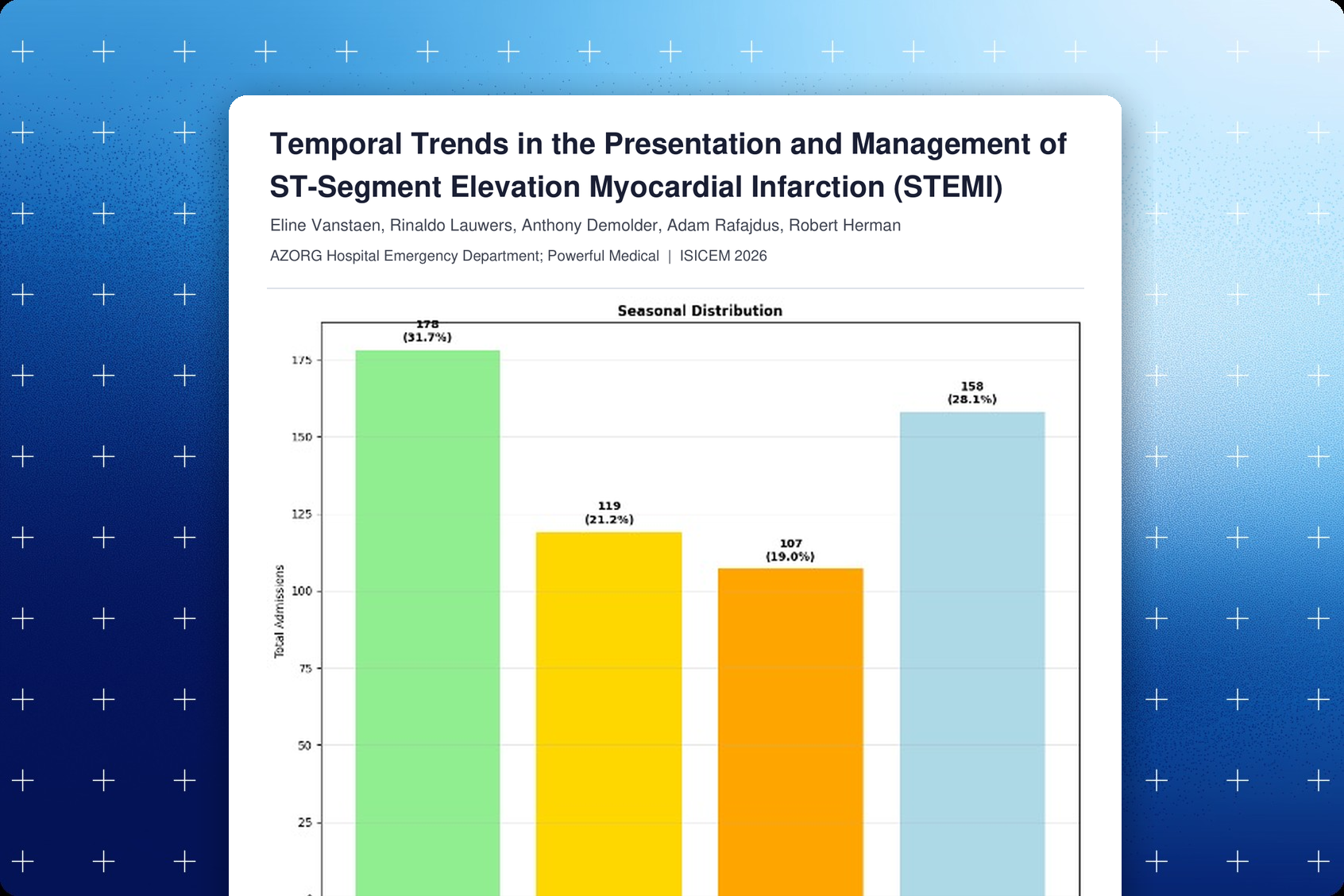
Among 562 chest-pain patients presenting to the emergency department and undergoing catheterization (mean age 68.2 ± 13.4 years, 69.6% male), 165 (29.4%) were diagnosed with STEMI. Chest-pain presentations were not uniformly distributed through the year: the busiest month was April, marking a seasonal peak in late winter and early spring, and the lowest incidence was in October (p=0.003, chi-square goodness-of-fit test); by season, spring accounted for 178 admissions (31.7%) and fall for 107 (19.0%). Monthly patterns were consistent across both years (p=0.30). Weekly analyses revealed a cyclical pattern, with the highest concentration of admissions on Mondays and Fridays and the lowest at weekends (p=0.016), and this weekly variation was consistent across all months of the year (p=0.329). Overall median door-to-cathlab time was significantly shorter in 2024 compared with 2023 (15.2 hours [1.5–45.5] vs 7.6 hours [0.9–22.6], p<0.001). Among STEMI patients, the shortest median door-to-cathlab time was observed in April (0.4 hours [0.3–1.1]), suggesting heightened clinical vigilance during clustered presentations, although this difference was not statistically significant compared with other months (p=0.158).
Conclusion
In this single-center chest pain registry, STEMI presentations showed clear temporal variation, peaking in late winter and early spring and reaching a low in autumn, with higher admissions on Mondays and Fridays and fewer at weekends. Temporal monitoring of STEMI activity may support more responsive resource planning in acute cardiac care.
Share this article



About PMcardio
PMcardio is the market leader in AI-powered diagnostics, addressing the world’s leading cause of death – cardiovascular diseases. The innovative clinical assistant empowers healthcare professionals to detect up to 40 cardiovascular diseases. In the form of a smartphone application, the certified Class IIb medical device interprets any 12-lead ECG image in under 5 seconds to provide accurate diagnoses and individualized treatment recommendations tailored to each patient.

About Powerful Medical
Powerful Medical leads one of the most important shifts in modern medicine by augmenting human-made clinical decisions with artificial intelligence. Our primary focus is on cardiovascular diseases, the world’s leading cause of death.
Established in 2017, Powerful Medical has embarked on a mission to revolutionize the diagnosis and treatment of cardiovascular diseases. We are a medical company backed by 28 world-class cardiologists and led by our expert Scientific Board with decades of experience in daily patient care, clinical research, and medical devices. The results of our research are implemented, developed, certified, and brought to market by our 50+ strong interdisciplinary team of physicians, data scientists, AI experts, software engineers, regulatory specialists, and commercial teams.