
Subsequent ECG STEMI Predicted on Time Zero ECG by an Artificial Intelligence Model
Overview
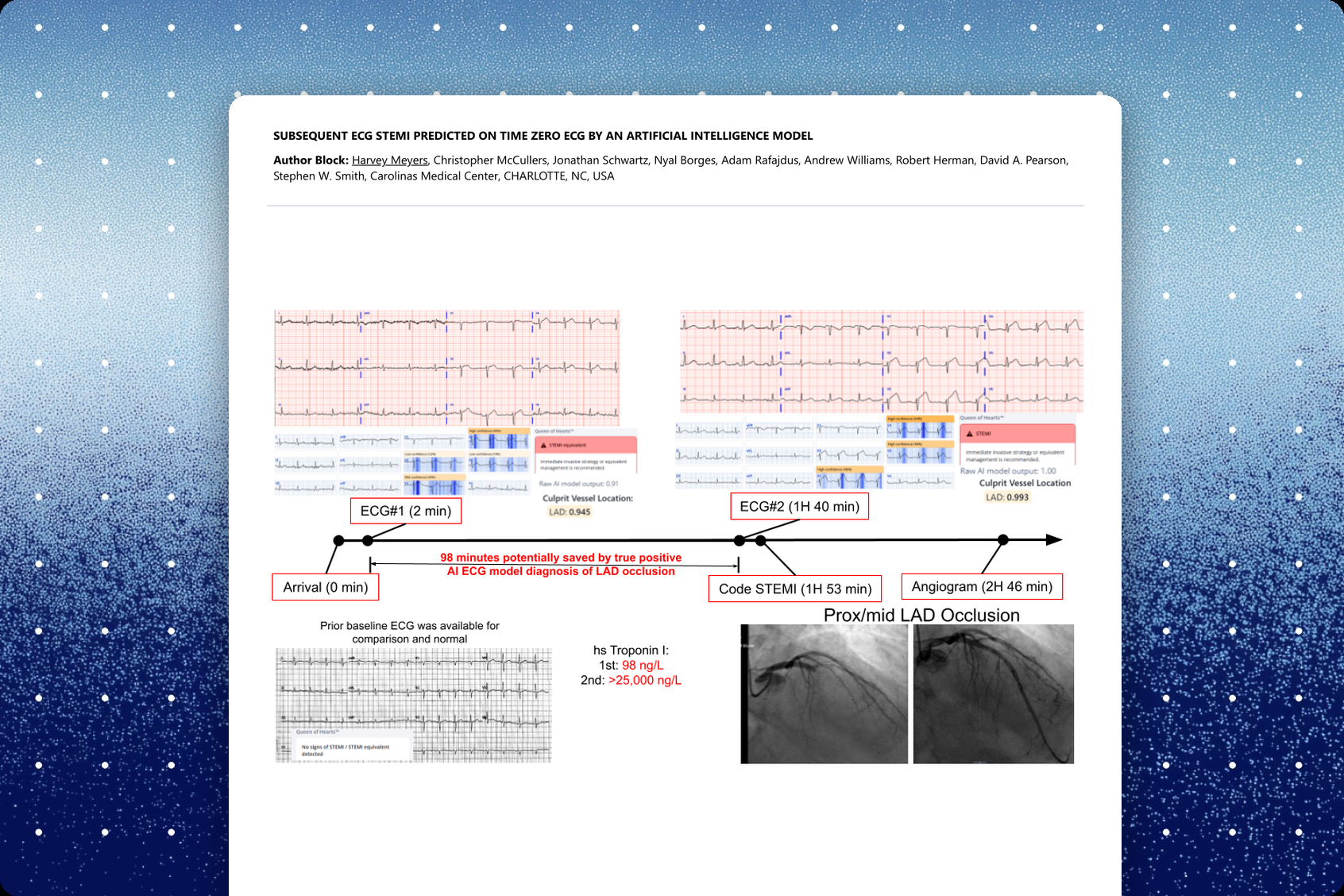
This retrospective study from a STEMI network of 3 PCI centers and 30 referring emergency departments around Charlotte, North Carolina, focused on patients whose first ECG was considered nondiagnostic and whose STEMI was recognized only on a subsequent ECG. Over 3.3 years, 380 such patients were included, representing 19% of all STEMIs. Applied retrospectively to the initial ECG, the PMcardio Queen of Hearts AI-ECG model identified 297 of the 380 patients (78%) as STEMI equivalent, a mean of 68 minutes before the diagnostic STEMI ECG. The model also predicted the culprit artery in 77% of patients and the leads that later developed diagnostic ST elevation in 94%.
Key findings
- Subsequent ECG STEMIs, in which the initial ECG was nondiagnostic, made up 19% of all STEMIs: 380 patients over 3.3 years, with a mean delay of 74 minutes to the diagnostic ECG.
- The AI model identified 297 of 380 patients (78%) as STEMI equivalent on the initial nondiagnostic ECG, a mean of 68 minutes before the diagnostic STEMI ECG.
- The AI model correctly predicted the culprit artery in 77% of patients and the initial ECG leads that later developed diagnostic ST elevation in 94%.
- Of 29 patients who died within 2 months, 28 were among those the AI model identified on the initial ECG.
Published in: ACC.26 (American College of Cardiology Annual Scientific Session 2026) – presented as a poster; abstract published in the Journal of the American College of Cardiology (JACC)
Published on: 29 March 2026
Background
Rapid and accurate recognition of ST-elevation myocardial infarction (STEMI) is essential. Having previously shown reduced false-positive cath lab activations with an artificial intelligence (AI) electrocardiogram (ECG) model, the investigators evaluated its ability to detect STEMI equivalents on initial “nondiagnostic” ECGs in patients later diagnosed with STEMI on a subsequent ECG.
Methods
From a STEMI database covering 3 PCI centers and 30 referring emergency departments (Atrium Health Carolinas Medical Center, Charlotte, North Carolina, USA), the investigators included all subsequent ECG code STEMI patients with an available initial ECG, a subsequent STEMI ECG and a post-catheterization, cardiologist-confirmed STEMI diagnosis. The ECGs were analyzed retrospectively by the PMcardio Queen of Hearts AI-ECG model.
Results
Over 3.3 years, 380 subsequent ECG code STEMIs were included (19% of all STEMIs; 72% male; mean age 61 years). Arrival was by walk-in in 57% and by ambulance in 43%, and 42% presented directly to a PCI center while 58% were transferred. Culprit arteries were the LAD in 43%, RCA in 33%, LCx in 19% and other in 4%, and 29 patients died within 2 months. The mean delay from the initial “nondiagnostic” ECG to the subsequent STEMI ECG was 74 minutes. The AI model correctly identified 297 of 380 patients (78%) as STEMI equivalent on the initial “nondiagnostic” ECG; in these patients, the mean delay to the diagnostic ECG was 68 minutes, and 28 deaths (9.4%) occurred. The model correctly predicted the culprit artery in 77% and the initial ECG leads that later developed diagnostic ST elevation on the subsequent ECG in 94%.
Conclusion
In addition to reducing false-positive activations, the AI ECG model identified 78% of subsequent ECG STEMI patients a mean of 68 minutes earlier, using ECGs that were initially nondiagnostic to clinicians.
Share this article



About PMcardio
PMcardio is the market leader in AI-powered diagnostics, addressing the world’s leading cause of death – cardiovascular diseases. The innovative clinical assistant empowers healthcare professionals to detect up to 40 cardiovascular diseases. In the form of a smartphone application, the certified Class IIb medical device interprets any 12-lead ECG image in under 5 seconds to provide accurate diagnoses and individualized treatment recommendations tailored to each patient.

About Powerful Medical
Powerful Medical leads one of the most important shifts in modern medicine by augmenting human-made clinical decisions with artificial intelligence. Our primary focus is on cardiovascular diseases, the world’s leading cause of death.
Established in 2017, Powerful Medical has embarked on a mission to revolutionize the diagnosis and treatment of cardiovascular diseases. We are a medical company backed by 28 world-class cardiologists and led by our expert Scientific Board with decades of experience in daily patient care, clinical research, and medical devices. The results of our research are implemented, developed, certified, and brought to market by our 50+ strong interdisciplinary team of physicians, data scientists, AI experts, software engineers, regulatory specialists, and commercial teams.