
Smartphone-based AI-enhanced ECG Detection of Left Ventricular Systolic Dysfunction in Chagas Disease: External Validation in a Resource-limited Setting
Overview
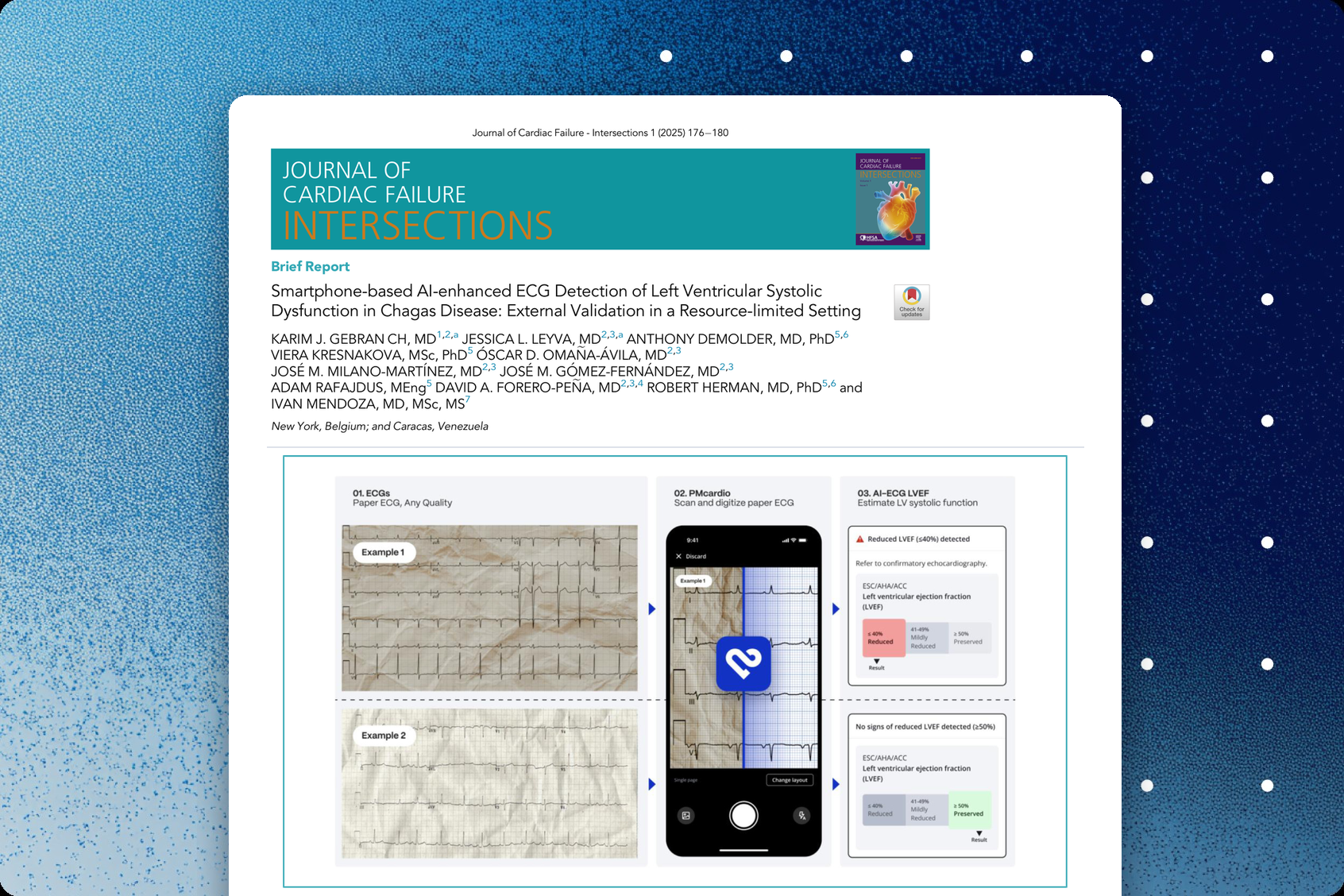
Patients with Chagas disease often live in low-resource communities where echocardiography is hard to access, yet early detection of left ventricular systolic dysfunction (LVSD) is key to improving their outcomes. This retrospective external validation at the Central University of Venezuela in Caracas tested the PMcardio AI-ECG LVEF model on paper ECGs that were simply photographed and digitized with a smartphone, using echocardiography within 1 month as the reference. Of 326 paper ECGs collected, 293 (89.8%) were successfully digitized and analyzed. At an LVEF threshold of <50%, the model achieved an AUC of 0.917 with 90.5% sensitivity and a 98.1% negative predictive value; at ≤40%, the AUC was 0.921 with 93.1% sensitivity and a 99.1% negative predictive value. Despite a modest positive predictive value, the model performed well in a population outside its training data, supporting smartphone AI-ECG as a low-cost, scalable screening tool for reduced LVEF in Chagas disease.
Key findings
- Of 326 paper ECGs from patients with Chagas disease, 293 (89.8%) were successfully photographed, digitized and analyzed with the PMcardio smartphone app; reduced LVEF prevalence was 14.3% (<50%) and 9.9% (≤40%).
- For LVEF <50%, the AI-ECG model reached an AUC of 0.917, sensitivity of 90.5%, specificity of 83.7% and NPV of 98.1%, identifying 38 of 42 patients with reduced LVEF.
- For LVEF ≤40%, the model reached an AUC of 0.921, sensitivity of 93.1%, specificity of 83.0% and NPV of 99.1%; PPV was modest at both thresholds (48.1% and 37.5%).
- After excluding low-quality ECG images, performance improved to an AUC of 0.949 (LVEF <50%) and 0.959 (LVEF ≤40%), with NPV of 99% and 100%, respectively.
Published in: Journal of Cardiac Failure - Intersections
Published on: 23 September 2025
Background
Chagas disease is a largely neglected tropical disease affecting an estimated 6 to 7 million people, most of them in Latin America, and 20–30% of those infected develop chronic Chagas cardiomyopathy, a progressive and often arrhythmogenic form associated with heart failure. Early detection and treatment of left ventricular systolic dysfunction (LVSD) are essential to reduce mortality and improve quality of life, but this is particularly challenging in the resource-limited communities where most patients with Chagas disease live. AI-enhanced ECG analysis of paper ECGs captured with a smartphone could offer a scalable, low-cost way to identify patients who need further assessment.
Methods
This retrospective external validation study used 326 paper-based ECGs from patients with Chagas disease confirmed by enzyme-linked immunosorbent assay (ELISA) and a transthoracic echocardiogram within 1 month, seen at the Tropical Cardiology Section of Tropical Medicine of the Universidad Central de Venezuela in Caracas. The paper ECGs were photographed, digitized and analyzed through the researchers' smartphones with the PMcardio app, using an AI-ECG LVEF model previously developed and validated on paired ECGs and echocardiograms from the Cardiovascular Center Aalst data vault. Performance was assessed at two LVEF thresholds (<50% and ≤40%) against existing echocardiography reports, using sensitivity, specificity, positive predictive value (PPV) and negative predictive value (NPV). A post hoc analysis excluded low-quality ECG images (faded ink, major artifacts affecting multiple leads or severe signal loss), assessed by a single rater blinded to the AI prediction.
Results
In total, 293 paper ECGs (89.8%) were successfully photographed, digitized and included in the analysis, and the prevalence of reduced LVEF was 14.3% at the <50% threshold and 9.9% at the ≤40% threshold. At LVEF <50%, the model achieved an AUC of 0.917, sensitivity of 90.5%, specificity of 83.7%, PPV of 48.1% and NPV of 98.1%. At LVEF ≤40%, the AUC was 0.921, with sensitivity of 93.1%, specificity of 83.0%, PPV of 37.5% and NPV of 99.1%. After excluding low-quality images, performance improved: at LVEF <50%, the AUC was 0.949 with sensitivity of 94.4%, specificity of 87.6%, PPV of 54.8% and NPV of 99%; at LVEF ≤40%, the AUC was 0.959 with sensitivity of 100%, specificity of 86.9%, PPV of 44.6% and NPV of 100%. The model performed well despite having been developed on a different population, suggesting that the distinctive features of Chagas cardiomyopathy do not prevent AI-ECG recognition of LVSD.
Conclusion
The smartphone-based PMcardio AI-ECG model is a novel, low-cost, scalable and effective screening tool for detecting reduced LVEF in patients with Chagas disease, particularly in low-resource settings. Its high sensitivity and NPV can help decide who needs further diagnostic testing, while its modest PPV warrants combining it with clinical judgment; more research is needed to define its appropriate use in clinical practice.
Share this article



About PMcardio
PMcardio is the market leader in AI-powered diagnostics, addressing the world’s leading cause of death – cardiovascular diseases. The innovative clinical assistant empowers healthcare professionals to detect up to 40 cardiovascular diseases. In the form of a smartphone application, the certified Class IIb medical device interprets any 12-lead ECG image in under 5 seconds to provide accurate diagnoses and individualized treatment recommendations tailored to each patient.

About Powerful Medical
Powerful Medical leads one of the most important shifts in modern medicine by augmenting human-made clinical decisions with artificial intelligence. Our primary focus is on cardiovascular diseases, the world’s leading cause of death.
Established in 2017, Powerful Medical has embarked on a mission to revolutionize the diagnosis and treatment of cardiovascular diseases. We are a medical company backed by 28 world-class cardiologists and led by our expert Scientific Board with decades of experience in daily patient care, clinical research, and medical devices. The results of our research are implemented, developed, certified, and brought to market by our 50+ strong interdisciplinary team of physicians, data scientists, AI experts, software engineers, regulatory specialists, and commercial teams.