
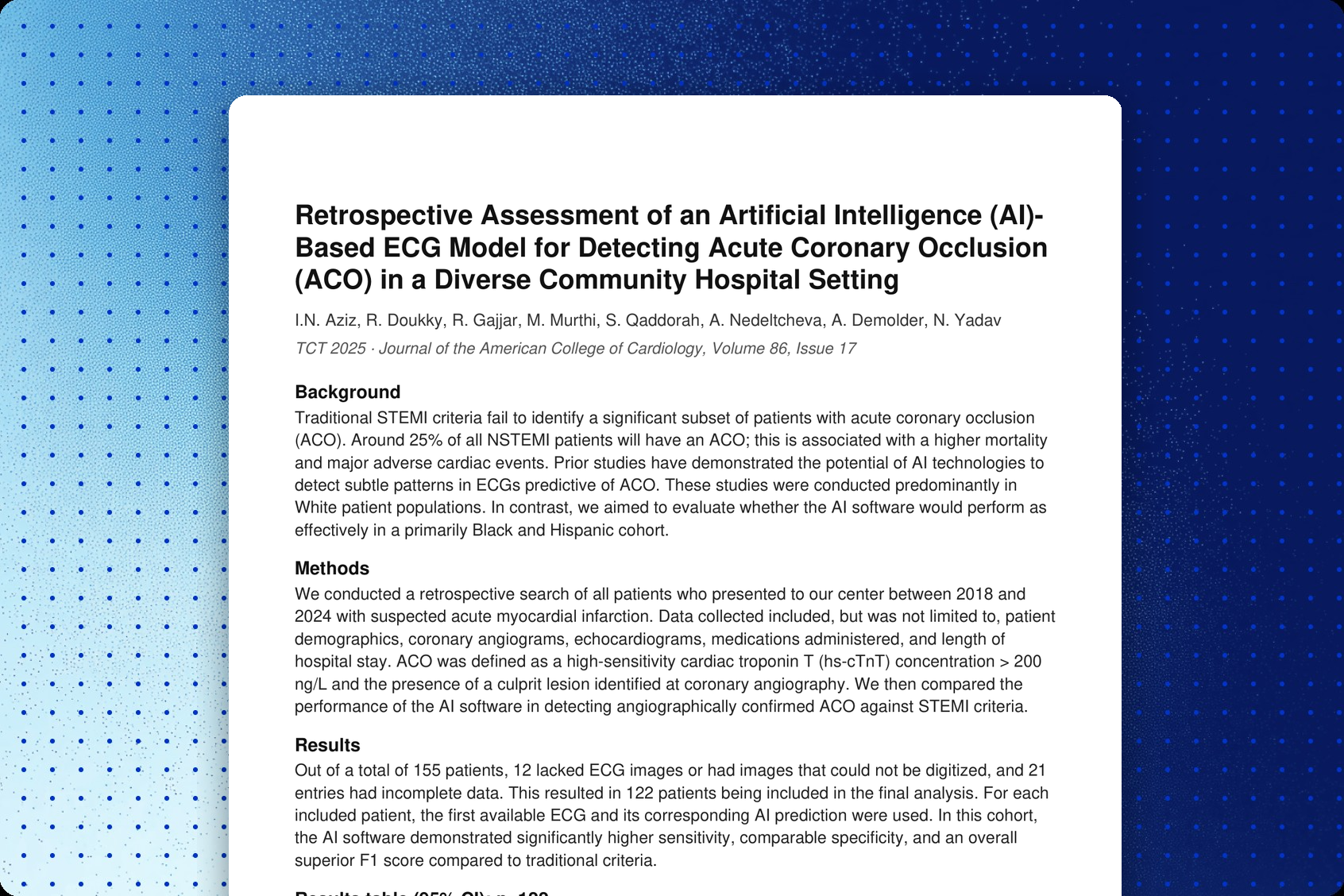
Retrospective Assessment of an Artificial Intelligence (AI)-Based ECG Model for Detecting Acute Coronary Occlusion (ACO) in a Diverse Community Hospital Setting
Overview
Earlier studies of AI-ECG detection of acute coronary occlusion (ACO) were conducted mainly in White populations. This retrospective study at Cook County Health, a diverse US community hospital, evaluated the PMcardio Queen of Hearts AI-ECG model (aOMI v1) in 122 patients with suspected acute myocardial infarction between 2018 and 2024, most of them Black or Hispanic. ACO, defined as a culprit lesion at angiography with high-sensitivity troponin T above 200 ng/L, was present in 80 patients (65.6%). On the first available ECG, the AI model detected 42.5% of occlusions versus 18.8% with STEMI criteria, with comparable specificity (90.5% vs 92.9%) and a higher F1 score (0.576 vs 0.306).
Key findings
- Of 155 patients screened, 122 were analyzed (49% Black, 30% Hispanic, 11% White, 9% Asian), and 80 (65.6%) had angiographically confirmed acute coronary occlusion.
- The AI model's sensitivity for ACO was 42.5%, compared with 18.8% for STEMI criteria and 25.0% for the managed-within-120-minutes comparator.
- Specificity was comparable (90.5% for the AI model vs 92.9% for STEMI criteria), with a PPV of 89.5% vs 83.3%.
- The AI model had a higher F1 score (0.576 vs 0.306) and accuracy (0.59 vs 0.443) than STEMI criteria.
Published in: TCT 2025 – presented as an oral presentation; abstract published in the Journal of the American College of Cardiology (JACC)
Published on: 27 October 2025
Background
Traditional STEMI criteria fail to identify a significant subset of patients with acute coronary occlusion (ACO). Around 25% of all patients with NSTEMI have an ACO, which is associated with higher mortality and more major adverse cardiac events. Previous studies have shown that AI technologies can detect subtle ECG patterns predictive of ACO, but these studies were conducted predominantly in White patient populations. This study evaluated whether the AI software performs as effectively in a primarily Black and Hispanic cohort.
Methods
The investigators retrospectively identified all patients who presented to their center, Cook County Health, between 2018 and 2024 with suspected acute myocardial infarction. Collected data included patient demographics, coronary angiograms, echocardiograms, medications administered and length of hospital stay. ACO was defined as a high-sensitivity cardiac troponin T (hs-cTnT) concentration above 200 ng/L together with a culprit lesion identified at coronary angiography. For each patient, the first available ECG and its prediction by the PMcardio Queen of Hearts AI-ECG model (aOMI v1) were used, and the performance of the AI model in detecting angiographically confirmed ACO was compared with STEMI criteria.
Results
Of 155 patients, 12 lacked ECG images or had images that could not be digitized and 21 had incomplete data, leaving 122 patients in the final analysis (49% Black, 30% Hispanic, 11% White and 9% Asian). ACO was present in 80 patients (65.6%). The AI model had a sensitivity of 0.425 (95% CI 0.316–0.536), compared with 0.188 (0.107–0.275) for STEMI criteria and 0.25 (0.16–0.347) for the managed-within-120-minutes comparator. Specificity was 0.905 (0.806–0.979) for the AI model and 0.929 (0.842–1.0) for STEMI criteria; PPV was 0.895 versus 0.833 and NPV 0.452 versus 0.375. Overall accuracy was 0.59 (0.50–0.68) versus 0.443 (0.358–0.529), and the F1 score was 0.576 (0.460–0.678) versus 0.306 (0.186–0.420). In this cohort, the AI model showed significantly higher sensitivity, comparable specificity and an overall superior F1 score compared with traditional criteria.
Conclusion
The AI-ECG model outperformed STEMI criteria in detecting acute coronary occlusion in this diverse patient population. These results highlight the potential of AI to support a shift toward an occlusion myocardial infarction paradigm, improving care for patients with ACO regardless of ST-segment elevation.
Share this article



About PMcardio
PMcardio is the market leader in AI-powered diagnostics, addressing the world’s leading cause of death – cardiovascular diseases. The innovative clinical assistant empowers healthcare professionals to detect up to 40 cardiovascular diseases. In the form of a smartphone application, the certified Class IIb medical device interprets any 12-lead ECG image in under 5 seconds to provide accurate diagnoses and individualized treatment recommendations tailored to each patient.

About Powerful Medical
Powerful Medical leads one of the most important shifts in modern medicine by augmenting human-made clinical decisions with artificial intelligence. Our primary focus is on cardiovascular diseases, the world’s leading cause of death.
Established in 2017, Powerful Medical has embarked on a mission to revolutionize the diagnosis and treatment of cardiovascular diseases. We are a medical company backed by 28 world-class cardiologists and led by our expert Scientific Board with decades of experience in daily patient care, clinical research, and medical devices. The results of our research are implemented, developed, certified, and brought to market by our 50+ strong interdisciplinary team of physicians, data scientists, AI experts, software engineers, regulatory specialists, and commercial teams.