
Real-world insights from an AI-ECG decision support platform: AI vs. blinded HCP STEMI ECG interpretation
Overview
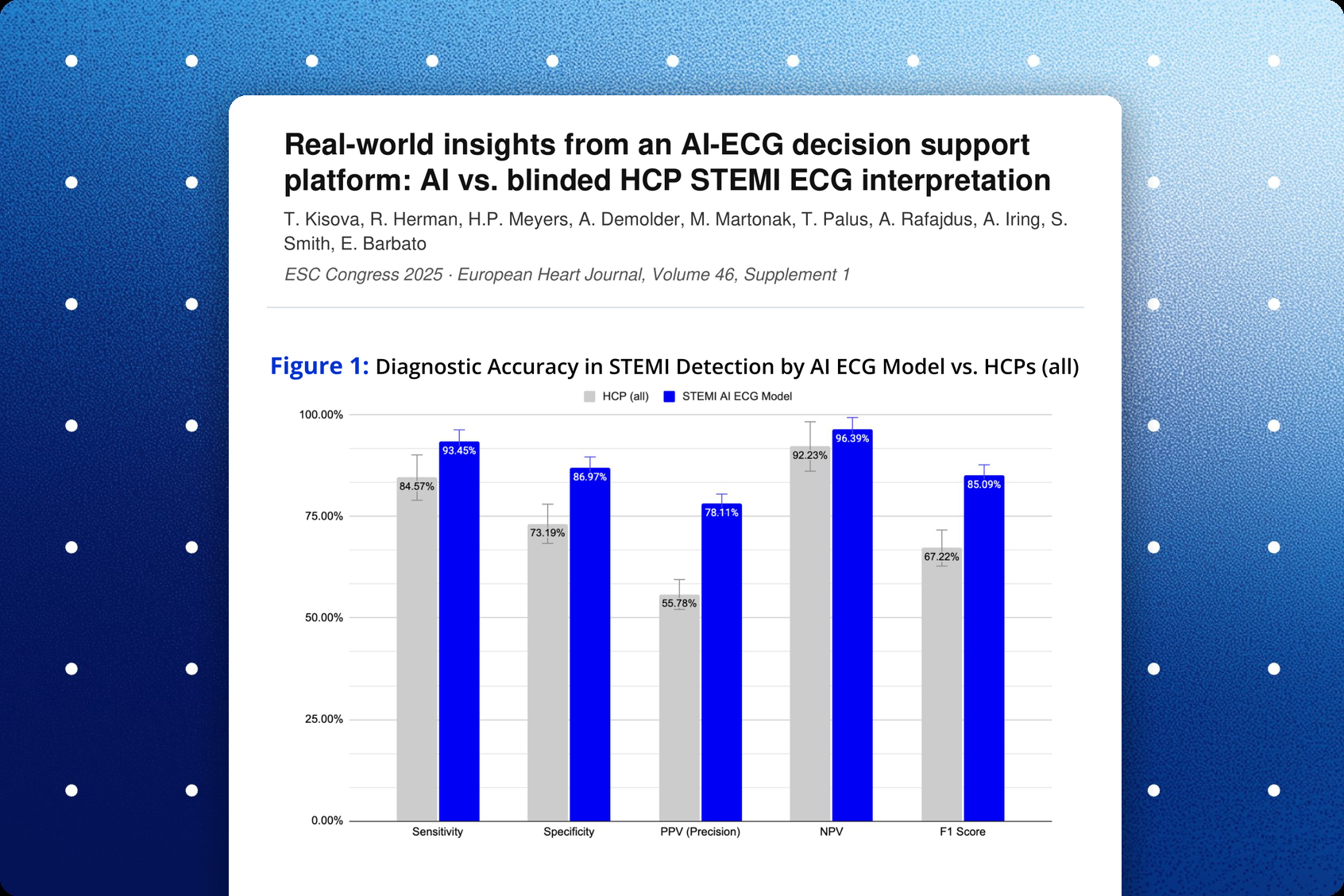
This retrospective analysis used 4,598 consecutive 12-lead ECGs uploaded by 1,423 users to the PMcardio AI-ECG decision-support platform between June 2023 and January 2024, with two expert physicians' STEMI classification as the reference standard. The PMcardio Queen of Hearts AI model (aOMI v1) detected STEMI with 93.5% sensitivity and 87.0% specificity, compared with 84.6% and 73.2% for healthcare professionals' own initial readings, which were made blinded to the AI output and were available for 1,423 ECGs. The AI outperformed the professionals on every metric (p<0.001), including positive predictive value (78.0% vs 55.8%). Cardiologists had a higher PPV than other professionals, but the AI remained superior to every subgroup.
Key findings
- On all 4,598 ECGs, the AI model achieved 93.5% sensitivity, 87.0% specificity, 78.0% PPV, 96.4% NPV and an F1 score of 85.1%.
- Blinded initial interpretations by 356 healthcare professionals (1,423 ECGs) reached 84.6% sensitivity, 73.2% specificity, 55.8% PPV, 92.3% NPV and an F1 score of 67.2% (p<0.001 for all comparisons with the AI).
- Cardiologists had a higher PPV (66.9%) than non-cardiologist physicians (56.7%) and non-physician professionals (52.0%; p=0.012), with no significant differences in sensitivity, specificity or NPV.
- The AI model remained superior to every professional subgroup, including cardiologists (p<0.05).
Published in: ESC Congress 2025 (European Heart Journal, Volume 46, Supplement 1)
Published on: 29 August 2025
Background
Early and accurate identification of ST-elevation myocardial infarction (STEMI) is critical for timely reperfusion therapy and better patient outcomes, yet the accuracy of STEMI detection from the electrocardiogram (ECG) varies among healthcare professionals (HCPs). Artificial intelligence (AI)-assisted ECG interpretation has the potential to reduce this variability and improve diagnostic accuracy, particularly in real-world settings where providers have diverse levels of expertise. This study compared the diagnostic performance of AI-assisted ECG analysis with self-reported HCP interpretations for STEMI detection, using real-world data from an AI-integrated ECG analysis platform.
Methods
A total of 4,598 consecutive 12-lead ECGs were uploaded to the PMcardio AI-ECG platform between June 2023 and January 2024 by 1,423 users seeking AI decision support. Two expert physicians provided the reference standard and classified 1,527 (33%) ECGs as STEMI. The AI ECG model, PMcardio Queen of Hearts (aOMI v1), was evaluated on the full dataset. For 1,423 (30%) ECGs, 356 HCPs had provided a self-declared initial interpretation, blinded to the AI output; these HCPs included 65 (18%) cardiologists, 199 (56%) non-cardiologist physicians and 92 (26%) non-physician HCPs. Diagnostic performance for STEMI detection was assessed with sensitivity, specificity, positive predictive value (PPV), negative predictive value (NPV) and F1 score, with 95% confidence intervals calculated using the Wilson score interval and statistical significance determined with the chi-square test.
Results
The AI ECG model significantly outperformed HCPs across all evaluated metrics (p<0.001). On the 4,598 ECGs, the AI achieved 93.5% sensitivity, 87.0% specificity, 78.0% PPV, 96.4% NPV and an F1 score of 85.1%. In contrast, HCPs across all training levels had 84.6% sensitivity, 73.2% specificity, 55.8% PPV, 92.3% NPV and an F1 score of 67.2%. By HCP role, cardiologists had a significantly higher PPV (66.9%) than non-cardiologist physicians (56.7%) and non-physicians (52.0%) (p=0.012), while sensitivity, specificity and NPV did not differ significantly between roles. The AI remained superior to all subgroups (p<0.05).
Conclusion
The AI ECG model demonstrated significantly higher diagnostic accuracy than healthcare professionals overall, including cardiologists. AI-assisted ECG analysis may improve early STEMI detection, reduce misdiagnoses and support clinical decision-making. Further research is warranted to evaluate its impact on time to reperfusion and patient outcomes.
Share this article



About PMcardio
PMcardio is the market leader in AI-powered diagnostics, addressing the world’s leading cause of death – cardiovascular diseases. The innovative clinical assistant empowers healthcare professionals to detect up to 40 cardiovascular diseases. In the form of a smartphone application, the certified Class IIb medical device interprets any 12-lead ECG image in under 5 seconds to provide accurate diagnoses and individualized treatment recommendations tailored to each patient.

About Powerful Medical
Powerful Medical leads one of the most important shifts in modern medicine by augmenting human-made clinical decisions with artificial intelligence. Our primary focus is on cardiovascular diseases, the world’s leading cause of death.
Established in 2017, Powerful Medical has embarked on a mission to revolutionize the diagnosis and treatment of cardiovascular diseases. We are a medical company backed by 28 world-class cardiologists and led by our expert Scientific Board with decades of experience in daily patient care, clinical research, and medical devices. The results of our research are implemented, developed, certified, and brought to market by our 50+ strong interdisciplinary team of physicians, data scientists, AI experts, software engineers, regulatory specialists, and commercial teams.