
Real-world adoption and use of PMcardio, an AI-powered ECG interpretation platform, in emergency care
Overview
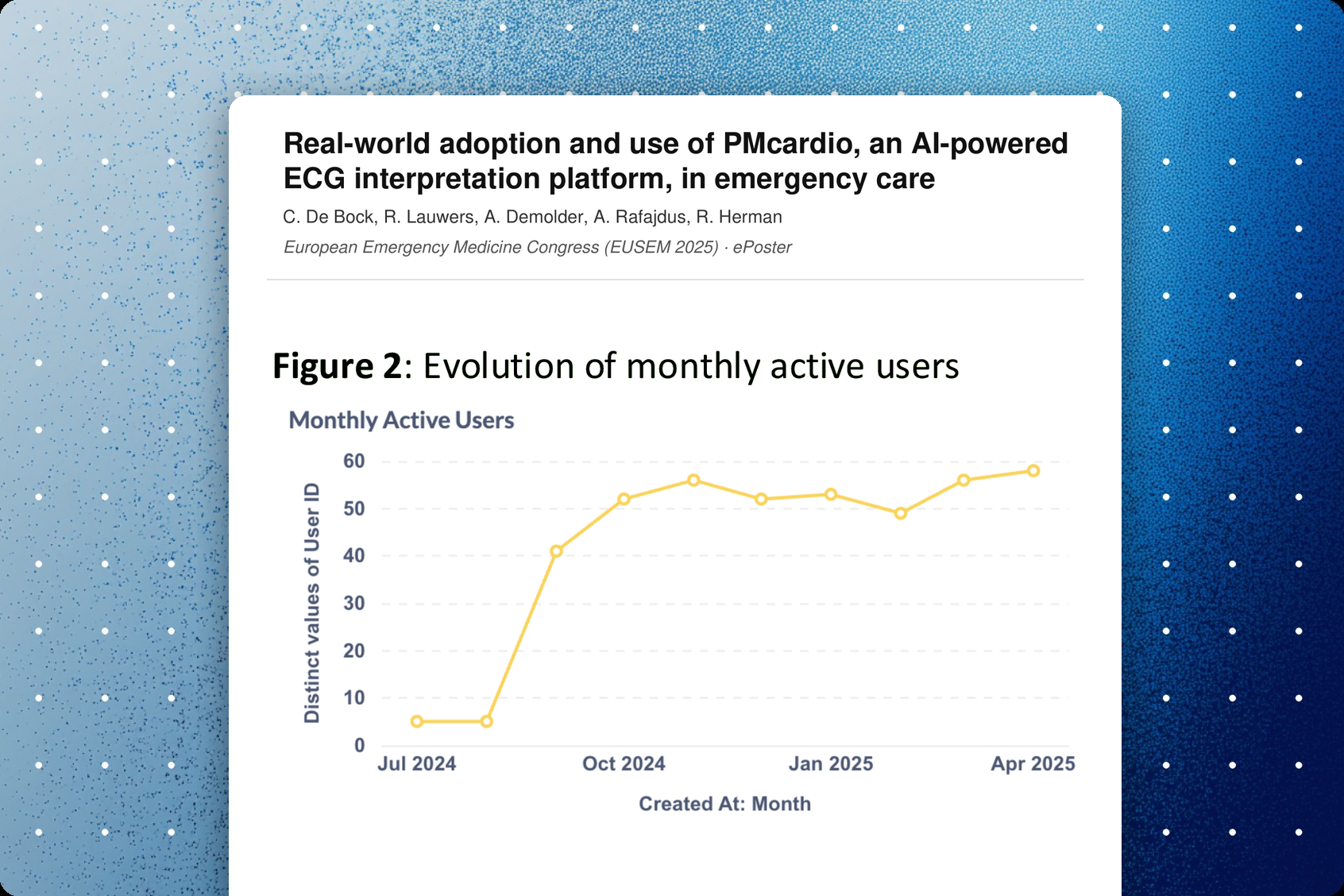
This retrospective observational study describes how the PMcardio AI-ECG platform was adopted in the emergency department and prehospital service of AZORG Aalst, Belgium, between 1 July 2024 and 30 April 2025. A total of 181 users, including emergency physicians, nurses and prehospital teams, scanned 2,838 ECGs, about 13 per day, with an average of 58 monthly, 46 weekly and 11 daily active users. The AI flagged occlusion myocardial infarction (OMI) in 8.2% of ECGs and returned its interpretation in under 10 seconds, and the median time from ECG acquisition to a user-initiated alert was under 10 minutes. The study assessed adoption and use, not diagnostic accuracy.
Key findings
- 181 users scanned 2,838 ECGs over the study period, about 13 per day, with 382 ECGs (13.5%) added in the most recent 30 days.
- On average, the platform had 58 monthly, 46 weekly and 11 daily active users, with high adoption among prehospital teams (PIT/MUG) and emergency department nurses.
- 80.2% of ECGs were recorded in hospital and 19.8% in the prehospital setting; 85.8% of scans came from smartphones and 14.2% from automated integration with prehospital ECG devices.
- The AI identified OMI in 8.2% of ECGs, delivered its output in under 10 seconds, and the median time from ECG acquisition to a user-initiated alert was under 10 minutes.
Published in: European Emergency Medicine Congress (EUSEM 2025) – presented as an ePoster
Published on: 30 September 2025
Background
Timely interpretation of the 12-lead electrocardiogram (ECG) is critical in the diagnosis and management of acute coronary syndromes (ACS), particularly occlusion myocardial infarction (OMI). PMcardio is an AI-powered platform that allows clinicians to scan and analyze ECGs with a mobile device. This study evaluated the real-world implementation, usage patterns and user engagement with PMcardio in an emergency care setting.
Methods
The authors conducted a retrospective, observational analysis of all ECGs scanned with PMcardio at AZORG Aalst hospital between 1 July 2024 and 30 April 2025. The AI-powered ECG interpretation platform was deployed across the emergency department, including physicians, nurses and prehospital teams. ECGs could be scanned with a smartphone or transmitted automatically from prehospital ECG devices. Usage metrics, diagnostic output from the ACS module (OMI detection) and user feedback data were analyzed, together with adoption variables such as retention, scan frequency and time from ECG acquisition to AI interpretation.
Results
A total of 2,838 ECGs were analyzed with PMcardio during the study period, scanned by 181 users; 382 ECGs (13.5%) were added within the most recent 30 days. On average, the user base consisted of 58 monthly, 46 weekly and 11 daily active users, and about 13 ECGs were scanned per day. Most use occurred on weekdays, with peak activity during daytime hours. The AI algorithm identified OMI in 8.2% of cases, and the median time from ECG acquisition to a user-initiated alert was under 10 minutes. User behavior analysis showed high adoption among prehospital teams (PIT/MUG) and emergency department nurses. Approximately 80.2% of ECGs were recorded in the hospital and 19.8% in the prehospital setting. Mobile devices accounted for 85.8% of scans, while 14.2% came from automated integrations with prehospital ECG devices. The time between ECG acquisition and AI interpretation was consistently under 10 seconds.
Conclusion
In this high-volume emergency care center, PMcardio was rapidly adopted and used consistently across diverse user profiles. The AI system provided fast support for OMI detection, helping to shorten time to decision-making, and its ease of use and mobile accessibility allowed integration into both hospital and prehospital workflows. These findings support the potential of AI-driven ECG tools to enhance early triage and empower broader clinical teams in acute cardiovascular care.
Share this article



About PMcardio
PMcardio is the market leader in AI-powered diagnostics, addressing the world’s leading cause of death – cardiovascular diseases. The innovative clinical assistant empowers healthcare professionals to detect up to 40 cardiovascular diseases. In the form of a smartphone application, the certified Class IIb medical device interprets any 12-lead ECG image in under 5 seconds to provide accurate diagnoses and individualized treatment recommendations tailored to each patient.

About Powerful Medical
Powerful Medical leads one of the most important shifts in modern medicine by augmenting human-made clinical decisions with artificial intelligence. Our primary focus is on cardiovascular diseases, the world’s leading cause of death.
Established in 2017, Powerful Medical has embarked on a mission to revolutionize the diagnosis and treatment of cardiovascular diseases. We are a medical company backed by 28 world-class cardiologists and led by our expert Scientific Board with decades of experience in daily patient care, clinical research, and medical devices. The results of our research are implemented, developed, certified, and brought to market by our 50+ strong interdisciplinary team of physicians, data scientists, AI experts, software engineers, regulatory specialists, and commercial teams.