
Potential Reduction of False Positive STEMI Activations by an Artificial Intelligence ECG Model
Overview
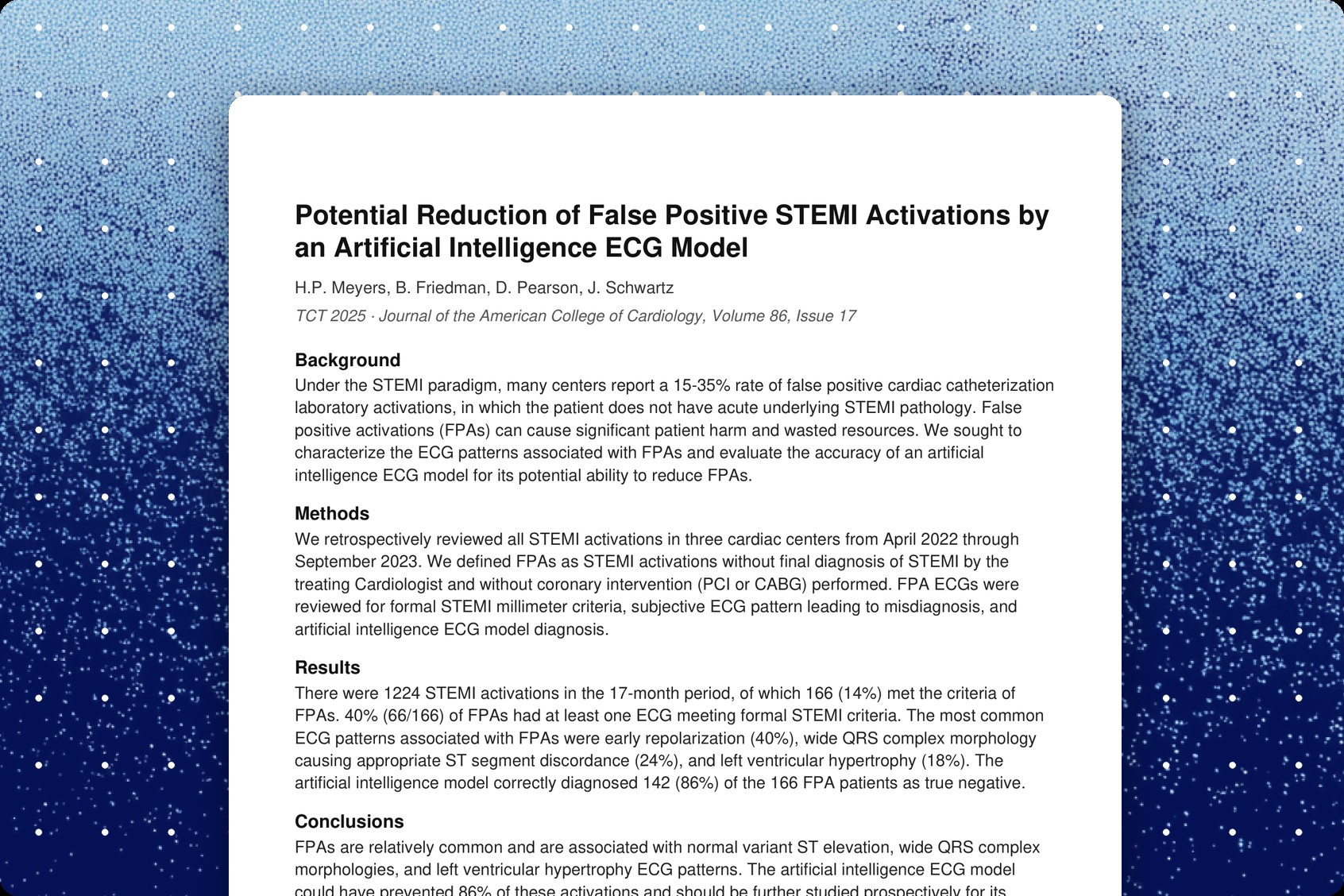
Under the STEMI paradigm, many centers report that 15–35% of cardiac catheterization laboratory activations are false positives, exposing patients to harm and wasting resources. This retrospective review of all 1,224 STEMI activations at three cardiac centers in Charlotte, North Carolina, between April 2022 and September 2023 found that 166 (14%) were false-positive activations, with no final STEMI diagnosis and no PCI or CABG. Forty percent of these patients had at least one ECG meeting formal STEMI criteria, and the ECG patterns most often associated with false-positive activations were early repolarization, wide QRS complexes and left ventricular hypertrophy. The PMcardio Queen of Hearts AI-ECG model (aOMI v1) classified 142 of the 166 (86%) as negative, suggesting it could have prevented most of these activations.
Key findings
- Of 1,224 STEMI activations over 17 months, 166 (14%) were false-positive activations, with no final STEMI diagnosis by the treating cardiologist and no PCI or CABG.
- 40% (66/166) of false-positive activations had at least one ECG meeting formal STEMI millimeter criteria.
- The most common ECG patterns associated with false-positive activations were early repolarization (40%), wide QRS complex morphology with appropriate ST-segment discordance (24%) and left ventricular hypertrophy (18%).
- The AI ECG model correctly classified 142 of the 166 false-positive activation patients (86%) as negative.
Published in: TCT 2025 – presented as an oral presentation; abstract published in the Journal of the American College of Cardiology (JACC)
Published on: 27 October 2025
Background
Under the STEMI paradigm, many centers report that 15–35% of cardiac catheterization laboratory activations are false positives, in which the patient has no underlying acute STEMI pathology. False-positive activations (FPAs) can cause significant patient harm and waste resources. This study characterized the ECG patterns associated with FPAs and evaluated the accuracy of an artificial intelligence (AI) ECG model for its potential to reduce them.
Methods
The investigators retrospectively reviewed all STEMI activations at three cardiac centers in Charlotte, North Carolina, from April 2022 through September 2023. FPAs were defined as STEMI activations without a final diagnosis of STEMI by the treating cardiologist and without coronary intervention (PCI or CABG). The ECGs of FPA patients were reviewed for formal STEMI millimeter criteria (blinded to clinical data), for the subjective ECG pattern that led to the misdiagnosis, and for the diagnosis of the AI ECG model, PMcardio Queen of Hearts (aOMI v1), which was used as a parallel, ECG-only interpretation.
Results
There were 1,224 STEMI activations in the 17-month period, of which 166 (14%) met the criteria for an FPA. Of these, 40% (66/166) had at least one ECG meeting formal STEMI criteria. The most common ECG patterns associated with FPAs were early repolarization (40%), wide QRS complex morphology causing appropriate ST-segment discordance (24%) and left ventricular hypertrophy (18%). The AI model correctly classified 142 (86%) of the 166 FPA patients as true negatives.
Conclusion
False-positive activations are relatively common and are associated with normal-variant ST elevation, wide QRS complex morphologies and left ventricular hypertrophy patterns. The AI ECG model could have prevented 86% of these activations and should be studied prospectively for its potential to safely reduce false-positive activations.
Share this article



About PMcardio
PMcardio is the market leader in AI-powered diagnostics, addressing the world’s leading cause of death – cardiovascular diseases. The innovative clinical assistant empowers healthcare professionals to detect up to 40 cardiovascular diseases. In the form of a smartphone application, the certified Class IIb medical device interprets any 12-lead ECG image in under 5 seconds to provide accurate diagnoses and individualized treatment recommendations tailored to each patient.

About Powerful Medical
Powerful Medical leads one of the most important shifts in modern medicine by augmenting human-made clinical decisions with artificial intelligence. Our primary focus is on cardiovascular diseases, the world’s leading cause of death.
Established in 2017, Powerful Medical has embarked on a mission to revolutionize the diagnosis and treatment of cardiovascular diseases. We are a medical company backed by 28 world-class cardiologists and led by our expert Scientific Board with decades of experience in daily patient care, clinical research, and medical devices. The results of our research are implemented, developed, certified, and brought to market by our 50+ strong interdisciplinary team of physicians, data scientists, AI experts, software engineers, regulatory specialists, and commercial teams.