
Performance Evaluation of the PMcardio Mobile Application for ECG Diagnosis of Occlusion Myocardial Infarction
Overview
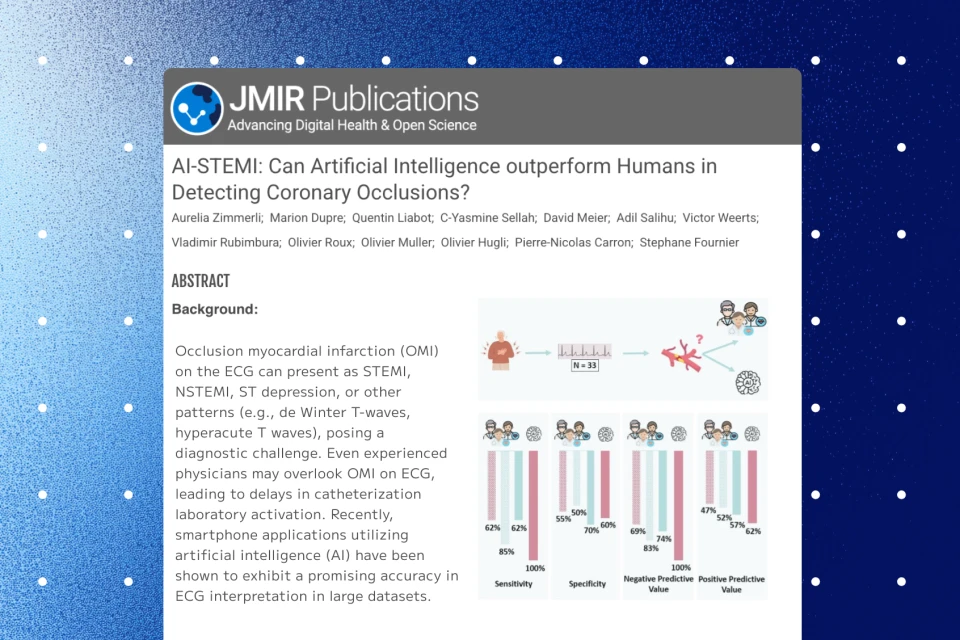
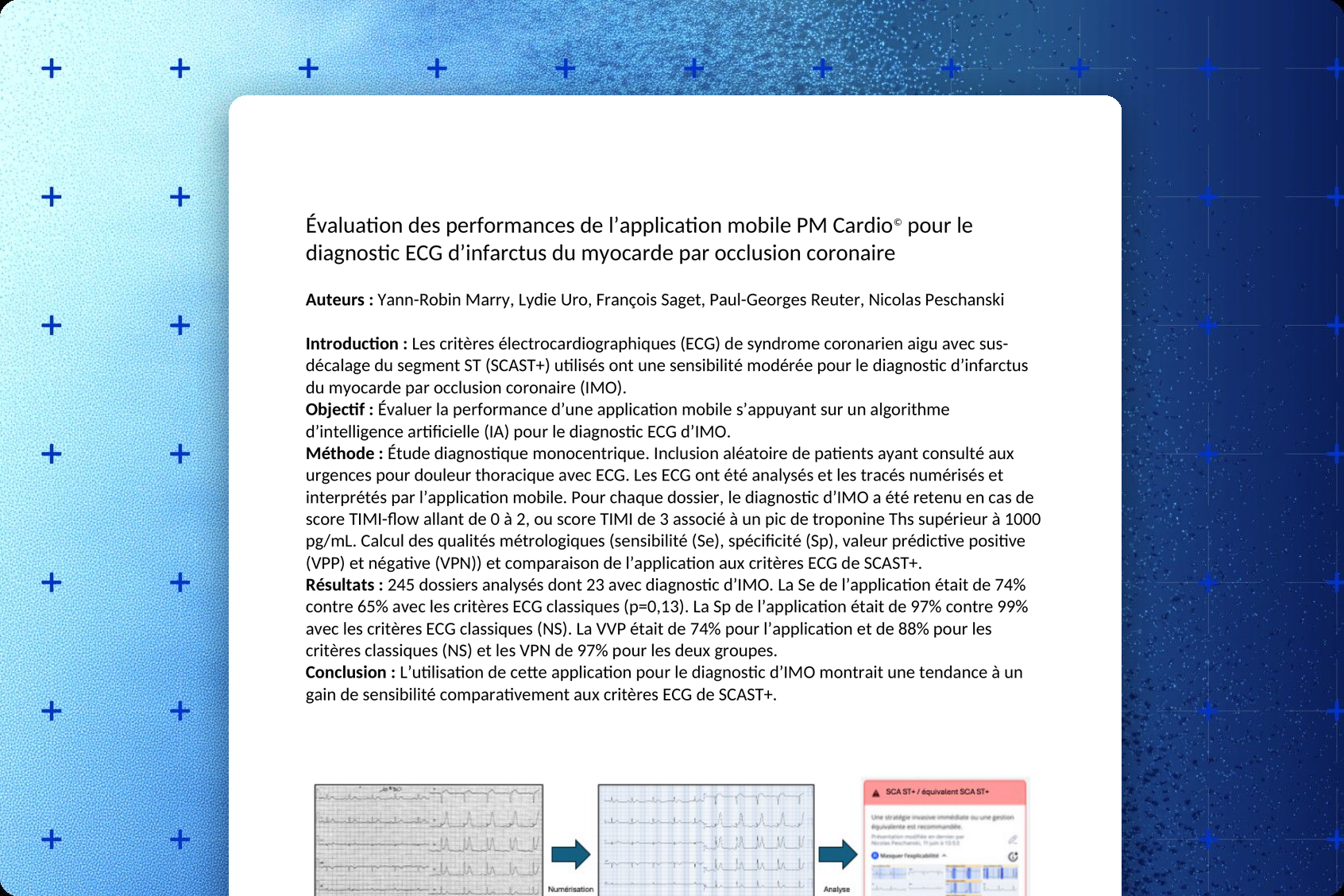
Standard ST-elevation ECG criteria have only moderate sensitivity for occlusion myocardial infarction (OMI), the heart attacks caused by a blocked coronary artery that need urgent reperfusion. In this independent single-center diagnostic study from the emergency department of Rennes University Hospital, France, the ECGs of 245 randomly selected chest-pain patients were digitized and interpreted with the PMcardio smartphone application and compared with classic STEMI ECG criteria. Twenty-three patients had OMI, defined as TIMI flow grade 0–2, or TIMI flow grade 3 with peak high-sensitivity troponin T above 1000 pg/mL. The app detected 74% of OMIs versus 65% with STEMI criteria (p = 0.13), with a specificity of 97% versus 99% and a negative predictive value of 97% for both. The authors conclude that the app showed a trend toward higher sensitivity than STEMI criteria.
Key findings
- Sensitivity for OMI was 74% with the PMcardio app versus 65% with classic STEMI ECG criteria (p = 0.13), a trend that did not reach statistical significance.
- Specificity was 97% versus 99% (not significant), and the negative predictive value was 97% for both approaches.
- The positive predictive value was 74% for the app versus 88% for STEMI criteria (not significant).
- 23 of 245 randomly selected emergency chest-pain patients had OMI, confirmed by TIMI flow grade or a peak hs-troponin T above 1000 pg/mL.
Published in: Urgences 2026 congress, Paris
Published on: 3 June 2026
Translated from the original French abstract.
Background
The ECG criteria for ST-elevation acute coronary syndrome (STEMI criteria) in current use have only moderate sensitivity for the diagnosis of occlusion myocardial infarction (OMI). This study evaluated the performance of a mobile application based on an artificial intelligence (AI) algorithm for the ECG diagnosis of OMI.
Methods
Single-center diagnostic study at the adult emergency department of Rennes University Hospital, France. Patients who presented to the emergency department with chest pain and had an ECG were randomly selected. Their ECGs were digitized and interpreted with the PMcardio mobile application. For each case, OMI was diagnosed in the presence of TIMI flow grade 0–2, or TIMI flow grade 3 associated with a peak high-sensitivity troponin T above 1000 pg/mL. Sensitivity, specificity, positive predictive value (PPV) and negative predictive value (NPV) were calculated, and the application was compared with classic STEMI ECG criteria.
Results
Of 245 cases analyzed, 23 had a diagnosis of OMI. The sensitivity of the application was 74% versus 65% with classic STEMI ECG criteria (p = 0.13). Specificity was 97% for the application versus 99% for STEMI criteria (not significant). The PPV was 74% for the application and 88% for STEMI criteria (not significant), and the NPV was 97% for both.
Conclusion
Use of the PMcardio mobile application for the diagnosis of OMI showed a trend toward higher sensitivity compared with STEMI ECG criteria.
Share this article



About PMcardio
PMcardio is the market leader in AI-powered diagnostics, addressing the world’s leading cause of death – cardiovascular diseases. The innovative clinical assistant empowers healthcare professionals to detect up to 40 cardiovascular diseases. In the form of a smartphone application, the certified Class IIb medical device interprets any 12-lead ECG image in under 5 seconds to provide accurate diagnoses and individualized treatment recommendations tailored to each patient.

About Powerful Medical
Powerful Medical leads one of the most important shifts in modern medicine by augmenting human-made clinical decisions with artificial intelligence. Our primary focus is on cardiovascular diseases, the world’s leading cause of death.
Established in 2017, Powerful Medical has embarked on a mission to revolutionize the diagnosis and treatment of cardiovascular diseases. We are a medical company backed by 28 world-class cardiologists and led by our expert Scientific Board with decades of experience in daily patient care, clinical research, and medical devices. The results of our research are implemented, developed, certified, and brought to market by our 50+ strong interdisciplinary team of physicians, data scientists, AI experts, software engineers, regulatory specialists, and commercial teams.