
Multi-centre study of an artificial intelligence ECG model for the detection of occlusive myocardial infarction within the UK
Overview
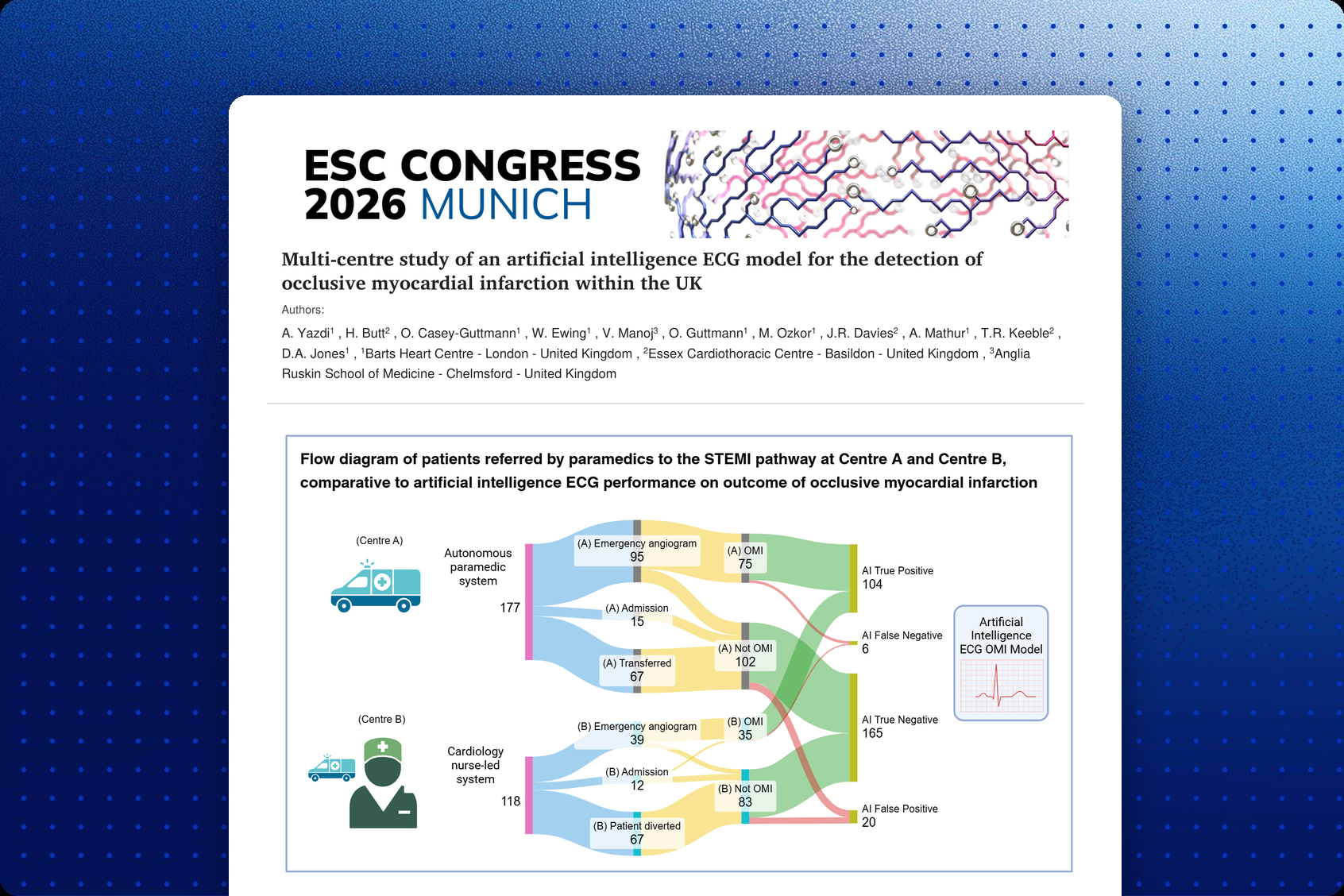
This independent, retrospective study from two large UK regional heart attack centres applied the Queen of Hearts AI-ECG model (aOMI v1) to 295 consecutive paramedic-referred suspected STEMI cases from 2024–2025 and compared it with each centre's existing triage pathway, using blinded adjudication of occlusive myocardial infarction (OMI) as the reference. Where paramedics activated the pathway on their own, 58% of activations were false positives; applying the AI model gave 94.6% sensitivity and 89.2% specificity and cut false-positive activations to 6%. Where a nurse-led remote cardiology review already acted as gatekeeper (91.4% sensitivity, 91.6% specificity), the AI model performed comparably, with 94.3% sensitivity and 89.2% specificity. Across both pathways, the AI model missed 5.5% of OMIs.
Key findings
- At the paramedic-led centre, 58% of activations were false positives; the AI model reached 94.6% sensitivity, 89.2% specificity and 91.5% accuracy, reducing false-positive activations to 6%.
- At the centre with nurse-led remote cardiology review, the AI model (94.3% sensitivity, 89.2% specificity, 90.7% accuracy) performed comparably to the existing gatekeeper (91.4% sensitivity, 91.6% specificity).
- Across all 295 cases, the AI model detected 104 of 110 adjudicated OMIs (sensitivity 94.55%, specificity 89.19%, accuracy 91.19%), a false-negative rate of 5.5%.
- In the combined cohort, the AI model had higher specificity (89.19% vs 85.41%) and PPV (83.87% vs 79.85%) than the actual decision to take patients to the cath lab, at slightly lower sensitivity (94.55% vs 97.27%).
Published in: ESC Congress 2026 – presented as an ePoster
Published on: 30 August 2026
Background
Pre-hospital triage strategies for ST-segment elevation myocardial infarction (STEMI) vary widely, from autonomous paramedic activation to remote cardiology consultation, and artificial intelligence (AI) interpretation of the electrocardiogram (ECG) is emerging as an alternative. Evaluating this technology across distinctly different clinical pathways is essential to determine its real-world utility. This retrospective validation study assessed whether an AI-ECG model can accurately detect occlusive myocardial infarction (OMI) compared with both standard paramedic and cardiology triage, and whether it could reduce false-positive pathway and emergency catheterisation laboratory activations without loss of diagnostic sensitivity.
Methods
The authors retrospectively analysed 295 suspected STEMI cases referred by paramedics and collected consecutively in cohorts between 2024 and 2025 at two large regional heart attack centres in the UK. Centre A (177 patients) operated without pre-hospital cardiology review and relied on paramedic activation. Centre B (118 patients) used a nurse-led cardiology remote review of the electronic ECG and clinical history. The final adjudicated diagnosis was compared against the standard-care decisions and the predictions of the Queen of Hearts AI-ECG model (aOMI v1). True OMI was defined as Thrombolysis in Myocardial Infarction (TIMI) flow grade 0 to II, or grade III flow with a confirmed culprit vessel and troponin elevation. All clinical notes and angiography were adjudicated independently and blinded.
Results
Of the 295 cases, 110 had adjudicated OMI (75 at Centre A and 35 at Centre B). Triage relying solely on paramedic activation produced a high proportion of false-positive alerts: 58% of activations at Centre A (PPV 42.37%). At Centre A, the AI model achieved 94.6% sensitivity, 89.2% specificity and 91.5% accuracy, reducing false-positive activations to 6% of activations. At Centre B, the existing remote cardiology review achieved 91.4% sensitivity and 91.6% specificity, and the AI model performed comparably, with 94.3% sensitivity, 89.2% specificity and 90.7% accuracy. In the combined cohort, the AI model identified 104 true positives, 6 false negatives, 165 true negatives and 20 false positives (sensitivity 94.55%, specificity 89.19%, PPV 83.87%, NPV 96.49%, accuracy 91.19%), compared with 97.27%, 85.41%, 79.85%, 98.14% and 89.83% for the actual decision to take patients to the catheterisation laboratory. Across both triage pathways, the AI model maintained a consistently low false-negative rate of 5.5%.
Conclusion
The OMI AI-ECG model showed broad clinical utility across diverse pre-hospital triage workflows. In paramedic-led pathways it markedly improved specificity and overall diagnostic accuracy, safely reducing unnecessary catheterisation laboratory activations, and it matched the high diagnostic performance of a cardiology remote review pathway with opportunities for more effective use of resources. These findings suggest that AI can effectively optimise STEMI pathway triage across a variety of underlying workflow structures.
Share this article



About PMcardio
PMcardio is the market leader in AI-powered diagnostics, addressing the world’s leading cause of death – cardiovascular diseases. The innovative clinical assistant empowers healthcare professionals to detect up to 40 cardiovascular diseases. In the form of a smartphone application, the certified Class IIb medical device interprets any 12-lead ECG image in under 5 seconds to provide accurate diagnoses and individualized treatment recommendations tailored to each patient.

About Powerful Medical
Powerful Medical leads one of the most important shifts in modern medicine by augmenting human-made clinical decisions with artificial intelligence. Our primary focus is on cardiovascular diseases, the world’s leading cause of death.
Established in 2017, Powerful Medical has embarked on a mission to revolutionize the diagnosis and treatment of cardiovascular diseases. We are a medical company backed by 28 world-class cardiologists and led by our expert Scientific Board with decades of experience in daily patient care, clinical research, and medical devices. The results of our research are implemented, developed, certified, and brought to market by our 50+ strong interdisciplinary team of physicians, data scientists, AI experts, software engineers, regulatory specialists, and commercial teams.