
Independent Validation of PMcardio Automated ECG Interpretation: 100% STEMI Detection but Systematic Over-Triage Across 182 Expert-Annotated Electrocardiograms
Overview
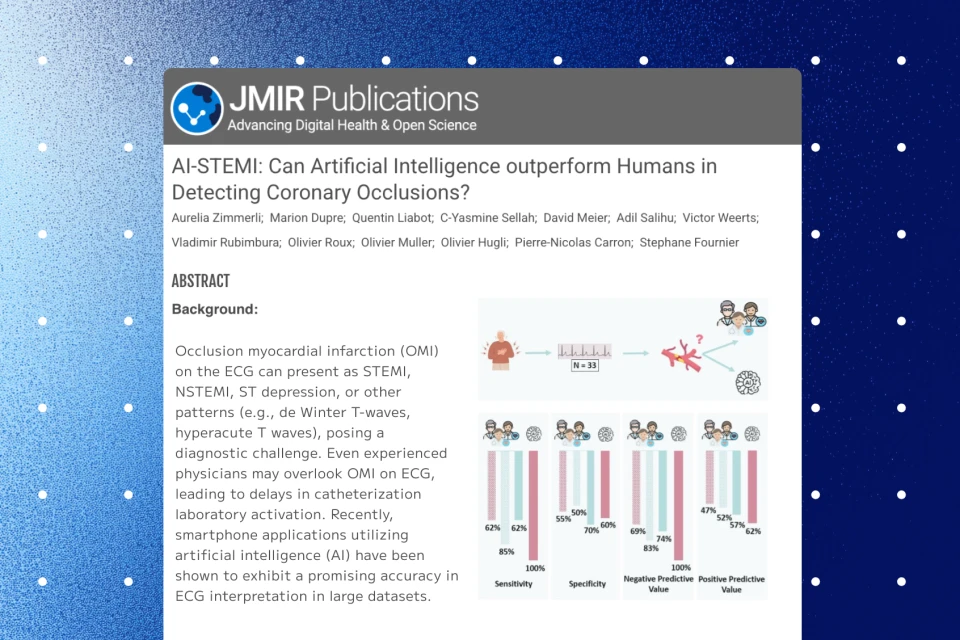
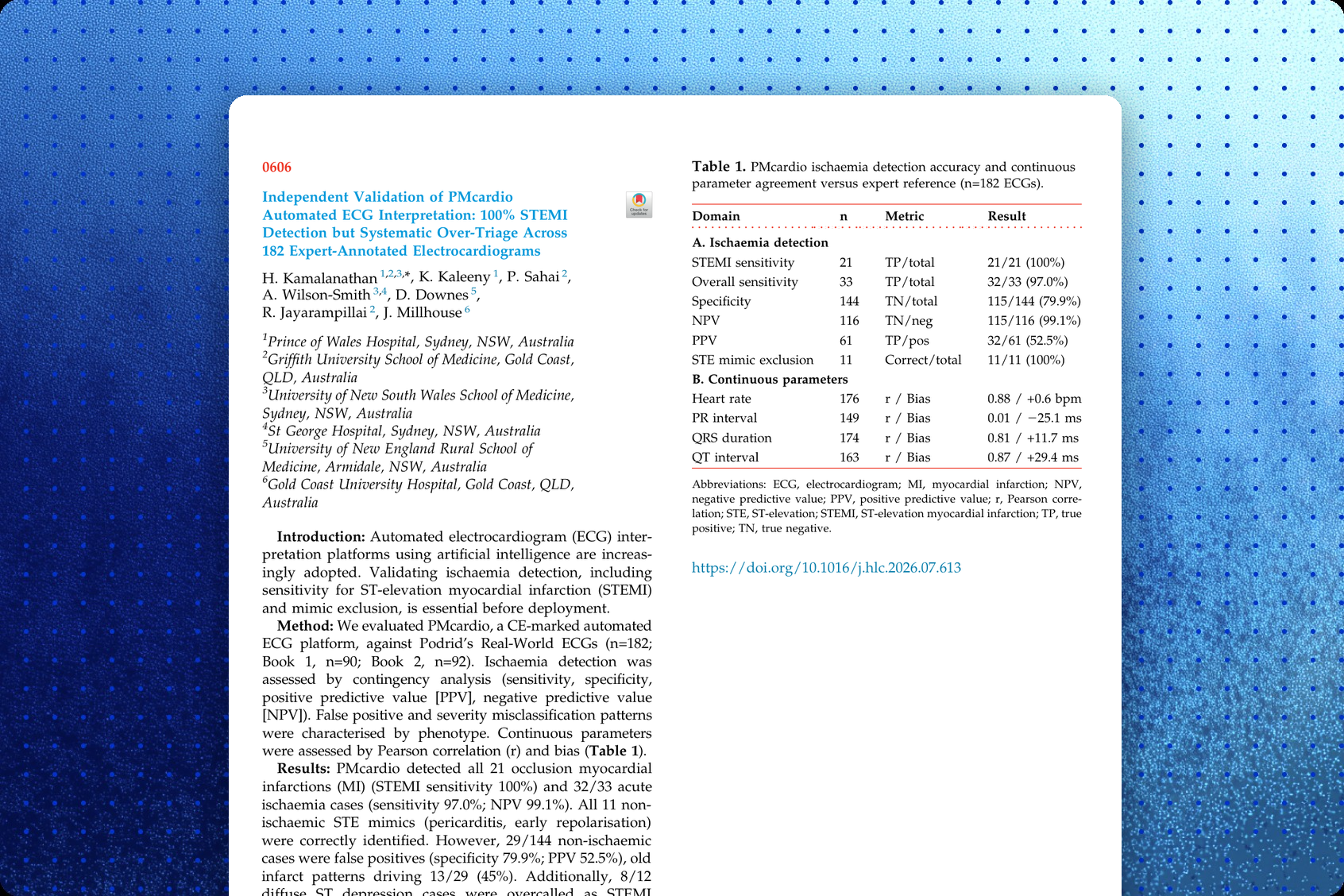
Automated, AI-based ECG interpretation is increasingly adopted, but its ability to detect ischaemia, including STEMI, and to exclude ST-elevation mimics needs independent validation before deployment. In this fully independent Australian study, investigators tested the CE-marked PMcardio platform on 182 expert-annotated ECGs from Podrid's Real-World ECGs. PMcardio detected all 21 occlusion myocardial infarctions (100% STEMI sensitivity), identified 32 of 33 acute ischaemia cases (97.0% sensitivity, 99.1% NPV) and correctly classified all 11 non-ischaemic ST-elevation mimics. The authors also reported systematic over-triage, with 29 of 144 non-ischaemic ECGs flagged as false positives (79.9% specificity, 52.5% PPV), driven mainly by old infarct patterns. They conclude that this profile may suit acute triage but warrants refinement to reduce false positives.
Key findings
- PMcardio detected all 21 occlusion myocardial infarctions in the 182-ECG set (STEMI sensitivity 100%) and 32 of 33 acute ischaemia cases overall (sensitivity 97.0%).
- Negative predictive value was 99.1% (115/116), and all 11 non-ischaemic ST-elevation mimics, such as pericarditis and early repolarisation, were correctly identified.
- Specificity was 79.9% (115/144) and PPV 52.5% (32/61); old infarct patterns accounted for 13 of the 29 false positives (45%), and 8 of 12 diffuse ST-depression ECGs were overcalled as STEMI equivalent.
- Automated heart rate correlated strongly with the expert reference (r = 0.88, bias +0.6 bpm), while QRS duration (+11.7 ms) and QT interval (+29.4 ms) were overestimated.
Published in: Heart, Lung and Circulation
Published on: August 2026
Background
Automated electrocardiogram (ECG) interpretation platforms that use artificial intelligence are increasingly adopted in clinical practice. Before deployment, it is essential to validate how well they detect ischaemia, including their sensitivity for ST-elevation myocardial infarction (STEMI), and how reliably they exclude non-ischaemic ST-elevation mimics. This fully independent study evaluated the PMcardio platform against expert-annotated ECGs.
Methods
The investigators evaluated PMcardio, a CE-marked automated ECG platform, against the expert interpretations of Podrid's Real-World ECGs (n = 182; Book 1, n = 90; Book 2, n = 92). Ischaemia detection was assessed by contingency analysis, reporting sensitivity, specificity, positive predictive value (PPV) and negative predictive value (NPV). False-positive and severity-misclassification patterns were characterised by phenotype. Agreement for continuous ECG parameters (heart rate, PR interval, QRS duration and QT interval) was assessed by Pearson correlation (r) and bias.
Results
PMcardio detected all 21 occlusion myocardial infarctions (STEMI sensitivity 100%) and 32 of 33 acute ischaemia cases (sensitivity 97.0%; NPV 99.1%, 115/116). All 11 non-ischaemic ST-elevation mimics, including pericarditis and early repolarisation, were correctly identified. However, 29 of 144 non-ischaemic cases were false positives (specificity 79.9%; PPV 52.5%, 32/61), with old infarct patterns driving 13 of the 29 (45%). In addition, 8 of 12 diffuse ST-depression cases were overcalled as STEMI equivalent. Heart rate correlation was strong (r = 0.88, bias +0.6 bpm), whereas QRS duration (r = 0.81, bias +11.7 ms) and QT interval (r = 0.87, bias +29.4 ms) were overestimated; PR interval agreement was poor (r = 0.01, bias −25.1 ms).
Conclusion
PMcardio achieved 100% STEMI sensitivity and 99.1% NPV but showed systematic over-triage, driven by old infarcts misclassified as acute ischaemia and diffuse ST depression overcalled as STEMI equivalent. The authors conclude that this profile may suit acute triage but warrants refinement to reduce false positives.
Share this article



About PMcardio
PMcardio is the market leader in AI-powered diagnostics, addressing the world’s leading cause of death – cardiovascular diseases. The innovative clinical assistant empowers healthcare professionals to detect up to 40 cardiovascular diseases. In the form of a smartphone application, the certified Class IIb medical device interprets any 12-lead ECG image in under 5 seconds to provide accurate diagnoses and individualized treatment recommendations tailored to each patient.

About Powerful Medical
Powerful Medical leads one of the most important shifts in modern medicine by augmenting human-made clinical decisions with artificial intelligence. Our primary focus is on cardiovascular diseases, the world’s leading cause of death.
Established in 2017, Powerful Medical has embarked on a mission to revolutionize the diagnosis and treatment of cardiovascular diseases. We are a medical company backed by 28 world-class cardiologists and led by our expert Scientific Board with decades of experience in daily patient care, clinical research, and medical devices. The results of our research are implemented, developed, certified, and brought to market by our 50+ strong interdisciplinary team of physicians, data scientists, AI experts, software engineers, regulatory specialists, and commercial teams.