
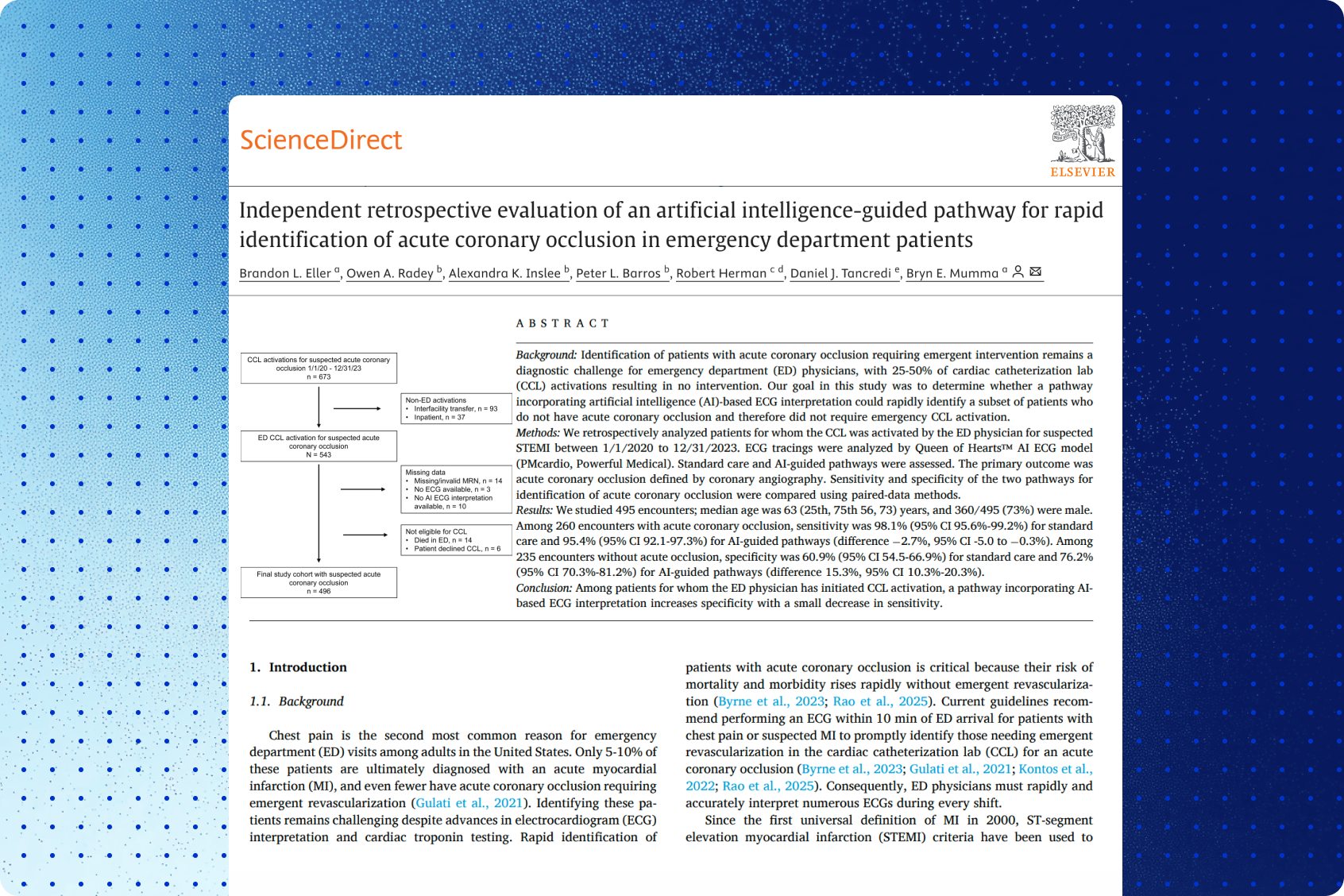
Independent retrospective evaluation of an artificial intelligence-guided pathway for rapid identification of acute coronary occlusion in emergency department patients
Overview
Between 25% and 50% of emergency catheterization lab activations for suspected STEMI end without intervention. This independent, investigator-led retrospective study at UC Davis Medical Center analysed 495 ED-physician catheterization lab (CCL) activations from 2020 to 2023, comparing standard care against a hypothetical pathway incorporating the PMcardio Queen of Hearts AI-ECG model, with angiographic acute coronary occlusion as the reference standard. The AI-guided pathway raised specificity from 60.9% to 76.2%, a 15.3 percentage-point gain, at a small sensitivity cost of 2.7 points, and identified occlusions a median of 16 minutes earlier in the cases where the two pathways differed on timing.
Key findings
- The AI-guided pathway raised specificity for acute coronary occlusion from 60.9% to 76.2%, a 15.3 percentage-point gain (95% CI 10.3–20.3).
- Discrimination improved from an AUC of 0.794 to 0.858 across 495 encounters (difference 0.063, 95% CI 0.038–0.088).
Published in: The Journal of Precision Medicine: Health and Disease
Published on: 19 June 2026
Background
Identifying which emergency department patients have an acute coronary occlusion requiring emergent intervention remains difficult: 25–50% of cardiac catheterization laboratory (CCL) activations end without intervention. This independent evaluation asked whether a pathway incorporating AI-based ECG interpretation could rapidly identify a subset of patients without acute coronary occlusion, who therefore did not require emergent CCL activation. The investigators had no financial interest in the model's developer and were blinded to the AI interpretations until final analysis.
Methods
Retrospective single-center observational cohort at the University of California, Davis Medical Center (Sacramento, CA). The authors analysed 495 encounters in which the ED physician activated the CCL for suspected STEMI between 1 January 2020 and 31 December 2023, narrowed from 673 activations. Each ECG was analysed by the PMcardio Queen of Hearts AI-ECG model, and a hypothetical AI-guided pathway was compared against standard care using paired-data methods. The primary outcome was acute coronary occlusion defined by coronary angiography.
Results
Median age was 63 years (25th, 75th 56, 73) and 360/495 (73%) were male; 260 encounters (52.5%) had an acute coronary occlusion. Among those 260, sensitivity was 98.1% (95% CI 95.6%-99.2%) for standard care and 95.4% (95% CI 92.1%-97.3%) for the AI-guided pathway, a difference of −2.7 percentage points (95% CI −5.0 to −0.3%). Among the 235 encounters without occlusion, specificity was 60.9% (95% CI 54.5%-66.9%) versus 76.2% (95% CI 70.3%-81.2%), a difference of 15.3 points (95% CI 10.3%-20.3%). AUC improved from 0.794 (0.762-0.827) to 0.858 (0.828-0.888). Restricting identification to the first 10 minutes widened the gap: specificity 37.0% versus 73.2%, AUC 0.560 versus 0.766. Among 248 occlusion cases positive on both pathways, 70 differed in diagnostic time and 67 of those 70 (96%) were earlier with AI, by a median of 16 minutes (IQR 4, 45). The AI-guided pathway would have deferred 43 of 347 emergent angiograms, 7 of which (16.3%) had an acute coronary occlusion.
Conclusion
Among patients for whom the ED physician has initiated CCL activation, a pathway incorporating AI-based ECG interpretation increases specificity with a small decrease in sensitivity.
Share this article



About PMcardio
PMcardio is the market leader in AI-powered diagnostics, addressing the world’s leading cause of death – cardiovascular diseases. The innovative clinical assistant empowers healthcare professionals to detect up to 40 cardiovascular diseases. In the form of a smartphone application, the certified Class IIb medical device interprets any 12-lead ECG image in under 5 seconds to provide accurate diagnoses and individualized treatment recommendations tailored to each patient.

About Powerful Medical
Powerful Medical leads one of the most important shifts in modern medicine by augmenting human-made clinical decisions with artificial intelligence. Our primary focus is on cardiovascular diseases, the world’s leading cause of death.
Established in 2017, Powerful Medical has embarked on a mission to revolutionize the diagnosis and treatment of cardiovascular diseases. We are a medical company backed by 28 world-class cardiologists and led by our expert Scientific Board with decades of experience in daily patient care, clinical research, and medical devices. The results of our research are implemented, developed, certified, and brought to market by our 50+ strong interdisciplinary team of physicians, data scientists, AI experts, software engineers, regulatory specialists, and commercial teams.