
Impact of AI-Assisted ECG Interpretation to Guide Emergency Coronary Angiography in a Tertiary Cardiac Centre: A Retrospective Study
Overview
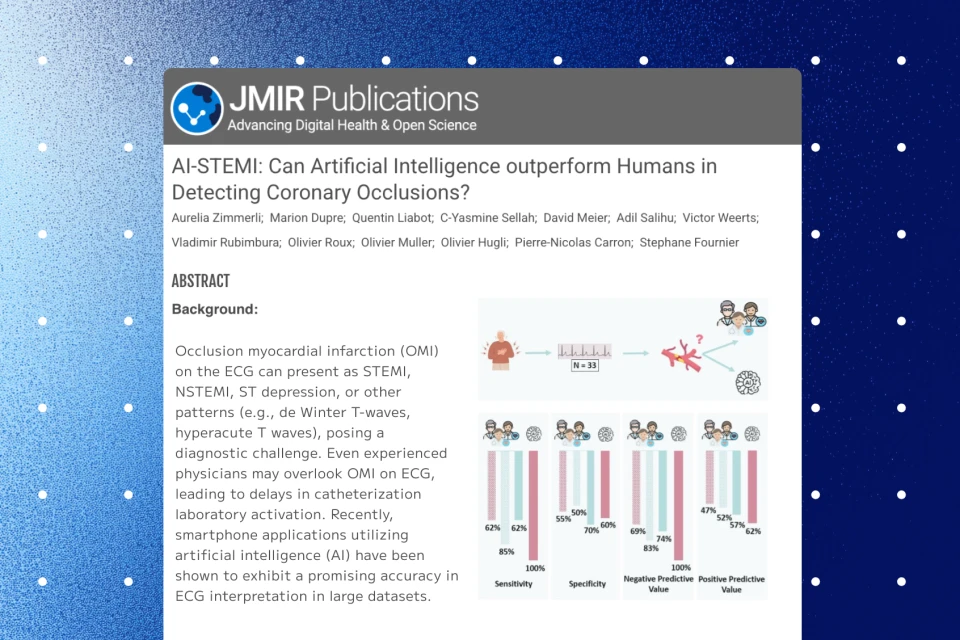
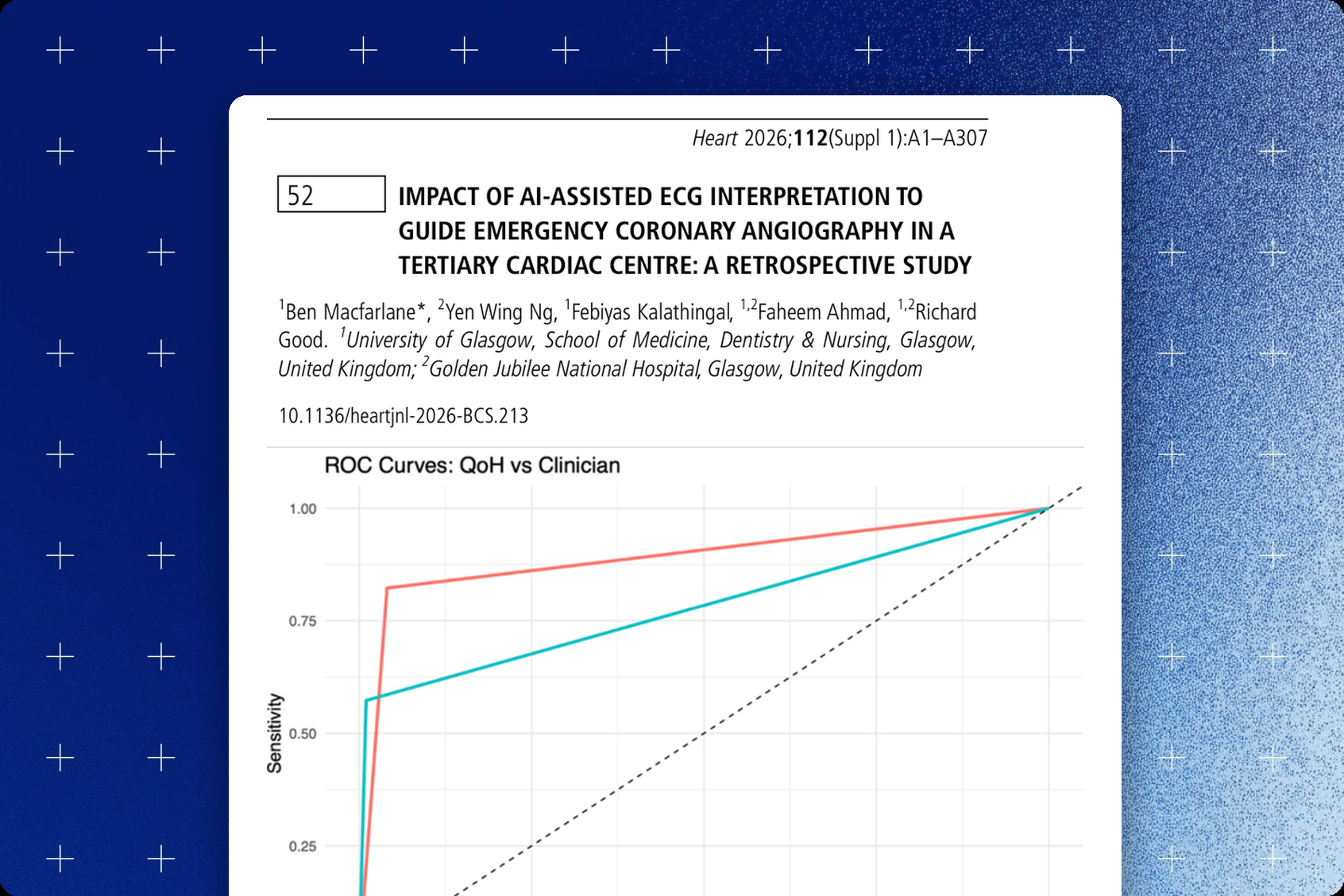
AI-assisted ECG interpretation has shown promise for detecting occlusive myocardial infarction (OMI), but mostly in primary care and emergency settings. This retrospective study applied the Queen of Hearts (QoH) AI model (PMcardio v3.3.0) to the ECGs of all 294 acute coronary syndrome referrals to the Golden Jubilee National Hospital, a tertiary primary PCI centre in Glasgow, over 4 weeks in February 2025. In total, 96 patients (33%) met OMI criteria. QoH detected OMI better than clinicians (AUROC 0.89 vs 0.78; p<0.0001), with higher sensitivity (0.82 vs 0.57) and negative predictive value (0.91 vs 0.83). Adopting QoH would theoretically have led to 32 additional emergency cath lab activations, a 56% increase, and 24 of those 32 patients met OMI criteria.
Key findings
- QoH discriminated OMI better than clinicians, with an AUROC of 0.89 vs 0.78 (p<0.0001).
- Sensitivity was 0.82 vs 0.57 and negative predictive value 0.91 vs 0.83 for QoH vs clinicians, while specificity was similar (0.96 vs 0.99; p=0.11).
- Of 87 patients QoH classified as OMI, 32 were not taken for emergency angiography; 24 of them met OMI criteria, and all 22 who later underwent angiography were revascularised.
- Theoretical adoption of QoH would have added 32 emergency cardiac catheterisation activations to the 57 performed, a 56% increase.
Published in: Heart (2026;112 Suppl 1:A200–A201) – presented at the British Cardiovascular Society Annual Conference 2026
Published on: 9 June 2026
Background
Artificial intelligence-assisted electrocardiogram interpretation (AI-ECG) has shown promise in detecting occlusive myocardial infarction (OMI), with previous studies focusing mainly on ECGs in primary care and emergency settings. This study investigated the potential impact of AI-ECG on cardiac catheterisation laboratory activation in a tertiary centre delivering primary percutaneous coronary intervention (PPCI).
Methods
All acute coronary syndrome (ACS) referrals to the Golden Jubilee National Hospital (GJNH), Glasgow, over a 4-week period in February 2025 were reviewed retrospectively. ECGs were anonymised and analysed with the Queen of Hearts (QoH) AI model (PMcardio v3.3.0). Patients were categorised by the cardiac team's initial decision after ECG review: emergency angiography (PPCI) at GJNH, admission to GJNH for urgent angiography within 24 hours, or transfer to a local hospital for further assessment with or without subsequent angiography. Confirmed OMI was defined as an acute occlusive culprit lesion with TIMI flow 0–1 on angiography; presumed OMI as an acute non-occlusive culprit lesion (TIMI 2–3), or no angiography, with a significant infarct size shown by troponin >100 times the upper limit of normal (TnT >1300 ng/L, TnI >3400 ng/L), a troponin rise >20 ng/L/hour, or a new regional wall motion abnormality on echocardiography. Diagnostic performance of QoH and clinicians was compared using the area under the receiver operating characteristic curve (AUROC) with DeLong's test.
Results
Of 294 ACS referrals, 57 (19%) underwent emergency angiography and 18 (6%) were admitted to GJNH for urgent angiography. The remaining 219 patients (74%) were transferred to their local hospital, and 45 of them (21%) later underwent invasive angiography. After review of electronic health records following discharge, 96 patients (33%) met OMI criteria, of whom 91 underwent revascularisation (87 PCI, 4 coronary artery bypass grafting). QoH classified 87 patients as OMI; 32 of these were not taken for emergency angiography, and of those 32, 24 met OMI criteria and 22 underwent invasive angiography, all of whom were revascularised. QoH showed superior discrimination for OMI compared with clinicians (AUROC 0.89 vs 0.78; p<0.0001), with significantly greater sensitivity (0.82 vs 0.57; p<0.0001) and negative predictive value (0.91 vs 0.83; p<0.0001). Specificity was 0.96 vs 0.99 (p=0.11), positive predictive value 0.92 vs 0.97, and F1 score 0.86 vs 0.72. Theoretical adoption of QoH would have led to 32 additional emergency cardiac catheterisation activations, a 56% increase.
Conclusion
Adoption of AI-ECG could significantly inform activation of emergency coronary angiography for suspected OMI. Larger prospective studies are required to determine improvements in patient outcomes and cost-effectiveness.
Share this article



About PMcardio
PMcardio is the market leader in AI-powered diagnostics, addressing the world’s leading cause of death – cardiovascular diseases. The innovative clinical assistant empowers healthcare professionals to detect up to 40 cardiovascular diseases. In the form of a smartphone application, the certified Class IIb medical device interprets any 12-lead ECG image in under 5 seconds to provide accurate diagnoses and individualized treatment recommendations tailored to each patient.

About Powerful Medical
Powerful Medical leads one of the most important shifts in modern medicine by augmenting human-made clinical decisions with artificial intelligence. Our primary focus is on cardiovascular diseases, the world’s leading cause of death.
Established in 2017, Powerful Medical has embarked on a mission to revolutionize the diagnosis and treatment of cardiovascular diseases. We are a medical company backed by 28 world-class cardiologists and led by our expert Scientific Board with decades of experience in daily patient care, clinical research, and medical devices. The results of our research are implemented, developed, certified, and brought to market by our 50+ strong interdisciplinary team of physicians, data scientists, AI experts, software engineers, regulatory specialists, and commercial teams.