
Human versus artificial intelligence–assisted ECG analysis for the detection of acute coronary occlusion in acute coronary syndrome
Overview
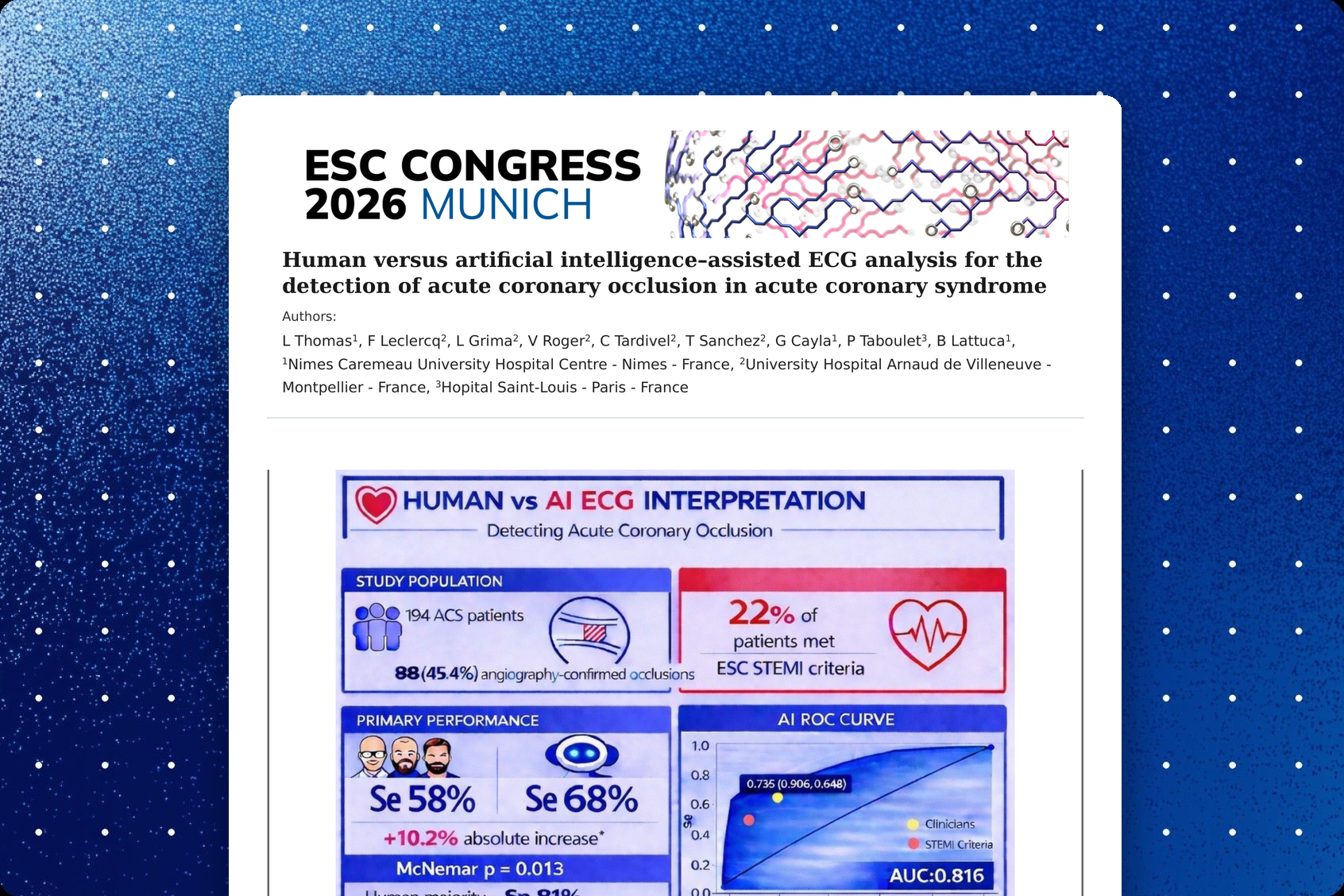
This independent retrospective study from two French university hospitals (Nîmes and Montpellier) compared an AI-based ECG algorithm, PMcardio Queen of Hearts with the aOMI v1 + mACS reperfused models, with 32 clinicians for detecting acute coronary occlusion (ACO) on pre-angiography ECGs from 194 patients with acute coronary syndrome. The AI was more sensitive than the clinicians for strict ACO (TIMI flow ≤1: 68.8% vs 59.7%, p = 0.035) and for extended ACO (TIMI flow ≤2: 68.2% vs 58.0%, p = 0.013), with similar specificity. Its overall accuracy (75.8%) exceeded every clinician group (66.5%–69.1%), and its readings were far more consistent (κ = 0.89 vs 0.44). Standard ESC STEMI criteria were present in only 22.2% of patients and detected about 37% of occlusions.
Key findings
- AI detected strict acute coronary occlusion (TIMI ≤1) with 68.8% sensitivity versus 59.7% for 32 clinicians (p = 0.035), at similar specificity (78% vs 79%).
- Under the extended definition (TIMI ≤2), AI sensitivity was 68.2% vs 58.0% for clinicians (p = 0.013), and AI identified 11 of 88 occlusions (12.5%) missed by the physician reviewers.
- AI accuracy was 75.8%, higher than every clinician group (66.5% for emergency residents to 69.1% for senior cardiologists).
- ESC STEMI criteria were met by only 22.2% of patients (43/194) and detected about 37% of occlusions; AI intra-observer agreement was κ = 0.89 vs 0.44 for clinicians.
Published in: ESC Congress 2026, Munich
Published on: 30 August 2026
Background
Prompt recognition of acute coronary artery occlusion (ACO) is critical for myocardial salvage and cath-lab activation in acute coronary syndrome (ACS), but interpreting ECG patterns remains challenging. Artificial intelligence (AI) has shown promise, but direct comparisons with first-line clinicians in routine practice are needed. This study compared the diagnostic performance of an AI-based ECG algorithm for ACO detection in ACS with that of human readers.
Methods
This retrospective bicentric study at Nîmes and Montpellier university hospitals included consecutive patients admitted for ACS with a planned invasive strategy. Twelve-lead ECGs recorded before angiography were independently classified as suggestive of ACO or not by 32 clinicians (senior cardiologists, cardiology residents, senior emergency physicians and emergency residents) blinded to all clinical and angiographic data, and by PMcardio Queen of Hearts with the aOMI v1 + mACS reperfused models, which gave a binary ACO output. Coronary angiography reviewed by two experienced practitioners was the reference, with two prespecified definitions of ACO: strict (TIMI flow ≤1) and extended (TIMI flow ≤2). Standard ESC STEMI ECG criteria, reviewed by three independent cardiologists, were also assessed. The primary endpoint was sensitivity for strict ACO, comparing AI with human readers. Secondary endpoints included accuracy, AI performance by receiver operating characteristic analysis, intra-observer agreement among clinicians and AI reproducibility (Cohen's κ).
Results
Of the 194 patients included, 77 (39.7%) had strict ACO (TIMI ≤1) and 88 (45.4%) met the extended definition (TIMI ≤2). AI had higher sensitivity than the clinicians under both definitions: 68.8% vs 59.7% for TIMI ≤1 (p = 0.035) and 68.2% vs 58.0% for TIMI ≤2 (p = 0.013), with similar specificity (78% vs 79% and 82.1% vs 81.1%, respectively). AI reclassified 11 of the 88 ACO (TIMI ≤2) patients (12.5%) not identified by the physician reviewers; the left circumflex was the culprit vessel in 45% of them. Intra-observer agreement was markedly higher for AI (κ = 0.89) than for clinicians (κ = 0.44). ESC STEMI ECG criteria were met by only 22.2% of patients (43/194) and had a lower sensitivity (37% under both definitions) than AI or human readers. Diagnostic accuracy did not differ significantly across clinician specialties, ranging from 66.5% for emergency residents to 69.1% for senior cardiologists, but remained below that of AI (75.8%).
Conclusion
AI-assisted ECG analysis significantly improved sensitivity for detecting acute coronary artery occlusion compared with human readers and standard ESC STEMI ECG criteria, without compromising specificity, while reducing interpretative variability. The authors conclude that these findings support integrating AI as a decision-support tool to optimise triage and early management in acute coronary syndromes.
Share this article



About PMcardio
PMcardio is the market leader in AI-powered diagnostics, addressing the world’s leading cause of death – cardiovascular diseases. The innovative clinical assistant empowers healthcare professionals to detect up to 40 cardiovascular diseases. In the form of a smartphone application, the certified Class IIb medical device interprets any 12-lead ECG image in under 5 seconds to provide accurate diagnoses and individualized treatment recommendations tailored to each patient.

About Powerful Medical
Powerful Medical leads one of the most important shifts in modern medicine by augmenting human-made clinical decisions with artificial intelligence. Our primary focus is on cardiovascular diseases, the world’s leading cause of death.
Established in 2017, Powerful Medical has embarked on a mission to revolutionize the diagnosis and treatment of cardiovascular diseases. We are a medical company backed by 28 world-class cardiologists and led by our expert Scientific Board with decades of experience in daily patient care, clinical research, and medical devices. The results of our research are implemented, developed, certified, and brought to market by our 50+ strong interdisciplinary team of physicians, data scientists, AI experts, software engineers, regulatory specialists, and commercial teams.