
External validation of the PMcardio AI-ECG model for detecting occlusion myocardial infarction in a Portuguese cohort
Overview
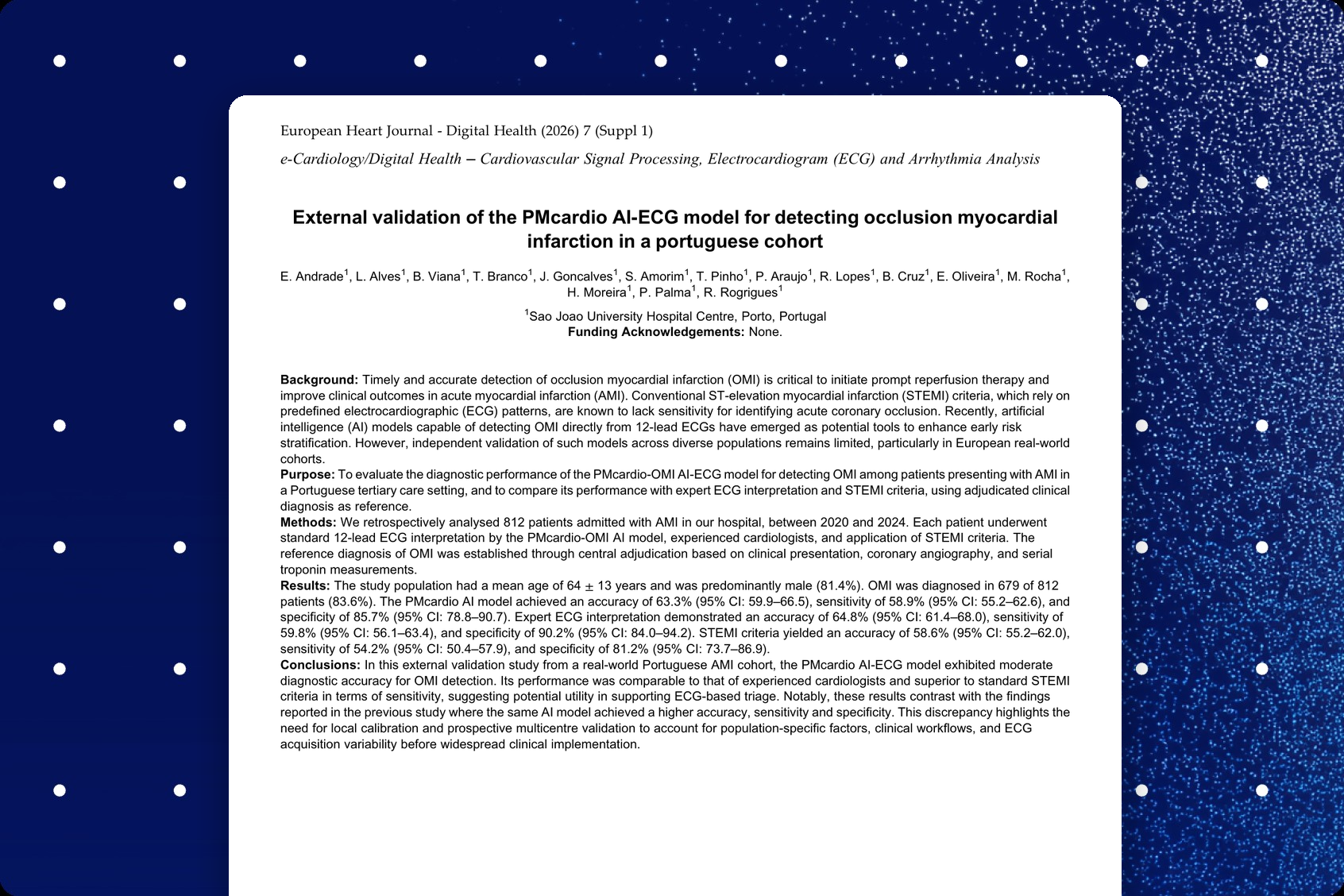
This independent, retrospective single-center study from São João University Hospital Centre in Porto, Portugal, evaluated version 1 of the PMcardio OMI AI-ECG model in 812 patients admitted with acute myocardial infarction (AMI) between 2020 and 2024, 679 (83.6%) of whom had an adjudicated occlusion myocardial infarction (OMI). The AI model reached an accuracy of 63.3%, a sensitivity of 58.9% and a specificity of 85.7%, comparable to experienced cardiologists (64.8%, 59.8% and 90.2%) and more sensitive than STEMI criteria (54.2%). The authors describe the model's diagnostic accuracy as moderate and lower than reported in a previous study of the same model, and call for local calibration and prospective multicenter validation before widespread clinical implementation.
Key findings
- In 812 patients admitted with acute myocardial infarction, 679 (83.6%) of whom had adjudicated OMI, the PMcardio AI-ECG model achieved 63.3% accuracy (95% CI 59.9–66.5), 58.9% sensitivity and 85.7% specificity.
- Experienced cardiologists interpreting the same patients' ECGs reached 64.8% accuracy, 59.8% sensitivity and 90.2% specificity, which the authors judged comparable to the AI model.
- STEMI criteria identified 54.2% of OMI cases (accuracy 58.6%, specificity 81.2%), a lower sensitivity than the AI model's 58.9%.
- The authors note these results are lower than previously reported for the same AI model and call for local calibration and prospective multicenter validation.
Published in: European Heart Journal – Digital Health – presented at the ESC Digital & AI Summit 2025
Published on: 12 January 2026
Background
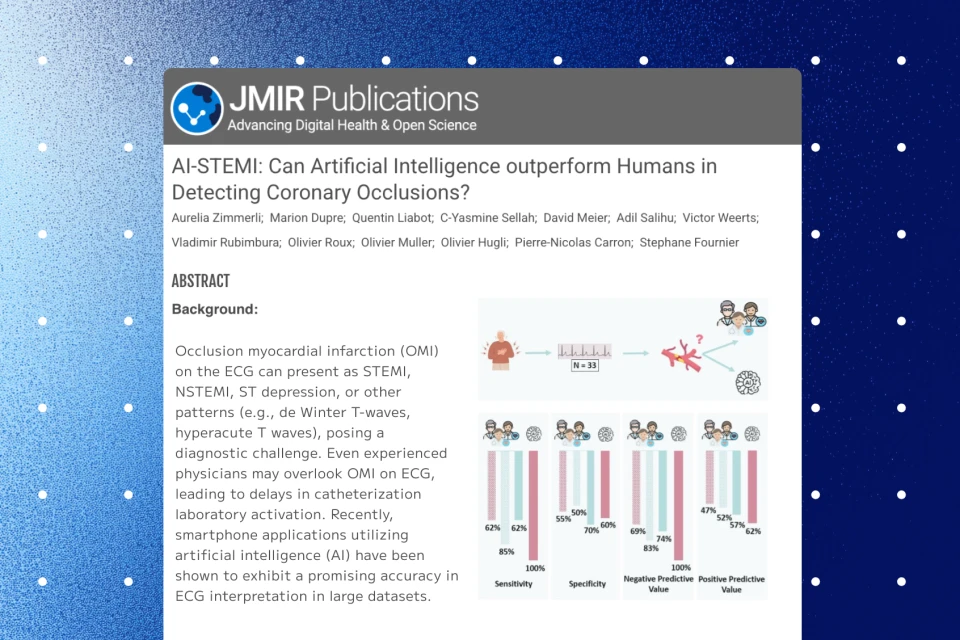
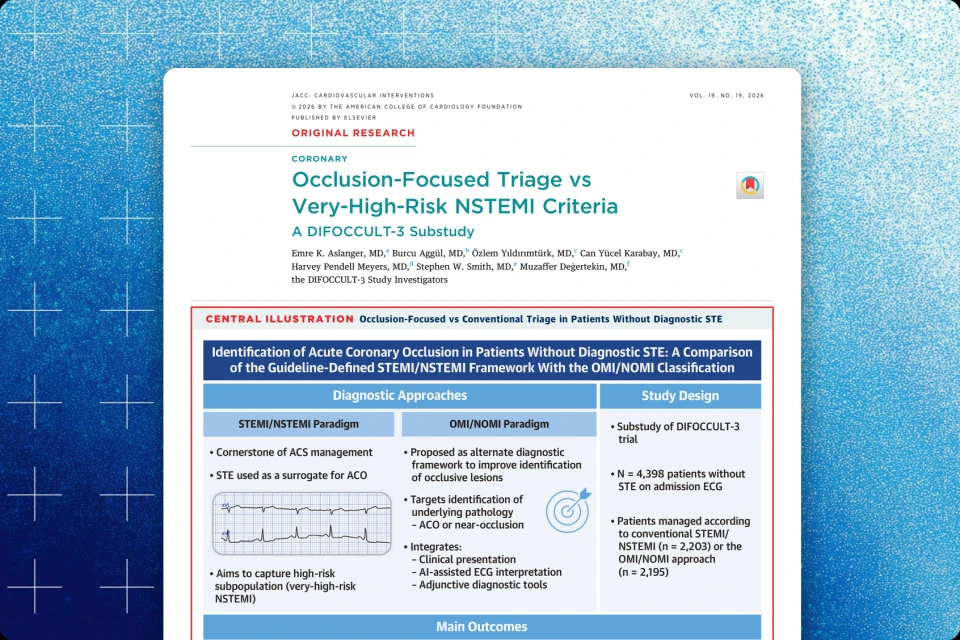
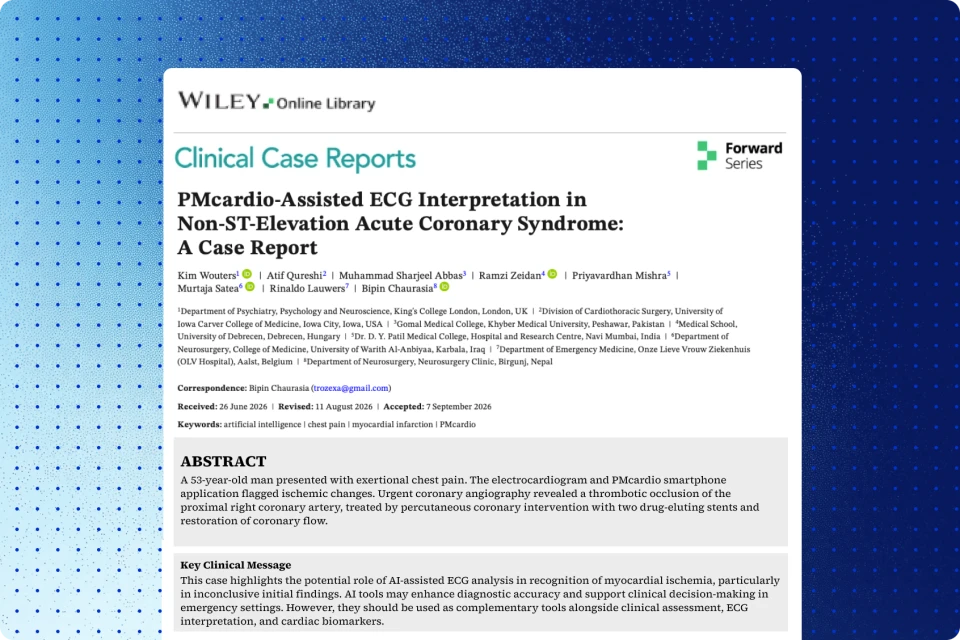
Timely and accurate detection of occlusion myocardial infarction (OMI) is critical to initiate prompt reperfusion therapy and improve outcomes in acute myocardial infarction (AMI). Conventional ST-elevation myocardial infarction (STEMI) criteria rely on predefined ECG patterns and are known to lack sensitivity for acute coronary occlusion. AI models that detect OMI directly from the 12-lead ECG have emerged as potential tools for early risk stratification, but independent validation across diverse populations remains limited, particularly in European real-world cohorts. This study evaluated the PMcardio OMI AI-ECG model in a Portuguese tertiary care setting and compared it with expert ECG interpretation and STEMI criteria.
Methods
The authors retrospectively analysed 812 patients admitted with AMI to São João University Hospital Centre (Porto, Portugal) between 2020 and 2024. Each patient's standard 12-lead ECG was interpreted by version 1 of the PMcardio OMI AI model, by experienced cardiologists, and by application of STEMI criteria. The reference diagnosis of OMI was established through central adjudication based on clinical presentation, coronary angiography and serial troponin measurements.
Results
Patients had a mean age of 64 ± 13 years and 81.4% were male; OMI was diagnosed in 679 of 812 patients (83.6%). The PMcardio AI model achieved an accuracy of 63.3% (95% CI 59.9–66.5), a sensitivity of 58.9% (95% CI 55.2–62.6) and a specificity of 85.7% (95% CI 78.8–90.7). Expert ECG interpretation by experienced cardiologists showed an accuracy of 64.8% (95% CI 61.4–68.0), a sensitivity of 59.8% (95% CI 56.1–63.4) and a specificity of 90.2% (95% CI 84.0–94.2). STEMI criteria yielded an accuracy of 58.6% (95% CI 55.2–62.0), a sensitivity of 54.2% (95% CI 50.4–57.9) and a specificity of 81.2% (95% CI 73.7–86.9).
Conclusion
In this real-world Portuguese AMI cohort, the PMcardio AI-ECG model showed moderate diagnostic accuracy for OMI detection, comparable to experienced cardiologists and more sensitive than standard STEMI criteria, suggesting potential utility in supporting ECG-based triage. As these results are lower than previously reported for the same model, the authors highlight the need for local calibration and prospective multicenter validation before widespread clinical implementation.
Share this article



About PMcardio
PMcardio is the market leader in AI-powered diagnostics, addressing the world’s leading cause of death – cardiovascular diseases. The innovative clinical assistant empowers healthcare professionals to detect up to 40 cardiovascular diseases. In the form of a smartphone application, the certified Class IIb medical device interprets any 12-lead ECG image in under 5 seconds to provide accurate diagnoses and individualized treatment recommendations tailored to each patient.

About Powerful Medical
Powerful Medical leads one of the most important shifts in modern medicine by augmenting human-made clinical decisions with artificial intelligence. Our primary focus is on cardiovascular diseases, the world’s leading cause of death.
Established in 2017, Powerful Medical has embarked on a mission to revolutionize the diagnosis and treatment of cardiovascular diseases. We are a medical company backed by 28 world-class cardiologists and led by our expert Scientific Board with decades of experience in daily patient care, clinical research, and medical devices. The results of our research are implemented, developed, certified, and brought to market by our 50+ strong interdisciplinary team of physicians, data scientists, AI experts, software engineers, regulatory specialists, and commercial teams.