
External Validation of an Electrocardiogram-Based Convolutional Neural Network Model for the Early Diagnosis of Occlusion Myocardial Infarction: A Prospective Multicenter Cohort Study
Overview
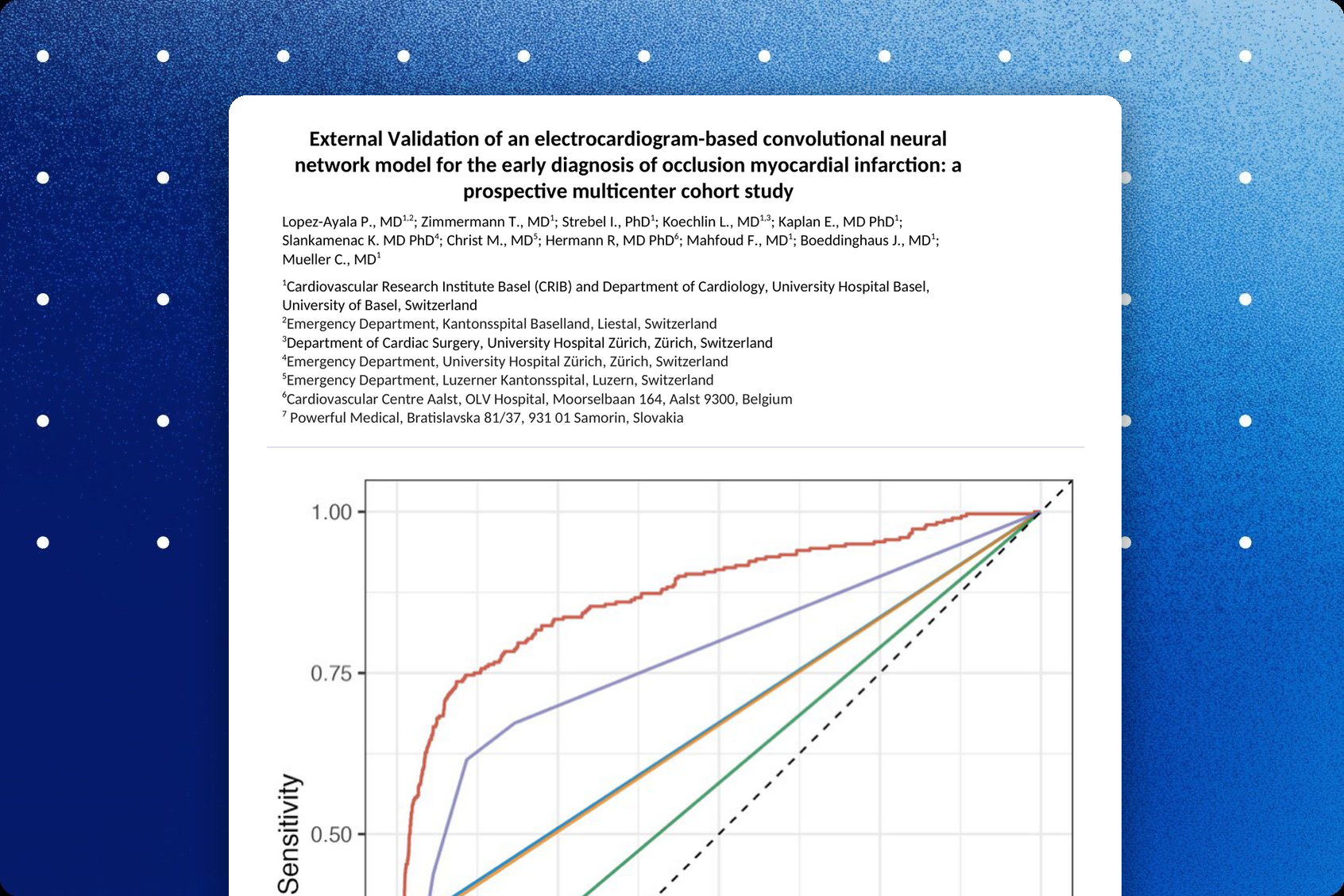
The Queen of Hearts aOMI v1 AI-ECG model was derived in a retrospective cohort of patients with acute coronary syndrome, so its performance in unselected emergency department (ED) patients had not been tested. In this external validation within the prospective, international APACE chest pain cohort, the model was applied to the ECGs of 4,728 unselected ED patients, 300 (6.3%) of whom had an adjudicated occlusion myocardial infarction (OMI). The model discriminated OMI with an AUC of 0.88 (95% CI 0.85–0.90), outperforming conventional ischemic ECG features (AUC 0.77 for ST elevation, ST depression and T-wave inversion combined). Its prespecified rule-in threshold (≥50%) reached 98.2% specificity and a 64.0% positive predictive value, better than the ESC single-measurement hs-cTnT rule-in cutoff (93.1% and 41.8%), and adding the model to a clinical model including hs-cTnT raised the AUC from 0.94 to 0.96.
Key findings
- In 4,728 unselected ED chest pain patients, of whom 300 (6.3%) had OMI, the Queen of Hearts aOMI v1 model discriminated OMI with an AUC of 0.88 (95% CI 0.85–0.90).
- The model outperformed conventional ischemic ECG features: ST elevation (AUC 0.66), ST depression (0.66), T-wave inversion (0.57) and all three combined (0.77).
- The rule-in threshold (≥50%) flagged 222 patients (4.7%) with 98.2% specificity and 64.0% PPV, versus 93.1% and 41.8% for the ESC hs-cTnT rule-in cutoff of ≥52 ng/L.
- Adding the model to a clinical model including hs-cTnT improved discrimination from an AUC of 0.94 (95% CI 0.93–0.95) to 0.96 (95% CI 0.95–0.97).
Published in: ESC Congress 2026, Munich – presented in the session "Acute coronary syndromes – novel biomarkers and artificial intelligence-enabled diagnostics"
Published on: 29 August 2026
Background
The Queen of Hearts aOMI v1 (QoH) model is an electrocardiogram (ECG)-based convolutional neural network (CNN) for the early diagnosis of occlusion myocardial infarction (OMI) that has shown good diagnostic performance. Because the model was derived in a retrospective cohort of patients presenting to a cardiovascular facility with acute coronary syndrome, external validation in unselected patients in the emergency department (ED) setting was lacking.
Methods
To externally validate the QoH model and compare it with standard ischemic ECG features and high-sensitivity cardiac troponin T (hs-cTnT), the investigators used an international diagnostic study (APACE, 13 centers) that prospectively enrolled unselected ED patients presenting with chest pain. Final diagnoses were centrally adjudicated. The primary endpoint was OMI, defined as angiographic evidence of an acute culprit lesion with TIMI flow 0–1, or TIMI flow 2–3 with a peak hs-cTnT ≥1000 ng/L; TIMI flow grades were assessed from coronary angiography reports and images by two interventional cardiologists. Model performance was assessed by discrimination (area under the receiver operating characteristic curve, AUC) and calibration. Added value was tested against a base model of age, sex, time since chest pain onset, coronary artery disease, diabetes, eGFR and hs-cTnT.
Results
Among 4,728 patients, OMI was the final diagnosis in 300 (6.3%). Patients with OMI had a higher predicted OMI probability than those without (40.4% vs 0.12%). Model discrimination was high (AUC 0.88, 95% CI 0.85–0.90), outperforming ischemic ECG features: ST elevation (AUC 0.66, 95% CI 0.63–0.69), ST depression (0.66, 0.63–0.69), T-wave inversion (0.57, 0.55–0.60) and their combination (0.77, 0.74–0.80). Calibration showed risk underestimation at low and overestimation at high predicted probabilities, which improved after recalibration. Adding QoH to a rich-for-prior-information model including hs-cTnT improved discrimination (AUC 0.94 [0.93–0.95] for the base model vs 0.96 [0.95–0.97] for the extended model). The originally derived rule-in probability of ≥50% triaged 222 patients (4.7%) towards rule-in, with a specificity of 98.2% (97.8–98.5) and a positive predictive value (PPV) of 64.0% (57.5–70.0), outperforming the European Society of Cardiology rule-in hs-cTnT cutoff of ≥52 ng/L (specificity 93.1% [92.4–93.8]; PPV 41.8% [37.7–46.1]). In the presented subgroup analysis, discrimination was consistent across age, sex and time-from-symptom-onset subgroups (AUC 0.86–0.91) and lower in patients with known coronary artery disease (0.81), previous PCI (0.78) or previous CABG (0.78).
Conclusion
In ED patients with chest pain, an ECG-based CNN model demonstrated high diagnostic accuracy for detecting OMI, outperforming traditional ECG features of ischemia and providing added value to hs-cTnT. Rule-in performance was good and superior to the established ESC single-measurement hs-cTnT strategy. The authors suggest that the model could help identify the up to 35% of NSTEMI patients with an occluded coronary artery who are missed by current ECG criteria, enabling faster reperfusion.
Share this article



About PMcardio
PMcardio is the market leader in AI-powered diagnostics, addressing the world’s leading cause of death – cardiovascular diseases. The innovative clinical assistant empowers healthcare professionals to detect up to 40 cardiovascular diseases. In the form of a smartphone application, the certified Class IIb medical device interprets any 12-lead ECG image in under 5 seconds to provide accurate diagnoses and individualized treatment recommendations tailored to each patient.

About Powerful Medical
Powerful Medical leads one of the most important shifts in modern medicine by augmenting human-made clinical decisions with artificial intelligence. Our primary focus is on cardiovascular diseases, the world’s leading cause of death.
Established in 2017, Powerful Medical has embarked on a mission to revolutionize the diagnosis and treatment of cardiovascular diseases. We are a medical company backed by 28 world-class cardiologists and led by our expert Scientific Board with decades of experience in daily patient care, clinical research, and medical devices. The results of our research are implemented, developed, certified, and brought to market by our 50+ strong interdisciplinary team of physicians, data scientists, AI experts, software engineers, regulatory specialists, and commercial teams.