
Electrocardiographically Subtle Inferior Myocardial Infarction: The Importance of Troponin, Clinical Context, and Artificial Intelligence
Overview
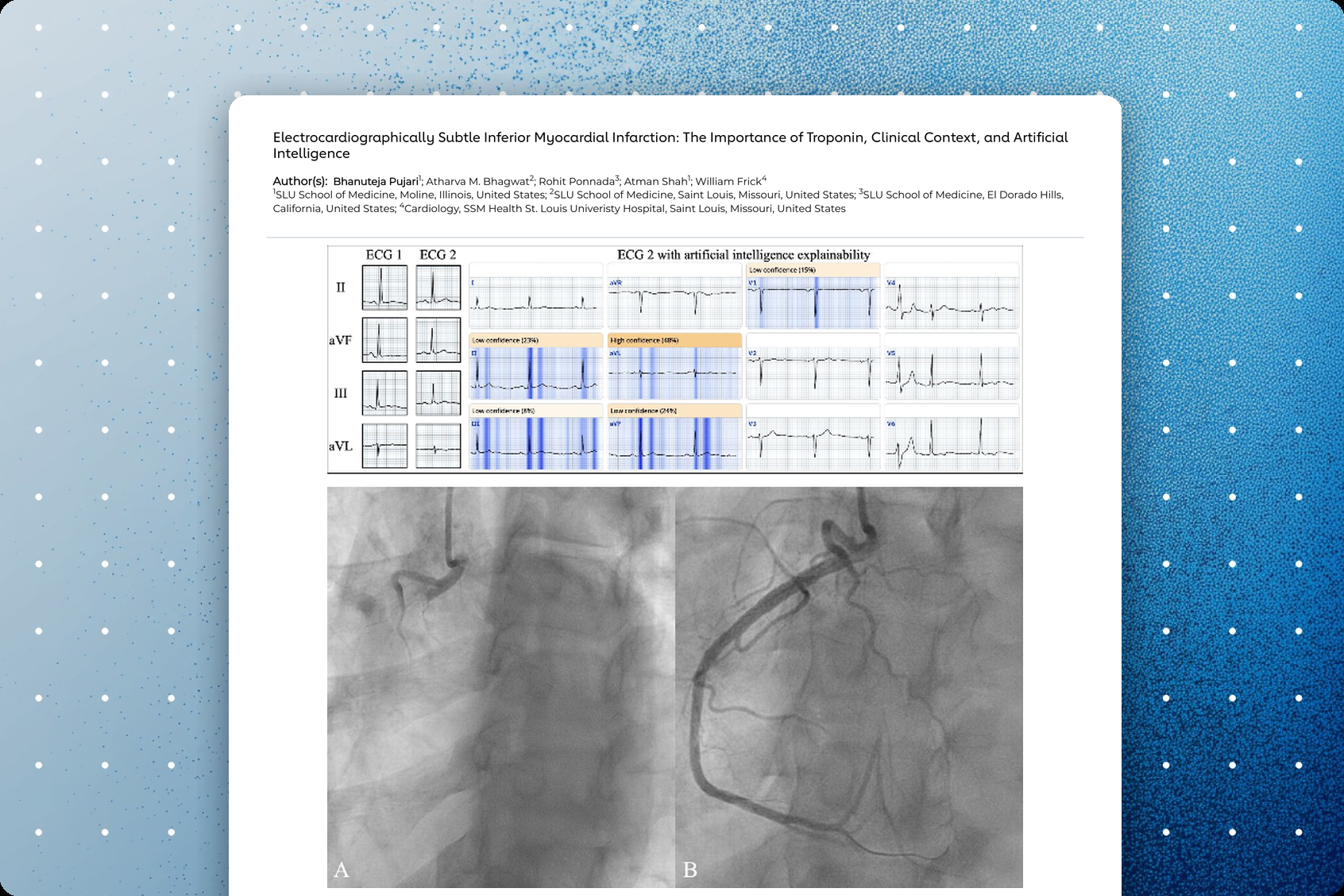
This independent case abstract from Saint Louis University and SSM Health describes a 43-year-old man with three days of intermittent chest pain whose ECG on arrival in the emergency department was nondiagnostic, even though troponin I was already 5,548 ng/L. Serial ECGs showed hyperacute T waves without diagnostic ST elevation, and coronary angiography 13 hours after arrival revealed an acute thrombotic occlusion of the proximal right coronary artery. Retrospective analysis with the PMcardio Queen of Hearts AI-ECG model highlighted findings consistent with inferoposterior occlusion myocardial infarction (OMI) that had not been recognized in real time. The authors conclude that early invasive evaluation should be considered when ECGs are diagnostic for OMI without meeting STEMI criteria.
Key findings
- The ECG on arrival was read as nondiagnostic although troponin I was already 5,548 ng/L; it later rose to 25,763 ng/L.
- Serial ECGs showed hyperacute T waves without diagnostic ST elevation, and angiography 13 hours after arrival revealed an acute thrombotic occlusion of the proximal right coronary artery.
- The authors note that the highest-risk NSTEMIs undergo urgent catheterization only 6.4% of the time, consistent with the delay seen in this case.
- Retrospective Queen of Hearts AI-ECG analysis highlighted findings consistent with inferoposterior OMI that had not been recognized in real time, when angiography was delayed until 13 hours after arrival.
Published in: American Heart Association (AHA) Scientific Sessions 2025 – presented as a poster (Clinical Case: Coronary Artery Disease); abstract published in Circulation (AHA Journals)
Published on: 10 November 2025
Background
Occlusion myocardial infarction (OMI) can present with minimal ECG changes, making diagnosis challenging without high clinical suspicion. STEMI criteria have limited sensitivity for acute coronary occlusion, and patients with NSTEMI and acute coronary occlusion have a longer time to angiography and worse outcomes than patients with STEMI and acute coronary occlusion.
Methods
The authors present the case of a 43-year-old man with a BMI of 36, hypertension and a 30 pack-year smoking history who had three days of intermittent chest pain radiating to the back, with nausea and dyspnea. His symptoms progressed, prompting repeated visits to urgent care and ultimately to the emergency department. His ECGs were later analyzed retrospectively with the PMcardio Queen of Hearts AI-ECG model.
Results
On arrival in the emergency department, the ECG was nondiagnostic, while troponin I was markedly elevated at 5,548 ng/L. Serial ECGs revealed hyperacute T waves without conventionally diagnostic ST elevation, and troponin rose to 25,763 ng/L. Coronary angiography 13 hours after arrival revealed an acute thrombotic occlusion of the proximal right coronary artery, and percutaneous coronary intervention was performed with resolution of pain. A repeat ECG showed reperfusion changes, and echocardiography showed inferior hypokinesis. Despite high-risk features, recognition and intervention were delayed, consistent with evidence that the highest-risk NSTEMIs undergo urgent catheterization 6.4% of the time. Retrospective analysis with the Queen of Hearts AI-ECG model helped identify diagnostic ECG findings that were not recognized in real time, highlighting findings consistent with inferoposterior OMI.
Conclusion
Elevated and rising troponin, even without dramatic ECG changes, should prompt urgent management. The Queen of Hearts AI-ECG model highlighted inferoposterior OMI findings that were missed in real time, supporting its potential role in earlier recognition of high-risk ECG patterns, and early invasive evaluation should be considered in patients whose ECGs are diagnostic for OMI without satisfying STEMI criteria.
Share this article



About PMcardio
PMcardio is the market leader in AI-powered diagnostics, addressing the world’s leading cause of death – cardiovascular diseases. The innovative clinical assistant empowers healthcare professionals to detect up to 40 cardiovascular diseases. In the form of a smartphone application, the certified Class IIb medical device interprets any 12-lead ECG image in under 5 seconds to provide accurate diagnoses and individualized treatment recommendations tailored to each patient.

About Powerful Medical
Powerful Medical leads one of the most important shifts in modern medicine by augmenting human-made clinical decisions with artificial intelligence. Our primary focus is on cardiovascular diseases, the world’s leading cause of death.
Established in 2017, Powerful Medical has embarked on a mission to revolutionize the diagnosis and treatment of cardiovascular diseases. We are a medical company backed by 28 world-class cardiologists and led by our expert Scientific Board with decades of experience in daily patient care, clinical research, and medical devices. The results of our research are implemented, developed, certified, and brought to market by our 50+ strong interdisciplinary team of physicians, data scientists, AI experts, software engineers, regulatory specialists, and commercial teams.