
Efficiency of an artificial intelligence powered electrocardiogram model for early detection of occlusion myocardial infarction in acute coronary syndrome: a multicenter cohort study
Overview
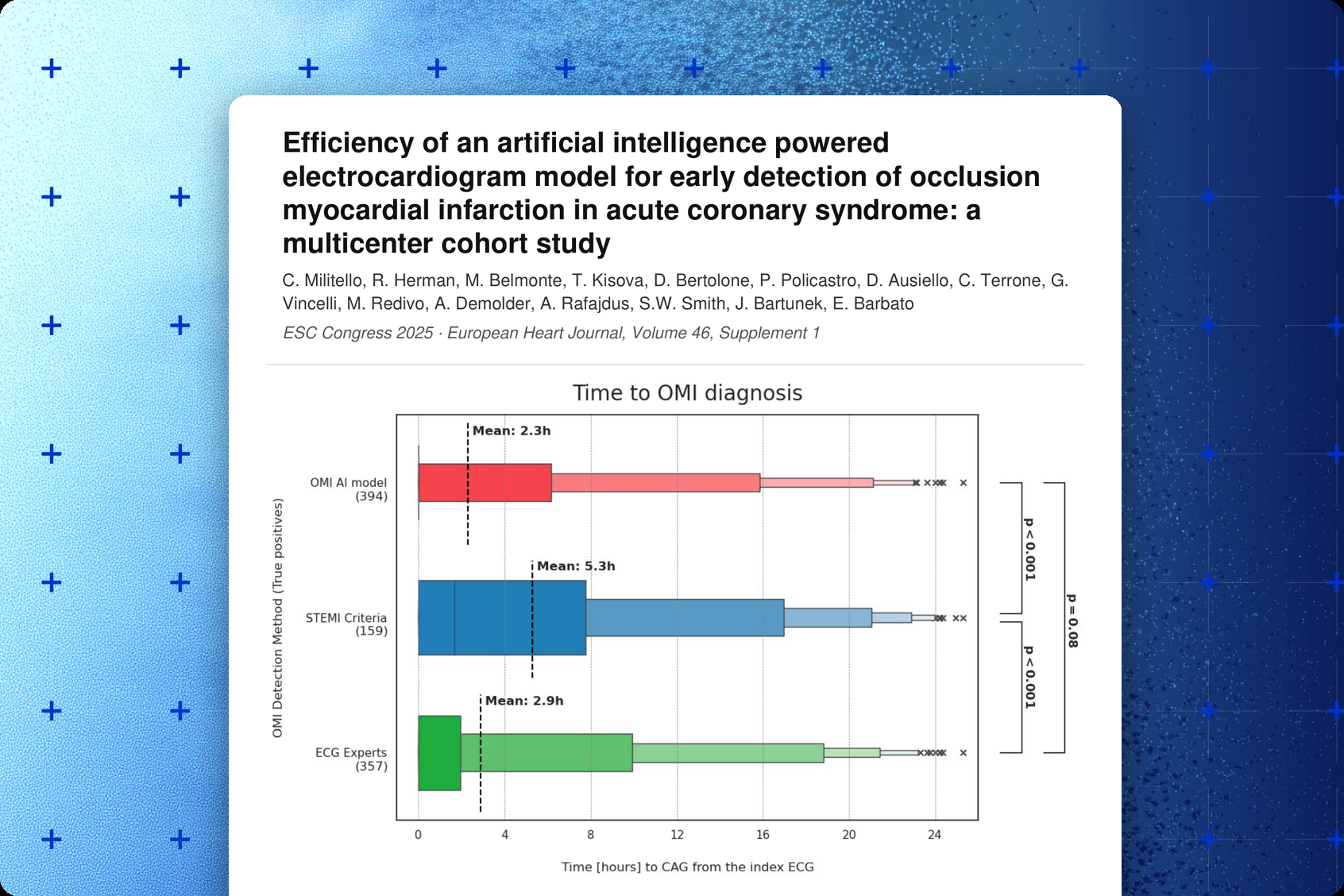
Many patients with acute coronary syndrome (ACS) have an acutely occluded coronary artery without typical ST elevation, so occlusion myocardial infarction (OMI) is often recognized late. This multicenter study compared how quickly an AI-ECG model, STEMI criteria and ECG experts identified OMI on serial ECGs recorded before coronary angiography in emergency department patients with ACS. The PMcardio OMI AI-ECG model identified OMI a mean of 2.3 hours after the first ECG, compared with 5.3 hours using STEMI criteria (P<0.001), and performed similarly to ECG experts (2.9 hours; P=0.8). It also detected more OMIs than STEMI criteria (394 vs 159 true positives).
Key findings
- Mean time from the first ECG to OMI diagnosis was 2.3 hours with the AI model versus 5.3 hours with STEMI criteria (P<0.001).
- The AI model was comparable with ECG experts, who reached the diagnosis after a mean of 2.9 hours (P=0.8).
- The AI model identified 394 OMIs (true positives), compared with 159 by STEMI criteria and 357 by ECG experts.
- Patients with OMI received interventions at similar rates regardless of STEMI criteria: 97.3% vs 95.9% (P=0.570), and 96.3% vs 92.4% (P=0.358) when OMI was limited to TIMI 0–1 flow.
Published in: ESC Congress 2025 (European Heart Journal, Volume 46, Supplement 1)
Published on: 31 August 2025
Background
Most patients with acute coronary syndromes (ACS) present without typical ST elevation. One third of patients with non-ST-elevation myocardial infarction (NSTEMI) have an acutely occluded culprit coronary artery, known as occlusion myocardial infarction (OMI), and delayed identification and invasive management of these patients leads to poor outcomes. This study evaluated the accuracy and time to diagnosis of OMI with an artificial intelligence (AI)-powered electrocardiogram (ECG) model, state-of-the-art diagnostic criteria and ECG experts in patients with ACS presenting to the emergency department for serial ECG evaluation.
Methods
The AI model, the PMcardio OMI AI-ECG model, was developed using 18,616 ECGs from 10,543 patients with suspected ACS from an international database with clinically validated outcomes. It was evaluated in an international cohort and compared with STEMI criteria and ECG experts for detecting OMI. In patients with multiple ECGs before coronary angiography, the maximum interpretation per patient was retained for benchmarking. The time to diagnose OMI was measured for each method as the time from the patient's initial ECG to the correct identification of OMI on subsequent ECGs; if a method detected OMI on the first ECG, the time to diagnosis was 0. When a method did not detect OMI on any ECG before coronary angiography, the time to diagnosis was set equal to the time to angiography.
Results
The mean age of the study population was 66 ± 14 years, 65.9% were male and 22.9% presented with OMI. The mean time to OMI diagnosis was significantly shorter with the OMI AI model than with STEMI criteria (2.3 vs 5.3 hours, P<0.001), and comparable with ECG experts (mean 2.9 hours, P=0.8). The AI model identified 394 OMIs (true positives), compared with 159 by STEMI criteria and 357 by ECG experts. Patients with OMI received interventions at a similar rate regardless of the presence of STEMI criteria, both with the primary outcome definition (97.3% vs 95.9%, P=0.570) and with the strictest OMI outcome of TIMI 0–1 flow only (96.3% vs 92.4%, P=0.358).
Conclusion
The novel AI-ECG model demonstrated superior accuracy and efficiency in detecting acute OMI compared with STEMI criteria. This suggests its potential to improve ACS triage, ensuring appropriate and timely referral for immediate revascularization.
Share this article



About PMcardio
PMcardio is the market leader in AI-powered diagnostics, addressing the world’s leading cause of death – cardiovascular diseases. The innovative clinical assistant empowers healthcare professionals to detect up to 40 cardiovascular diseases. In the form of a smartphone application, the certified Class IIb medical device interprets any 12-lead ECG image in under 5 seconds to provide accurate diagnoses and individualized treatment recommendations tailored to each patient.

About Powerful Medical
Powerful Medical leads one of the most important shifts in modern medicine by augmenting human-made clinical decisions with artificial intelligence. Our primary focus is on cardiovascular diseases, the world’s leading cause of death.
Established in 2017, Powerful Medical has embarked on a mission to revolutionize the diagnosis and treatment of cardiovascular diseases. We are a medical company backed by 28 world-class cardiologists and led by our expert Scientific Board with decades of experience in daily patient care, clinical research, and medical devices. The results of our research are implemented, developed, certified, and brought to market by our 50+ strong interdisciplinary team of physicians, data scientists, AI experts, software engineers, regulatory specialists, and commercial teams.