
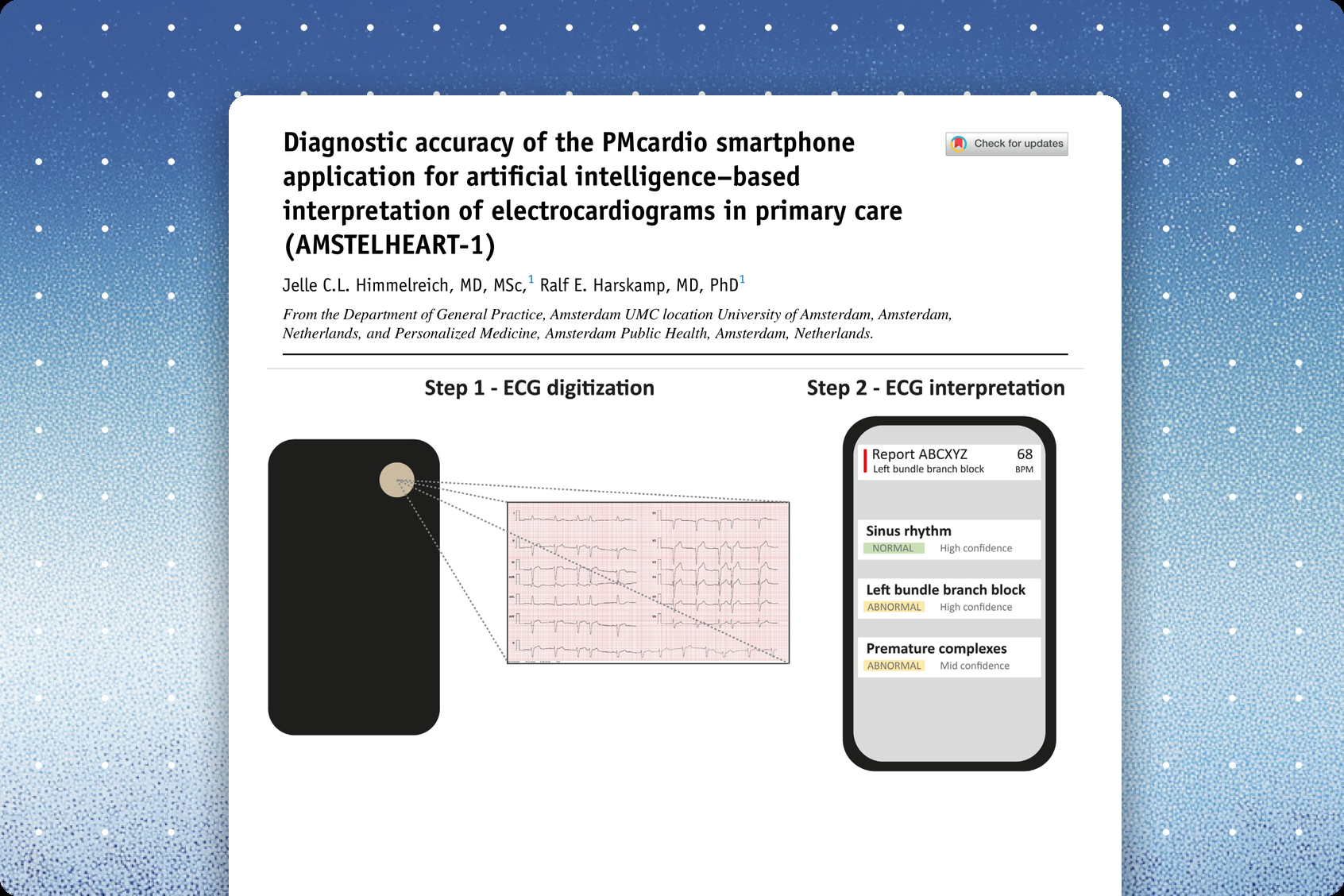
Diagnostic accuracy of the PMcardio smartphone application for artificial intelligence–based interpretation of electrocardiograms in primary care (AMSTELHEART-1)
Overview
Reading 12-lead ECGs in routine primary care can be difficult for less experienced readers. In this independent study from Amsterdam UMC, the PMcardio smartphone app interpreted photographed ECGs from 290 consecutive patients in 11 Dutch general practices, compared against a blinded expert panel. The app detected any major ECG abnormality with 86% sensitivity and 92% specificity, and atrial fibrillation or flutter with 97% sensitivity and 99% specificity. Results were nearly identical on Android and iOS (kappa 0.95 for major abnormalities), while sensitivity for signs of past or present ischemia was lower at 54%.
Key findings
- Among 290 consecutive primary care patients, PMcardio detected any major ECG abnormality with 86% sensitivity, 92% specificity and a 95% negative predictive value.
- Atrial fibrillation or flutter was detected with 97% sensitivity and 99% specificity, with a positive predictive value of 94%.
- Android and iOS results agreed almost perfectly, with kappa 0.95 for major ECG abnormalities and 1.00 for atrial fibrillation.
- Sensitivity for ECG signs of past or present ischemia was 54% overall but rose to 80% in patients presenting with new symptoms.
Published in: Cardiovascular Digital Health Journal
Published on: 5 April 2023
Background
The 12-lead ECG is commonly used in routine primary care, yet it can be difficult for less experienced readers to interpret adequately. The PMcardio smartphone application analyzes a photographed 12-lead ECG with artificial intelligence, but its ECG interpretation had not been independently validated in a primary care setting. This study set out to validate PMcardio as a stand-alone 12-lead ECG interpretation tool for general practice.
Methods
The authors used data from consecutive adults who underwent a GP-ordered 12-lead ECG for any routine care indication in 11 general practices across the Netherlands, combining the VESTA study (April 2017–July 2018) with an extension cohort (January–December 2022). Every ECG was photographed and analyzed by PMcardio (version 2.5, detecting 42 ECG features) on an Android phone (Samsung Galaxy M31, primary analysis) and an iPhone SE2020. The reference standard was consensus of 2 blinded expert readers, with a third cardiologist resolving disagreements. The primary outcome was any major ECG abnormality (MEA): atrial fibrillation or flutter (AF), markers of past or present myocardial ischemia, or clinically relevant impulse or conduction abnormalities. AF was the key secondary outcome. The manufacturer was not involved in the design, conduct or reporting of the study.
Results
Of 295 ECGs, 290 patients were included (median age 67 years, IQR 55–74; 48% female; 60% presenting with new symptoms). PMcardio produced a result for 285 ECGs (98%) on both phones. The expert panel found MEA in 71 patients (25%) and AF in 35 (12%). For MEA, PMcardio had a sensitivity of 86% (95% CI 76–93%) and a specificity of 92% (95% CI 87–95%), with a PPV of 77% and an NPV of 95%. For AF, sensitivity was 97% (95% CI 85–100%) and specificity 99% (95% CI 97–100%). Sensitivity for clinically relevant impulse or conduction abnormalities was 89% (specificity 92%), whereas sensitivity for signs of past or present ischemia was lower at 54% (specificity 96%), improving to 80% in patients presenting with new symptoms. Agreement between Android and iOS was very high (kappa 0.95 for MEA and 1.00 for AF).
Conclusion
A smartphone app that interprets photographed 12-lead ECGs showed good diagnostic accuracy for major ECG abnormalities and near-perfect accuracy for atrial fibrillation in routine primary care, performing equally on Android and iOS. Caution is warranted when assessing signs of past ischemia in asymptomatic patients and conduction abnormalities on lower-quality ECGs.
Share this article



About PMcardio
PMcardio is the market leader in AI-powered diagnostics, addressing the world’s leading cause of death – cardiovascular diseases. The innovative clinical assistant empowers healthcare professionals to detect up to 40 cardiovascular diseases. In the form of a smartphone application, the certified Class IIb medical device interprets any 12-lead ECG image in under 5 seconds to provide accurate diagnoses and individualized treatment recommendations tailored to each patient.

About Powerful Medical
Powerful Medical leads one of the most important shifts in modern medicine by augmenting human-made clinical decisions with artificial intelligence. Our primary focus is on cardiovascular diseases, the world’s leading cause of death.
Established in 2017, Powerful Medical has embarked on a mission to revolutionize the diagnosis and treatment of cardiovascular diseases. We are a medical company backed by 28 world-class cardiologists and led by our expert Scientific Board with decades of experience in daily patient care, clinical research, and medical devices. The results of our research are implemented, developed, certified, and brought to market by our 50+ strong interdisciplinary team of physicians, data scientists, AI experts, software engineers, regulatory specialists, and commercial teams.