
Development of the CASPER-Score: A bedside tool integrating AI-based ECG analysis with key clinical predictors to identify relevant coronary artery stenosis in patients after out-of-hospital cardiac arrest
Overview
Immediate coronary angiography after out-of-hospital cardiac arrest (OHCA) is recommended when the post-resuscitation ECG shows ST-segment elevation, but its role in other patients remains controversial, and STEMI can be hard to diagnose after arrest. This single-center retrospective study at University Hospital Zurich analyzed the admission ECGs of 204 OHCA patients who underwent coronary angiography within seven days with the PMcardio AI-ECG app (v2.10); 157 (77%) had relevant coronary artery stenosis and 127 (62.3%) were revascularized. AI-detected occlusion myocardial infarction (OMI) was the strongest independent predictor of relevant stenosis (adjusted odds ratio 19.7), alongside age ≥65 years, male sex and an initial shockable rhythm. Combined into the 0–8-point CASPER-Score, these four bedside variables identified relevant coronary artery stenosis with an AUC of 0.86, compared with 0.78 for AI-derived OMI detection alone.
Key findings
- AI-detected OMI on the admission ECG was the strongest independent predictor of relevant coronary artery stenosis after OHCA (adjusted odds ratio 19.7, 95% CI 6.2–62.8) and contributes 4 of the 8 CASPER-Score points.
- The CASPER-Score (age ≥65 years 1 point, male sex 2, initial shockable rhythm 1, AI-detected OMI 4) discriminated relevant coronary artery stenosis with an AUC of 0.86 (95% CI 0.80–0.92), versus 0.78 for AI-derived OMI detection alone.
- PMcardio flagged OMI on the admission ECG in 64.5% of patients with relevant coronary artery stenosis versus 9.1% of those without.
- In the 146 patients without ST-segment elevation, a CASPER-Score of ≥3 classified 102 as high risk, of whom 87 (85.3%) had relevant coronary artery stenosis.
Published in: Resuscitation
Published on: 7 July 2026
Background
Out-of-hospital cardiac arrest (OHCA) is a leading cause of death worldwide and is frequently caused by acute coronary syndromes. Guidelines recommend immediate coronary angiography when the post-resuscitation ECG shows ST-segment elevation myocardial infarction (STEMI), but its role in patients without STEMI remains controversial, as randomized trials showed no benefit of a routine immediate invasive strategy, and STEMI can be difficult to diagnose after arrest. AI-assisted ECG interpretation has shown promising accuracy for myocardial infarction detection, but its value for predicting relevant coronary artery lesions and the need for revascularization after OHCA had not been studied. This study aimed to identify independent predictors of relevant coronary artery stenosis and revascularization after OHCA and to develop a bedside risk score from variables available at initial assessment.
Methods
The authors conducted a single-center, retrospective cohort study at the Institute of Intensive Care Medicine, University Hospital Zurich, Switzerland, including patients admitted to the ICU after OHCA between January 2019 and December 2021 who were directly admitted to the center and underwent coronary angiography within seven days. The first 12-lead ECG after admission was exported from the electronic medical record, anonymized, converted to an image and analyzed with PMcardio (v2.10), a CE-marked Class IIb AI-powered ECG interpretation app, on a smartphone; OMI was considered detected when the AI probability category indicated any OMI probability. The primary outcome was relevant coronary artery stenosis (≥50% diameter stenosis of the left main coronary artery or ≥70% of any other vessel); the secondary outcome was coronary revascularization (PCI or CABG). Multivariable logistic regression with backward elimination was performed using only variables available at initial assessment, the regression coefficients were converted into an integer bedside score, and internal validation used bootstrap resampling with 5000 repetitions.
Results
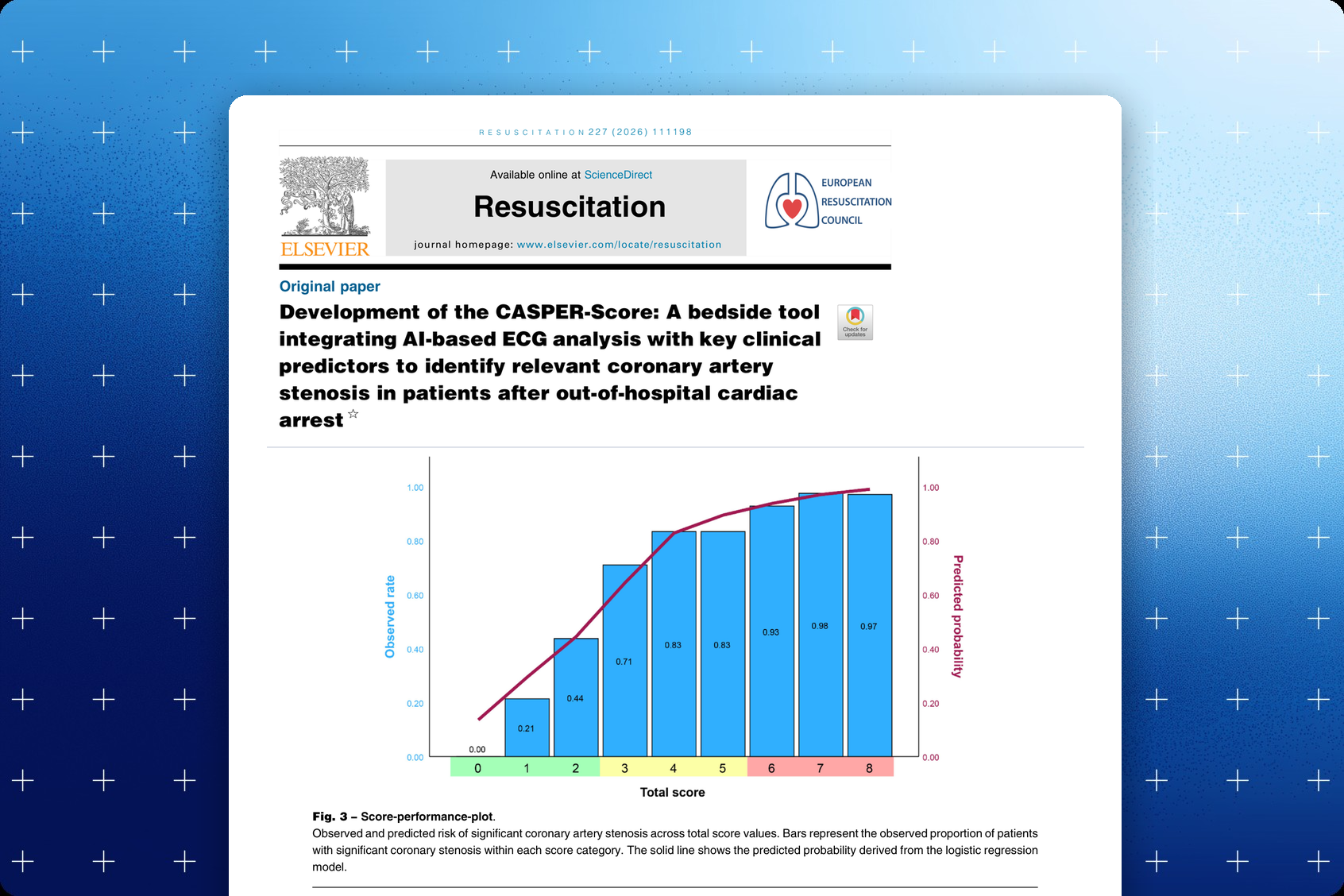
Of 667 screened patients, 324 were directly admitted to the ICU after OHCA, and 204 (63.0%) underwent coronary angiography within seven days and were included, 188 (92.2%) of them on the day of admission. Relevant coronary artery stenosis was present in 157 patients (77%), 127 (62.3%) underwent revascularization, and 58 (28.4%) had ST-segment elevation on the post-ROSC ECG. AI-detected OMI (adjusted odds ratio 19.67, 95% CI 6.16–62.78), male sex (4.41), age ≥65 years (3.34) and an initial shockable rhythm (2.31) were independent predictors of relevant stenosis and formed the CASPER-Score (0–8 points), with 0–2 points indicating low, 3–5 intermediate and ≥6 high risk; the observed rate of relevant stenosis rose from 0% at 0 points to 97–98% at 7–8 points. The regression model reached an AUC of 0.86 (95% CI 0.80–0.93) and the CASPER-Score an AUC of 0.86 (95% CI 0.80–0.92), compared with 0.78 (95% CI 0.70–0.85) for AI-derived OMI detection alone, and bootstrap validation confirmed stable discrimination (CASPER-Score 95% CI 0.79–0.92). In the 146 patients without ST-segment elevation, 104 (71.2%) had relevant stenosis; a CASPER-Score of ≥3 classified 102 (69.9%) as high risk, of whom 87 (85.3%) had relevant stenosis. Predicting revascularization was harder: a model combining AI-detected OMI, STEMI, male sex and shockable rhythm reached an AUC of 0.74 (95% CI 0.67–0.81), versus 0.67 (95% CI 0.59–0.75) for AI-derived OMI detection alone.
Conclusion
In OHCA patients undergoing coronary angiography, AI-derived OMI detection was a strong, independent predictor of relevant coronary artery stenosis. The CASPER-Score, combining age, male sex, shockable initial rhythm and AI-derived OMI detection, may support early risk stratification and decision-making on coronary angiography after OHCA. It predicts relevant coronary artery disease rather than acute culprit lesions, and prospective multicenter validation is warranted.
Share this article



About PMcardio
PMcardio is the market leader in AI-powered diagnostics, addressing the world’s leading cause of death – cardiovascular diseases. The innovative clinical assistant empowers healthcare professionals to detect up to 40 cardiovascular diseases. In the form of a smartphone application, the certified Class IIb medical device interprets any 12-lead ECG image in under 5 seconds to provide accurate diagnoses and individualized treatment recommendations tailored to each patient.

About Powerful Medical
Powerful Medical leads one of the most important shifts in modern medicine by augmenting human-made clinical decisions with artificial intelligence. Our primary focus is on cardiovascular diseases, the world’s leading cause of death.
Established in 2017, Powerful Medical has embarked on a mission to revolutionize the diagnosis and treatment of cardiovascular diseases. We are a medical company backed by 28 world-class cardiologists and led by our expert Scientific Board with decades of experience in daily patient care, clinical research, and medical devices. The results of our research are implemented, developed, certified, and brought to market by our 50+ strong interdisciplinary team of physicians, data scientists, AI experts, software engineers, regulatory specialists, and commercial teams.