
Detection of Acute Coronary Occlusion in Bradycardic Patients Using ECG: Comparison of STEMI Criteria Versus Artificial Intelligence–Enhanced Interpretation
Overview
In patients with a slow heart rate, ST-segment changes on the ECG can reflect either strain on the heart or a truly blocked coronary artery, which makes acute coronary occlusion (ACO) hard to recognize with standard STEMI criteria. This independent study from the Chest Pain Unit of the University of Cologne tested an AI-ECG model on the admission ECGs of 485 bradycardic chest pain patients and compared it with conventional STEMI criteria. The AI-ECG model had a much higher area under the curve (0.968 vs 0.607), detected 5 of 11 occlusions versus 3 of 11, and raised far fewer false alarms (6 vs 33). Because neither approach was sensitive enough to safely exclude ACO, the authors conclude that an ECG-only strategy is insufficient in these patients and call for prospective validation.
Key findings
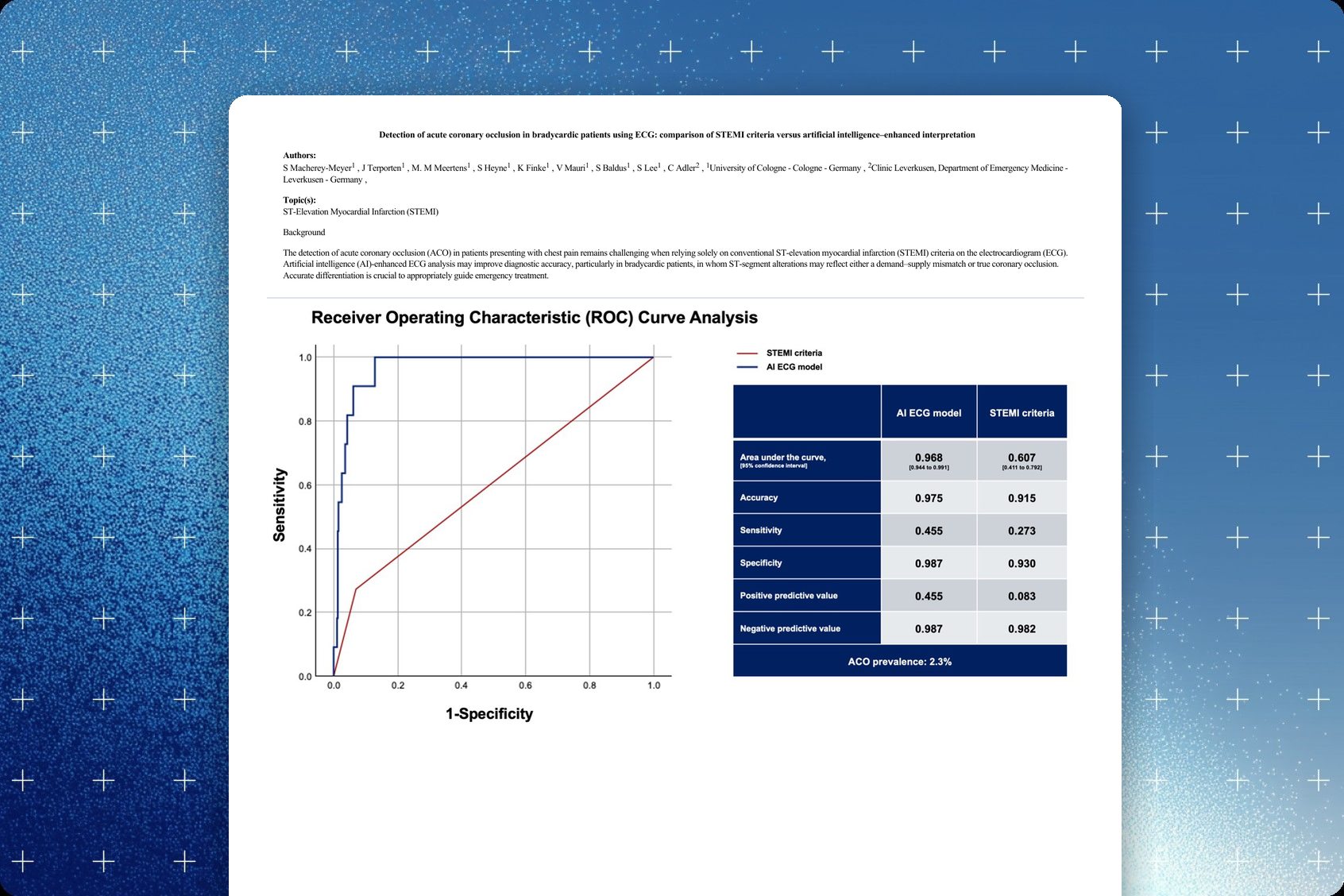
- The AI-ECG model reached an AUC of 0.968 (95% CI 0.944–0.991) for acute coronary occlusion, versus 0.607 (95% CI 0.411–0.792) for STEMI criteria.
- False-positive findings fell from 33 (6.8%) with STEMI criteria to 6 (1.2%) with the AI-ECG model; specificity was 98.7% vs 93.0%.
- The AI-ECG model detected 5 of 11 occlusions (45.5%) versus 3 of 11 (27.3%) for STEMI criteria, so neither approach could safely rule out ACO.
- In the troponin-based rule-out subgroup, the AI-ECG model had one false positive and could potentially have avoided 15 emergency coronary angiographies.
Published in: ESC Congress 2026 (abstract 86489, ePoster)
Published on: 30 August 2026
Background
The detection of acute coronary occlusion (ACO) in patients presenting with chest pain remains challenging when relying solely on conventional ST-elevation myocardial infarction (STEMI) criteria on the electrocardiogram (ECG). In bradycardic patients, ST-segment alterations may reflect either a demand–supply mismatch or true coronary occlusion, and accurate differentiation is crucial to guide emergency treatment. Artificial intelligence (AI)-enhanced ECG analysis may improve diagnostic accuracy in this group. The study evaluated the diagnostic performance of an AI-based ECG model for detecting ACO on the admission ECG of bradycardic chest pain patients, compared with conventional STEMI criteria, in a Chest Pain Unit (CPU) setting.
Methods
All consecutive bradycardic patients (<60 bpm) presenting with chest pain to the CPU of the University of Cologne between November 2018 and June 2021 were included. Clinical management followed current European Society of Cardiology guidelines. The endpoint was ACO, adjudicated by an independent physician blinded to the AI predictions using coronary angiography, biomarker kinetics and echocardiography. Diagnostic performance was assessed by receiver operating characteristic (ROC) analysis and compared with STEMI criteria.
Results
Of 4,440 patients treated in the CPU, 485 presented with bradycardia and were included (mean age 57.7 ± 18.4 years; 71.8% male; mean heart rate 53.9 ± 4.8 bpm). Rhythms were sinus bradycardia (92.6%), atrial fibrillation (2.3%), idioventricular rhythm (0.4%) and other rhythms (4.7%). The prevalence of ACO was 2.3% (n = 11). The area under the curve was 0.968 (95% CI 0.944–0.991) for the AI-ECG model and 0.607 (95% CI 0.411–0.792) for STEMI criteria. STEMI criteria identified 3 cases of ACO (sensitivity 27.3%), whereas the AI-ECG model detected 5 (45.5%). STEMI criteria yielded 33 false-positive findings (6.8%), compared with 6 (1.2%) for the AI-ECG model. Specificity was 98.7% vs 93.0%, positive predictive value 45.5% vs 8.3%, negative predictive value 98.7% vs 98.2% and accuracy 97.5% vs 91.5% for the AI-ECG model vs STEMI criteria. In the low-risk subgroup ("rule-out" according to the troponin-based algorithm), the AI-ECG model produced only one false-positive result and, compared with strict application of STEMI criteria, could potentially have avoided 15 emergency coronary angiographies.
Conclusion
In bradycardic patients presenting with acute chest pain, a purely ECG-based strategy is insufficient for the reliable detection of acute coronary occlusion. Neither approach achieved sufficient sensitivity to safely exclude ACO; however, the AI-ECG model substantially reduced false-positive findings compared with conventional STEMI criteria. The low prevalence of ACO in this cohort warrants further prospective validation of the AI-ECG model.
Share this article



About PMcardio
PMcardio is the market leader in AI-powered diagnostics, addressing the world’s leading cause of death – cardiovascular diseases. The innovative clinical assistant empowers healthcare professionals to detect up to 40 cardiovascular diseases. In the form of a smartphone application, the certified Class IIb medical device interprets any 12-lead ECG image in under 5 seconds to provide accurate diagnoses and individualized treatment recommendations tailored to each patient.

About Powerful Medical
Powerful Medical leads one of the most important shifts in modern medicine by augmenting human-made clinical decisions with artificial intelligence. Our primary focus is on cardiovascular diseases, the world’s leading cause of death.
Established in 2017, Powerful Medical has embarked on a mission to revolutionize the diagnosis and treatment of cardiovascular diseases. We are a medical company backed by 28 world-class cardiologists and led by our expert Scientific Board with decades of experience in daily patient care, clinical research, and medical devices. The results of our research are implemented, developed, certified, and brought to market by our 50+ strong interdisciplinary team of physicians, data scientists, AI experts, software engineers, regulatory specialists, and commercial teams.