
Detecting Occlusion Myocardial Infarction with an AI-Powered ECG Model: A Retrospective Cohort Study
Overview
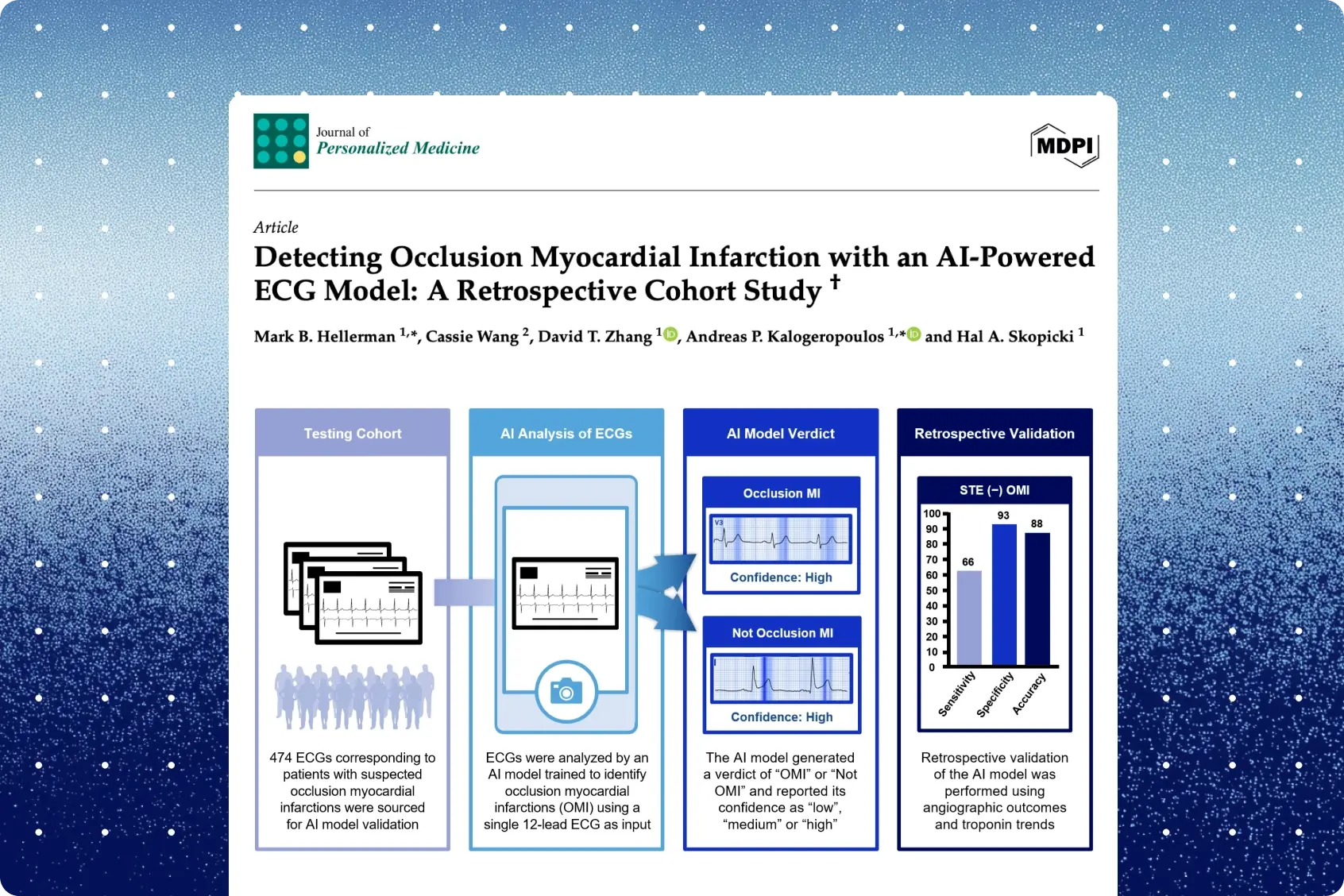
Patients with NSTEMI whose culprit artery is completely occluded face a higher risk of death, yet conventional STEMI criteria often miss them. In this one-year retrospective cohort of 474 patients with suspected occlusion myocardial infarction (OMI), PMcardio's Queen of Hearts AI ECG model detected 90% of angiographically confirmed OMIs — with 89.4% accuracy and 93.2% specificity — outperforming STEMI criteria across every metric. Critically, it flagged two-thirds of the OMIs that did not meet STEMI criteria, the high-risk NSTEMI cases most likely to be overlooked.
Key findings
- In 474 suspected-OMI patients, Queen of Hearts detected 90% of confirmed occlusion MIs.
- 89.4% accuracy and 93.2% specificity — beating STEMI criteria on every metric.
- Flagged 66% of occlusion MIs that did not meet STEMI criteria (high-risk NSTEMIs).
Published in: Journal of Personalized Medicine
Published on: 24 March 2026
Background
Patients with NSTEMI who are found with a totally occluded culprit vessel on coronary angiography are at higher risk of mortality and major adverse cardiac events. Artificial intelligence (AI) models can help identify this subgroup of NSTEMIs.
Methods
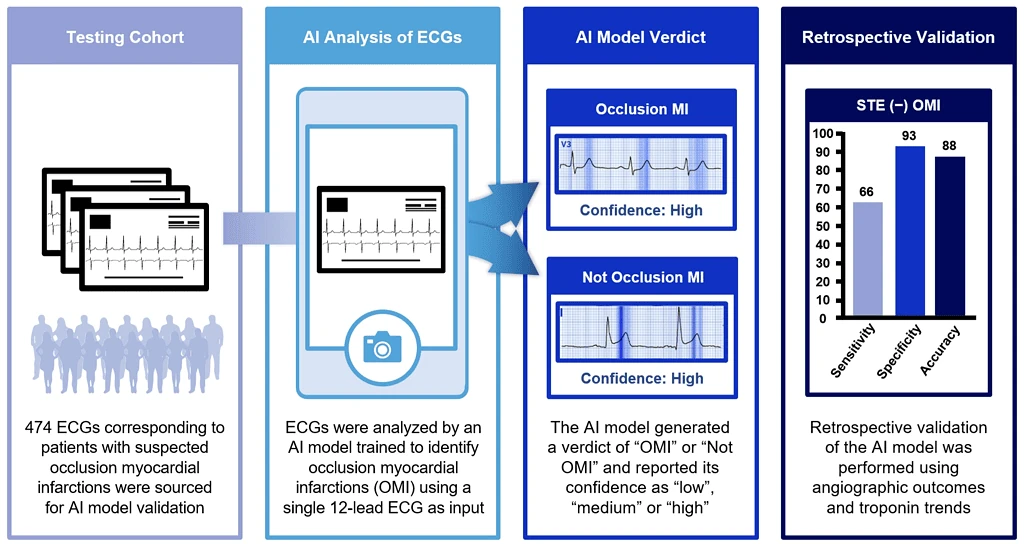
In this retrospective cohort study, 12-lead ECGs corresponding to patients with suspected OMI were analyzed by an AI model. Confirmation of OMI was based on angiographic evidence of acute culprit coronary artery stenosis.
Results
Over a one-year period, emergency physicians at our hospital identified 474 patients with suspected OMI, of whom 88 met STEMI criteria. Out of the 142 angiographically confirmed OMIs, the AI model correctly identified 115 (81%) with high confidence, corresponding to an accuracy of 89.4%, sensitivity of 90.0%, specificity of 93.2%, positive predictive value (PPV) of 84.6%, and negative predictive value (NPV) of 91.4%. Out of the 74 angiographically confirmed OMIs that did not meet STEMI criteria, the AI model correctly identified 49 (66%) with high confidence, corresponding to an accuracy of 87.9%, sensitivity of 66.2%, specificity of 93.4%, PPV of 72.1%, and NPV of 91.5%. Out of the 68 angiographically confirmed OMIs that met STEMI criteria, the AI model correctly identified 66 (97%) with high confidence, corresponding to an accuracy of 95.5%, sensitivity of 97.1%, specificity of 90.0%, PPV of 97.1%, and NPV of 90.0%. Conclusions: The AI model examined in this study outperformed the STEMI criteria for the identification of OMI with respect to accuracy, sensitivity, specificity, PPV, and NPV and accurately identified a significant portion of NSTEMIs found to have total thrombotic coronary artery occlusion.
Conclusion
The AI model examined in this study outperformed the STEMI criteria for the identification of OMI with respect to accuracy, sensitivity, specificity, PPV, and NPV and accurately identified a significant portion of NSTEMIs found to have total thrombotic coronary artery occlusion.
Authors: Mark B. Hellerman, Cassie Wang, David T. Zhang, Andreas P. Kalogeropoulos and Hal A. Skopicki
Share this article



About PMcardio
PMcardio is the market leader in AI-powered diagnostics, addressing the world’s leading cause of death – cardiovascular diseases. The innovative clinical assistant empowers healthcare professionals to detect up to 40 cardiovascular diseases. In the form of a smartphone application, the certified Class IIb medical device interprets any 12-lead ECG image in under 5 seconds to provide accurate diagnoses and individualized treatment recommendations tailored to each patient.

About Powerful Medical
Powerful Medical leads one of the most important shifts in modern medicine by augmenting human-made clinical decisions with artificial intelligence. Our primary focus is on cardiovascular diseases, the world’s leading cause of death.
Established in 2017, Powerful Medical has embarked on a mission to revolutionize the diagnosis and treatment of cardiovascular diseases. We are a medical company backed by 28 world-class cardiologists and led by our expert Scientific Board with decades of experience in daily patient care, clinical research, and medical devices. The results of our research are implemented, developed, certified, and brought to market by our 50+ strong interdisciplinary team of physicians, data scientists, AI experts, software engineers, regulatory specialists, and commercial teams.