
Artificial intelligence–enhanced detection of acute coronary occlusion in tachycardic patients using surface ECG
Overview
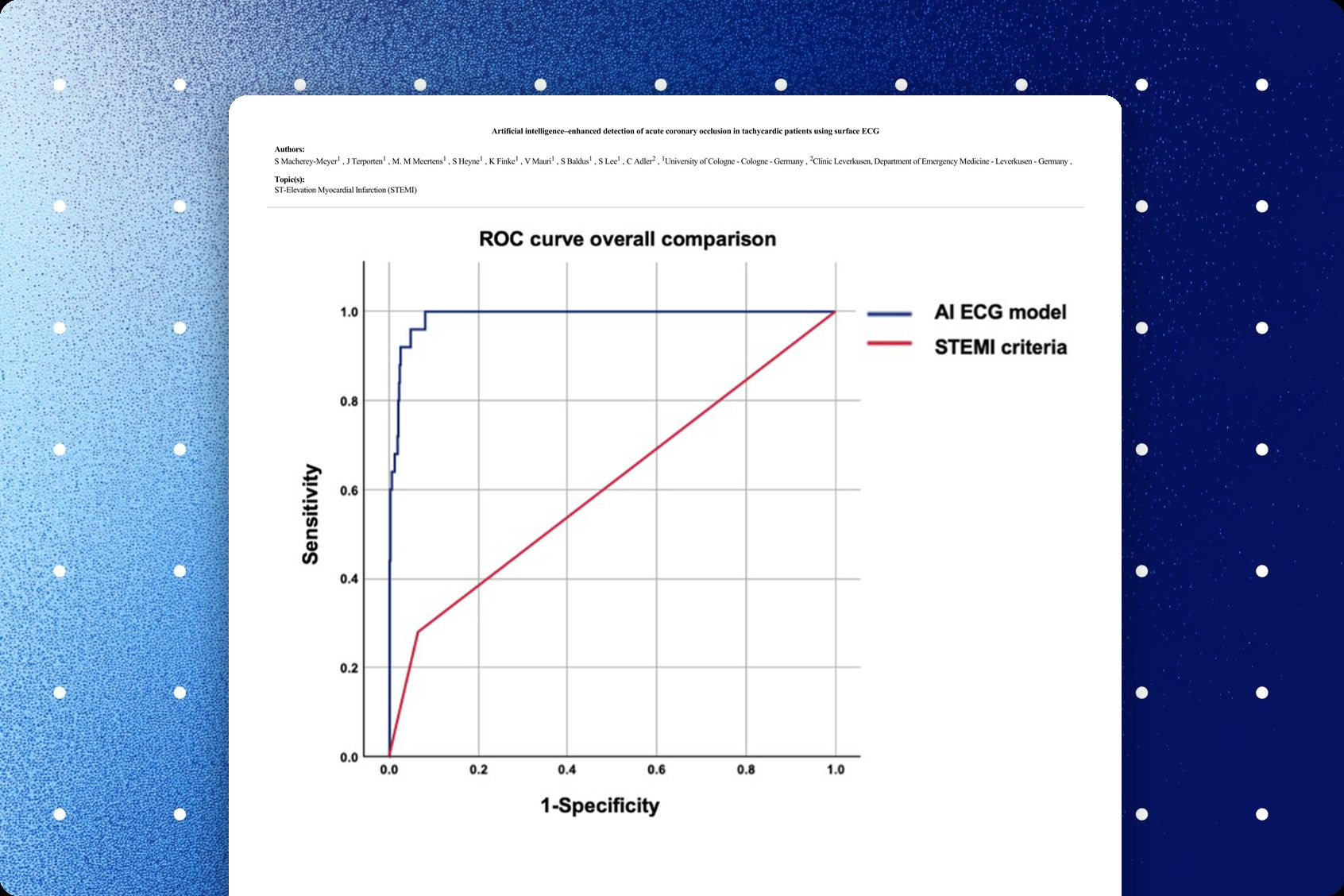
In patients with chest pain and a fast heart rate, ST-segment changes on the ECG may reflect artefacts, supply–demand mismatch or a true coronary occlusion, which makes the decision between emergency angiography and arrhythmia treatment difficult. This study from the chest pain unit of University Hospital Cologne tested an AI-ECG model (Queen of Hearts) against conventional STEMI criteria in 639 consecutive chest-pain patients with tachycardia (>100 bpm) on the admission ECG. Acute coronary occlusion (ACO) was present in 25 patients (3.9%): STEMI criteria identified 7 of them (28%), while the AI-ECG model identified 19 (76%), with an area under the curve of 0.987 vs 0.607. In the low-risk rule-out population, the AI produced 7 false positives versus 22 for STEMI criteria, potentially avoiding 15 unnecessary emergency angiographies.
Key findings
- The AI-ECG model identified 19 of 25 acute coronary occlusions (76%) in tachycardic chest-pain patients, versus 7 of 25 (28%) for STEMI criteria.
- Area under the curve was 0.987 (95% CI 0.978–0.996) for the AI-ECG model versus 0.607 (95% CI 0.480–0.735) for STEMI criteria.
- The AI outperformed STEMI criteria in both narrow-complex (AUC 0.985 vs 0.610; n = 590) and broad-complex tachycardia (AUC 1.0 vs 0.558; n = 49).
- In the 431-patient low-risk rule-out population, the AI had 7 false positives (1.6%) versus 22 (5.1%) for STEMI criteria, potentially avoiding 15 unnecessary emergency angiographies.
Published in: ESC Congress 2026 (European Society of Cardiology)
Published on: 30 August 2026
Background
Conventional STEMI criteria frequently fail to identify acute coronary occlusion (ACO), which occurs in up to one in four patients labelled as non-STEMI. AI-enhanced ECG analysis could improve diagnostic precision, particularly in tachycardic patients, in whom ST-segment deviations may reflect artefacts, supply–demand mismatch or true coronary occlusion. Telling these apart is essential to decide between emergency coronary angiography and primary arrhythmia management. The study assessed the diagnostic performance of an AI-ECG model for detecting ACO in chest-pain patients with tachycardia on the admission ECG, compared with conventional STEMI criteria, in a metropolitan chest pain unit (CPU) cohort.
Methods
All consecutive patients presenting with chest pain and tachycardia (>100 bpm) to the CPU of University Hospital Cologne, Germany, between November 2018 and June 2021 were included. Clinical management followed current European Society of Cardiology guidelines. The admission ECG was analysed by an AI-ECG model (Queen of Hearts) based on a deep convolutional neural network. The endpoint was ACO, adjudicated by an independent physician blinded to the AI predictions using coronary angiography, biomarker kinetics and echocardiography. Diagnostic performance was assessed by ROC analysis and compared with STEMI criteria. A predefined subgroup analysis distinguished narrow-complex (QRS <120 ms) and broad-complex (QRS ≥120 ms) tachycardias.
Results
A total of 639 patients were included (mean age 56.3 ± 19.3 years; 60.6% male). The most common rhythms were sinus tachycardia (305; 47.7%), atrial fibrillation (119; 18.6%), other supraventricular tachycardia (75; 11.7%), paced rhythm (69; 9.4%), atrial flutter (45; 7.1%) and ventricular tachycardia (26; 4.1%). Overall, 590 patients (92.3%) had narrow-complex and 49 (7.7%) broad-complex tachycardia. The prevalence of ACO was 3.9% (n = 25). STEMI criteria identified only 7 of these 25 cases (28%), whereas the AI-ECG model correctly classified 19 of 25 (76%). The area under the curve was 0.987 (95% CI 0.978–0.996) for the AI-ECG model and 0.607 (95% CI 0.480–0.735) for STEMI criteria. The AI-ECG model also had higher accuracy (0.970 vs 0.909), specificity (0.979 vs 0.935), positive predictive value (0.594 vs 0.149) and negative predictive value (0.990 vs 0.970). The advantage was consistent across both subgroups: AUC 0.985 vs 0.610 in narrow-complex and 1.0 vs 0.558 in broad-complex tachycardia. False positives occurred in 2.0% (n = 13) of the overall population with the AI versus 6.3% (n = 40) with STEMI criteria. In the low-risk rule-out population (n = 431), the AI-ECG model yielded 7 false positives (1.6%) versus 22 (5.1%) for STEMI criteria, potentially avoiding 15 unnecessary emergency angiographies.
Conclusion
In tachycardic chest-pain patients, conventional STEMI criteria inadequately guide the need for emergency coronary angiography, resulting in both missed occlusions and potentially avoidable interventions. AI-enhanced ECG analysis markedly improved ACO detection and may enable more selective, clinically guided triage. Its strong negative predictive value may help distinguish patients who need primary arrhythmia management from those who need urgent coronary intervention, supporting prospective validation in independent cohorts.
Share this article



About PMcardio
PMcardio is the market leader in AI-powered diagnostics, addressing the world’s leading cause of death – cardiovascular diseases. The innovative clinical assistant empowers healthcare professionals to detect up to 40 cardiovascular diseases. In the form of a smartphone application, the certified Class IIb medical device interprets any 12-lead ECG image in under 5 seconds to provide accurate diagnoses and individualized treatment recommendations tailored to each patient.

About Powerful Medical
Powerful Medical leads one of the most important shifts in modern medicine by augmenting human-made clinical decisions with artificial intelligence. Our primary focus is on cardiovascular diseases, the world’s leading cause of death.
Established in 2017, Powerful Medical has embarked on a mission to revolutionize the diagnosis and treatment of cardiovascular diseases. We are a medical company backed by 28 world-class cardiologists and led by our expert Scientific Board with decades of experience in daily patient care, clinical research, and medical devices. The results of our research are implemented, developed, certified, and brought to market by our 50+ strong interdisciplinary team of physicians, data scientists, AI experts, software engineers, regulatory specialists, and commercial teams.